First Home Buyer
FHA and conventional loans solve different problems, and picking the wrong one can cost a California buyer tens of thousands of dollars over the life of the loan — or the house itself, in a competitive offer. Here's the real comparison.
A companion piece to our How to Buy a House in the US series and our earlier look at how much house a $150,000 salary buys in California — this one tackles the financing decision most first-time buyers assume is simple, and isn't.
A buyer I worked with a couple of years ago fell for a 1940s Spanish bungalow in a modest, competitive neighborhood — the kind of house with original tilework and a knob-and-tube electrical panel that hadn't been touched since the Eisenhower administration. She offered close to asking price, financed with an FHA loan, 3.5 percent down. She lost the house to a lower conventional offer.
Her agent — not me, on that one — got a call from the listing side afterward, and the reasoning was blunt: FHA loans come with property condition standards a conventional appraisal doesn't require, and on a house with visible knob-and-tube wiring and some peeling exterior paint, that seller didn't want to risk the deal stalling out over a repair list. It wasn't personal, and it wasn't really even about her offer. It was about the loan type attached to it.
That story tends to surprise first-time buyers, because most of what gets written about FHA versus conventional loans focuses on down payment minimums and credit scores, as if that's the whole decision. It isn't. The real comparison touches your monthly payment, your total cost over the life of the loan, which houses you can even compete for, and how a seller reads your offer before they've met you. Here's the whole picture, not just the headline numbers.
Before we begin: every rate, fee, and dollar figure in this article is an example, meant to help you follow the math. Loan limits, mortgage insurance rates, and underwriting guidelines change over time and vary by lender, so verify current numbers with a loan officer before making a decision. Figures for 2026 loan limits are sourced and cited at the end of this article.

The Basic Difference, in One Paragraph
A conventional loan is a mortgage that isn't backed by a government agency — it typically follows guidelines set by Fannie Mae and Freddie Mac, the entities that buy most conventional loans from lenders, which is why you'll hear these called "conforming" loans. An FHA loan, by contrast, is insured by the Federal Housing Administration, a part of HUD. The government isn't lending you the money in either case — a private lender still originates the loan — but with FHA, the government is guaranteeing the lender against loss if you default, which is precisely why FHA can afford to be more forgiving about credit scores and down payments than a conventional loan can.
That single difference in who's backing the risk is the root of nearly every other difference on this list.
The Side-by-Side Comparison
FHA Loan | Conventional Loan | |
|---|---|---|
Minimum down payment | 3.5% (with a 580+ credit score) | 3–5% for many first-time buyer programs |
Minimum credit score | As low as 500 with 10% down; 580 for 3.5% down | Typically 620+, though the best pricing starts around 740 |
Mortgage insurance | Upfront premium (UFMIP) + monthly MIP | Monthly PMI only, no upfront premium |
When mortgage insurance goes away | Life of the loan if under 10% down; 11 years if 10%+ down | Cancels automatically around 78% loan-to-value, or on request at 80% |
DTI flexibility | Generally more forgiving, especially with strong compensating factors | Stricter caps, though strong credit can widen them |
Property condition standards | Must meet FHA minimum property standards — no peeling paint, exposed wiring, safety hazards | Appraisal focuses on value, not condition, so more flexibility on fixer-uppers |
Loan limits | County-specific, generally lower than or equal to conventional limits | County-specific, generally equal to or higher than FHA limits |
Eligible properties | Primary residence only | Primary residence, second homes, and investment properties |
Seller's perception in a bidding war | Sometimes viewed as riskier due to appraisal/condition requirements | Generally viewed as the more straightforward close |
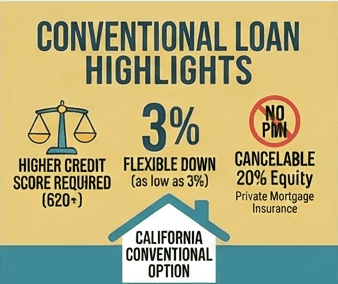
Where Conventional Wins: Mortgage Insurance That Actually Ends
This is the single biggest cost difference between the two loan types, and it's the one most first-time buyers underestimate, because it doesn't show up as a big number on day one — it shows up as a slow drain over years.
FHA charges two layers of mortgage insurance. There's an upfront mortgage insurance premium, or UFMIP, equal to 1.75 percent of your loan amount, which typically gets rolled into the loan itself rather than paid in cash at closing. Then there's an annual MIP, charged monthly, that runs roughly in the 0.5 to 0.75 percent range depending on your loan size, term, and down payment. The part that catches people off guard is the duration: if you put down less than 10 percent, which most FHA borrowers do, that monthly MIP sticks around for the entire life of the loan. Not until you hit 20 percent equity. Not until some milestone. For thirty years, unless you refinance out of the FHA loan entirely.
Conventional PMI works differently. There's no upfront premium, only a monthly charge, and — this is the important part — it doesn't last forever. Once your loan balance drops to roughly 78 percent of the home's original value, your lender is required to cancel it automatically. You can also request removal once you hit 80 percent, sometimes sooner if your home's value has risen and you get a new appraisal to prove it.
Let's put real numbers on this, on a $550,000 house, example figures throughout:
FHA (3.5% down) | Conventional (5% down) | |
|---|---|---|
Down payment | $19,250 | $27,500 |
Loan amount (FHA includes financed UFMIP) | $540,038 | $522,500 |
Monthly P&I | $3,413 | $3,285 |
Monthly mortgage insurance | $248 | $283 |
Total monthly payment | $3,661 | $3,568 |
How long insurance lasts | Life of the loan (30 years, since down payment is under 10%) | ~11 years, until automatic cancellation |
Total mortgage insurance paid over the life of the loan | ~$58,000 | ~$38,000, then $0 |
Notice what's happening here. FHA actually starts slightly more expensive per month in this example, largely because the UFMIP gets financed into a bigger loan balance. But the real gap opens over time. The conventional buyer's PMI eventually disappears, and after roughly eleven years, their monthly payment drops by nearly $300 while the FHA buyer keeps paying MIP for the full thirty years. Across the life of the loan, that's a difference of roughly $20,000 in this example — money that never had to leave the conventional buyer's pocket at all.
This is the single strongest argument for conventional financing when a buyer can qualify for it: the insurance cost has an exit ramp. FHA's doesn't, unless you refinance.
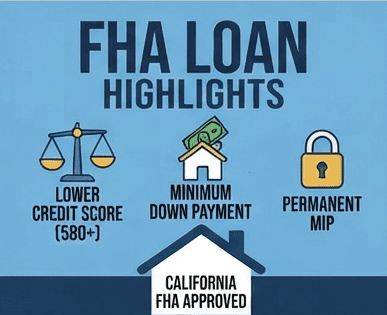
Where FHA Wins: Getting In the Door at All
None of that matters if you can't qualify for the conventional loan in the first place, and this is where FHA earns its reputation as the first-time buyer's loan.
FHA's credit score threshold is meaningfully lower — 580 gets you 3.5 percent down, and even scores as low as 500 can qualify with 10 percent down, territory where most conventional lenders simply won't approve a loan at all. FHA also tends to be more forgiving on DTI, the debt-to-income ratio we covered in Part 1 of our buying guide, which matters enormously for buyers carrying real debt, and for buyers whose income is strong but whose credit history is thin — a profile that describes a lot of people who've been in the US for only a few years and haven't built up the credit file a conventional underwriter wants to see.
There's also a practical, human factor here. Gift funds — money from family helping with the down payment, which we covered in Part 4 — are generally easier to document and use under FHA guidelines, and FHA allows sellers to contribute more toward a buyer's closing costs in many cases, which can matter enormously for a buyer who has enough income to handle the monthly payment but not much cash sitting around.
For a buyer with a 610 credit score, a car payment, and not much saved beyond the down payment itself, FHA isn't the "second-best" option. It's often the only option that gets them into a house at all, while they spend the next couple of years building the credit and reserves that would make conventional financing available the next time around.
The Property Condition Problem — Why FHA Can Cost You the House
This is the part of the comparison that rarely gets discussed outside of conversations with agents, and it's exactly what happened to the buyer in the bungalow story above.
FHA loans require the appraiser to check not just value, but livability and safety — no exposed wiring, no significant deferred maintenance, no peeling paint on a home built before 1978 (a lead-paint-era rule), functioning heat, a roof with real remaining life, and so on. If the house fails, those items typically need to be fixed before the loan can close, and in a competitive multiple-offer situation, that's exactly the kind of contingency-adjacent uncertainty a seller doesn't want to deal with when a conventional or cash offer is sitting right next to yours without it.
Conventional appraisals still check condition to some degree, but the bar is meaningfully lower, and the flexibility is real. This matters most in two very California-specific situations: older housing stock — a huge share of homes in LA, the Bay Area, and plenty of other desirable neighborhoods predate 1978 — and competitive markets, where sellers have the luxury of preferring the offer that closes with the fewest surprises.
None of this means FHA buyers can't win competitive offers. Plenty do. But it's worth knowing, going in, that on an older or lightly deferred-maintenance house, an FHA offer sometimes needs to be stronger in other ways — price, closing timeline, flexibility — to compete on equal footing with a conventional buyer making an otherwise similar offer.
Loan Limits: How Much House Either Loan Actually Covers
Both FHA and conventional loans have county-specific limits, adjusted annually, and California's high home prices mean these limits matter here more than almost anywhere else in the country.
For 2026, the standard conforming loan limit across most of California sits at $832,750, with a high-cost ceiling of $1,249,125 in expensive counties — Los Angeles, Orange, San Francisco, Santa Clara, and several others qualify for that top figure. FHA limits follow a similar structure: a floor around $541,287 in lower-cost counties, and a ceiling that matches the conventional high-cost limit at $1,249,125 in the same expensive counties.
In practice, this means FHA and conventional loans can finance an identical purchase price in LA or the Bay Area — the limits converge at the top end. Where they diverge is in moderate-cost counties, where the FHA limit can sit meaningfully below the conventional limit, and a buyer targeting a higher price point may find conventional is the only loan type that reaches far enough. Loan limits adjust every year, so treat any specific figure, including the ones above, as a snapshot to verify with your lender rather than a permanent number.
A Framework for Deciding
Rather than asking "which loan is better," a more useful question is which of these describes you more closely.
FHA tends to fit better when: your credit score sits below the low-to-mid 600s, your cash for a down payment is genuinely tight, your DTI is on the higher side because of real debt, you're buying a newer or well-maintained property unlikely to trip an FHA appraisal, and you're planning to refinance out of FHA within a handful of years anyway once your credit and equity improve.
Conventional tends to fit better when: your credit score is comfortably above 680 to 700, you can put down at least 5 percent without draining your reserves, you're eyeing an older home or a competitive multiple-offer situation where FHA's property standards could work against you, and you'd rather have mortgage insurance that eventually disappears than a lower barrier to entry today.
And for some buyers, the honest answer is to get pre-approved for both and compare the actual numbers your specific lender quotes you, rather than deciding from a table like this one. The gap between FHA and conventional pricing shifts constantly with rates and mortgage insurance costs, and the only way to know which one wins for you, this month, is to run both.
FAQ
Q1. Can I switch from FHA to conventional later? Yes, through refinancing, once your credit and equity support it. Many FHA buyers use it as a starting point and refinance into a conventional loan a few years in specifically to shed the lifetime MIP.
Q2. Is FHA only for first-time buyers? No. FHA doesn't require you to be a first-time buyer, though it does require the home to be your primary residence, which rules it out for second homes and investment properties entirely.
Q3. Does a higher credit score help with an FHA loan too? It helps your interest rate, since FHA lenders still price rates partly off credit score, but it doesn't reduce your MIP the way it can lower conventional PMI. FHA's mortgage insurance pricing is far less sensitive to credit score than conventional PMI is.
Q4. Why did the seller in the bungalow story prefer the conventional offer? Because FHA's property condition requirements introduced a risk the seller didn't want — the possibility that repairs would be required before closing, on a house with visible wiring and paint issues. It wasn't about the buyer's qualifications; it was about the loan type's appraisal standards.
Q5. Are FHA loans assumable? Yes, and this is one of FHA's underused advantages — a future buyer can potentially take over your FHA loan and its interest rate, which can be a meaningful selling point if rates have risen since you bought. Conventional loans are generally not assumable.
Quick Check: FHA vs. Conventional
Q1. Which agency insures an FHA loan?
(a) Fannie Mae
(b) The Federal Housing Administration
(c) The buyer's own lender
B
The Federal Housing Administration, part of HUD, insures the lender against loss on FHA loans.
Q2. (T/F) FHA mortgage insurance always cancels once you reach 20% equity, just like conventional PMI.
F — With less than 10% down, FHA MIP lasts the life of the loan; conventional PMI cancels around 78% loan-to-value
Q3. What two costs make up FHA mortgage insurance?
(a) Upfront UFMIP and monthly MIP
(b) Application fee and appraisal fee
(c) Title insurance and escrow fee
A
An upfront mortgage insurance premium (UFMIP) plus a monthly MIP.
Q4. In the worked example, roughly how much more total mortgage insurance did the FHA buyer pay over the life of the loan compared to the conventional buyer?
(a) About $2,000
(b) About $20,000
(c) About $100,000
B
Roughly $58,000 for FHA versus roughly $38,000 for conventional in the worked example — about a $20,000 gap.
Q5. Why did the seller in this article's opening story pass on the FHA offer?
(a) The price was too low
(b) FHA property condition standards created closing risk on an older home
(c) FHA buyers can't close within 30 days
B
The seller's side worried about FHA's stricter property condition standards holding up closing on a house with old wiring and peeling paint.
Q6. (T/F) Conventional loans can be used to buy a second home or investment property, while FHA generally cannot.
T — FHA is restricted to primary residences; conventional financing covers second homes and investment properties too.
Q7. Which loan type tends to be more forgiving of a lower credit score?
(a) FHA
(b) Conventional
(c) They're identical
A
FHA, with scores as low as 580 (or even 500 with 10% down) potentially qualifying.
Q8. What is a practical advantage of an assumable FHA loan?
(a) It has no interest rate
(b) A future buyer could take over the loan's existing rate
(c) It can never be refinanced
B
An assumable FHA loan can let a future buyer take over your existing rate, which becomes valuable if rates have risen since you bought.
About the author: I'm a licensed real estate agent practicing in California. This article is part of a series written for first-time buyers navigating their first American home purchase.
This article is for general informational purposes only and is not legal, tax, or lending advice. All figures are illustrative examples; actual mortgage insurance rates, loan limits, and underwriting guidelines vary by lender and change over time. Confirm current numbers with a loan officer before making a decision.
Sources:
Back to Magazine