Home Owner
The premium that once felt like a rounding error on your closing statement has become one of the biggest, least predictable line items in owning a home in California. Here's what actually changed, and what it costs now.
In short: California's home insurance market has genuinely changed since 2022, not just gotten more expensive. Major insurers pulled back from writing new policies, state regulators overhauled the rate-approval system to let insurers use forward-looking wildfire models, and the 2025 Los Angeles wildfires alone cost insurers roughly $41 billion, pushing rates up further in 2026. For homeowners in higher-risk areas who've been dropped by their carrier, the state's FAIR Plan has become the fallback, and it typically costs 1.5 to 3 times what an admitted policy would, on top of a separate policy most people didn't know they'd need.
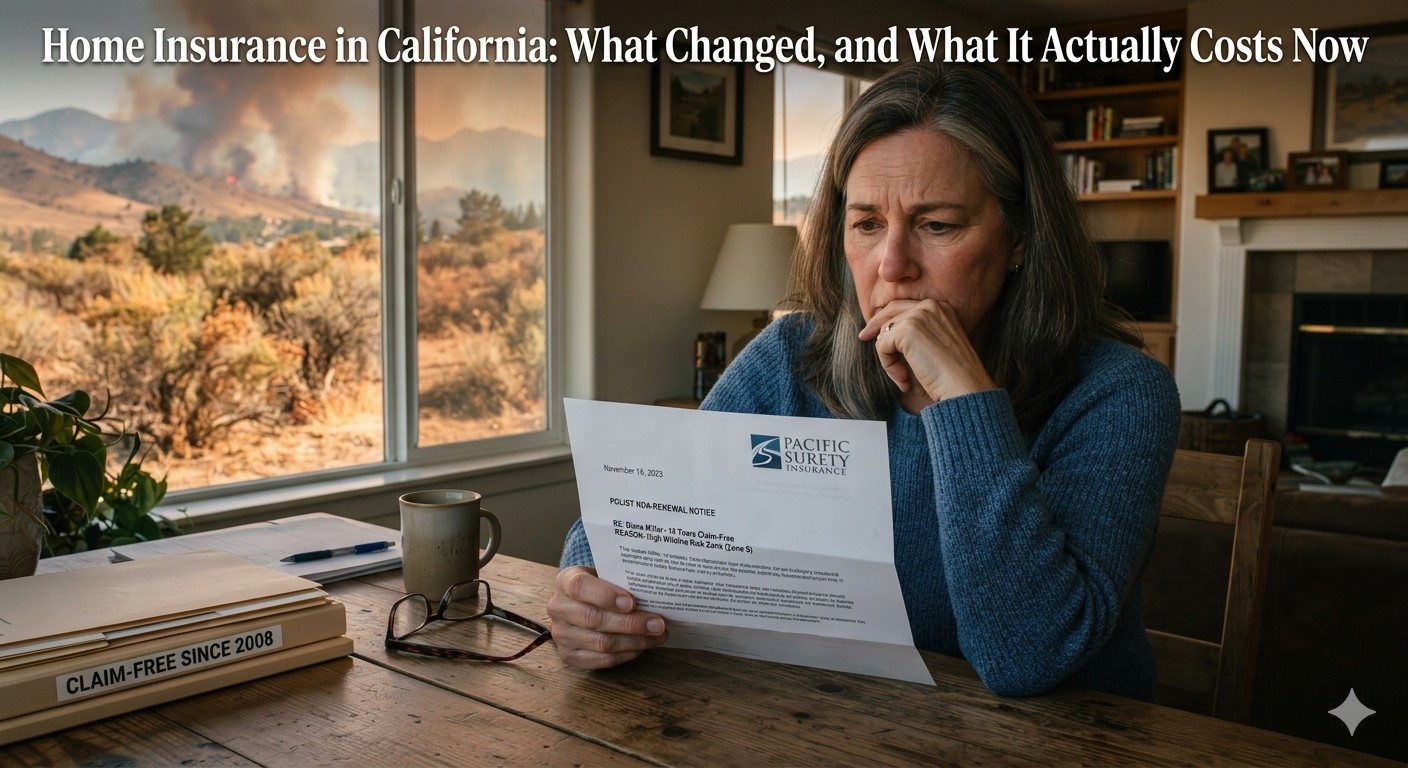
Diane had owned her home in the hills above Los Angeles for fifteen years without a single claim, and the letter that arrived in the spring still managed to catch her off guard. Her insurer was non-renewing her policy, effective in sixty days, citing wildfire risk in her area. She'd paid the same company faithfully for over a decade. It didn't matter. The letter wasn't personal, and that was almost the hardest part to accept: it wasn't about her home specifically, or her history as a customer. It was about a map.
What came next was worse than the letter itself. Diane spent weeks calling brokers, most of whom told her the same thing: almost nothing in the admitted market wanted to touch a home in her zone anymore. She eventually landed on the California FAIR Plan, the state's insurer of last resort, and then learned that the FAIR Plan alone wouldn't actually replace what she'd lost. She needed a second policy on top of it just to cover theft, liability, and water damage the way her old policy always had. By the time she added it all up, her annual insurance cost had gone from just over $2,000 to more than $7,500, without a single claim, a single renovation, or a single thing about her house actually changing.
What Actually Changed
Starting in late 2022, several of California's largest insurers, including some of the most recognizable names in the state, began pausing new homeowner policies and non-renewing existing ones in wildfire-exposed areas. This wasn't a temporary pullback. It reflected a genuine mismatch: insurers said state rules were preventing them from pricing policies to reflect actual wildfire risk, and many simply stopped writing new business rather than keep losing money on it.
In response, the state rolled out what's known as the Sustainable Insurance Strategy, the broadest overhaul of California insurance regulation in roughly three decades. Insurers are now allowed to use forward-looking catastrophe models, built on predictive algorithms and climate data, instead of relying only on historical loss data the way the rules previously required. In exchange, the twelve largest insurers in the state committed to writing at least 85 percent of new policies in historically underserved, higher-risk areas. The state also streamlined its notoriously slow rate-approval process, which had been averaging around 236 days, toward the 180-day timeline the law originally intended.
Then came the January 2025 Los Angeles wildfires, the Palisades and Eaton fires among them, which cost insurers an estimated $41 billion. Insurers are now recouping those losses the way they typically do: through rate increases. Cumulative rate hikes since 2023 already total around 16 percent, and 2026 alone is projected to bring another 16 percent on top of that, meaning a policy that felt expensive just three years ago can now cost well over a third more.
The FAIR Plan: The Safety Net Nobody Wants to Need
The California FAIR Plan exists specifically for homeowners like Diane, people the standard insurance market won't cover. It's grown accordingly: FAIR Plan policies are up 157 percent since September 2022, with total insured value up 250 percent over the same period, now standing at roughly $768 billion across the state.
The FAIR Plan's biggest catch is that it was originally designed to cover fire damage only. Most homeowners need a separate difference-in-conditions policy, often called a DIC wrap, layered on top to cover everything a standard policy normally would: theft, liability, water damage, and more. That second policy typically adds another 25 to 60 percent on top of the FAIR Plan premium itself, and the combined cost of FAIR Plan plus DIC generally runs 1.5 to 3 times what an admitted-market policy would cost for the same home, when an admitted policy is even available at all.
Diane's Actual Numbers
Here's what this looked like laid out in full, example figures throughout, for a home in a high fire-hazard zone in the hills above Los Angeles. In 2021, Diane's admitted-market policy cost about $2,100 a year. After her non-renewal, her FAIR Plan premium came to roughly $5,500 a year, and the required DIC wrap added another $2,200, for a combined total of about $7,700 a year in 2026.
That's roughly 3.7 times what she was paying five years earlier, an increase of $5,600 a year, or about $467 more every single month, for coverage that in some ways is less complete than what she originally had. None of this reflects anything Diane did. It reflects where her house happens to sit on a map that's been redrawn since she bought it.
What You Can Actually Do About It
Ask about mitigation credits. Under the state's Safer From Wildfire program, insurers are now required to factor home-hardening measures, like ember-resistant vents, defensible space, and fire-resistant roofing, into their rates. Documenting these upgrades can genuinely lower a quote, and it's worth asking any insurer or broker directly rather than assuming it won't matter.
Work with an independent broker who writes surplus lines. Beyond the admitted market and the FAIR Plan, there's a smaller, less-advertised surplus lines market that sometimes offers better terms for higher-risk homes than either of the more visible options. A broker who specializes in California wildfire-zone properties will generally know this market far better than a single company's captive agent.
Reconsider your deductible. Raising your deductible, particularly on wildfire and wind coverage specifically, can meaningfully lower your premium if you have the reserve to cover a larger out-of-pocket cost in the rare event of a real claim. We covered the broader logic of keeping that kind of reserve in how much cash you actually need saved.
Revisit your coverage every renewal, not just when you're forced to. The market is genuinely shifting as insurers respond to the new regulatory rules, and a policy that wasn't available two years ago may be available now. Treating your insurance the way you'd treat any other major recurring cost we've covered in this chapter, like the home maintenance calendar we walked through earlier, means checking in on it regularly rather than only when a non-renewal letter forces the issue.
FAQ
Q1. Why did my insurer non-renew me if I've never filed a claim? Non-renewal decisions are increasingly based on broad risk models tied to your property's location and surrounding conditions, not your individual claims history. A clean record doesn't guarantee renewal if your area's overall risk profile has been reclassified.
Q2. Is the FAIR Plan actually a good option, or just the only one? For many homeowners in high-risk areas right now, it's genuinely the only realistic option, since admitted insurers may not offer coverage at all. It's worth treating it as a stopgap to revisit at each renewal, not necessarily a permanent solution.
Q3. Will these rate increases eventually level off? Regulators intend for the current reforms to stabilize the market over time by encouraging insurers back into higher-risk areas, but the near-term trajectory, especially after major fire losses, still points toward continued increases through at least 2026.
Q4. Does home hardening actually lower my premium, or is that just marketing? Under current state rules, insurers are required to factor documented mitigation measures into their pricing, so it can have a genuine, quantifiable effect. The size of that effect varies by insurer and by which specific upgrades you've made.
Quick Check: California Home Insurance
Q1. What began pushing major insurers to pause or non-renew policies in California starting in late 2022?
(a) A new state tax on insurance premiums
(b) A shortage of licensed insurance agents
(c) Insurers saying they couldn't price policies to reflect actual wildfire risk under the old rules
C
Insurers cited an inability to price policies to reflect actual wildfire risk under the previous rate-approval rules as a core reason for pulling back starting in late 2022.
Q2. (T/F) The California FAIR Plan provides the same full scope of coverage as a standard admitted homeowners policy, with no additional policy needed.
F — The FAIR Plan was originally designed to cover fire damage only, and most homeowners need a separate difference-in-conditions policy to cover theft, liability, water damage, and other standard risks.
Q3. What does California's Sustainable Insurance Strategy allow insurers to use when setting wildfire-related rates?
(a) Forward-looking catastrophe models instead of only historical data
(b) A fixed statewide rate regardless of location
(c) Data only from the past two years
A
The Sustainable Insurance Strategy allows insurers to use forward-looking catastrophe models and predictive data, rather than relying solely on historical losses, when setting wildfire-related rates.
Q4. In Diane's example, roughly how much more did her combined FAIR Plan and DIC coverage cost compared to her 2021 admitted policy?
(a) About the same amount
(b) Roughly 3.7 times more
(c) About 10 percent more
B
Diane's combined FAIR Plan and DIC cost came to roughly 3.7 times her original 2021 admitted-market premium.
Q5. According to the article, what can homeowners do that may genuinely lower their premium?
(a) Document home-hardening measures like defensible space and fire-resistant roofing
(b) Cancel their policy entirely
(c) Avoid mentioning any home improvements to their insurer
A
Documenting home-hardening measures like defensible space and fire-resistant roofing can genuinely lower a premium, since insurers are now required to factor these mitigation efforts into their pricing.
About the author: I'm a licensed real estate agent practicing in California. This article is part of NITU Path, Chapter 5, a series written to walk buyers through their entire homeownership journey.
This article is for general informational and educational purposes only and is not insurance, financial, or legal advice. Insurance premiums, availability, and regulations change frequently and vary significantly by property, insurer, and location. Consult a licensed insurance broker or agent about your specific situation.
Sources:
Back to Magazine