First Home Buyer
The down payment is the number everyone quotes. It's not the number you'll actually need liquid and ready, and the gap between the two catches a lot of buyers off guard mid-search.
In short: Your down payment is the biggest number, but it's not the only cash you'll need, and several of the others come due faster than people expect. Earnest money is typically due within a few days of an accepted offer, not at closing. Inspection and appraisal fees are usually paid directly, out of pocket, during escrow. Add closing costs and a reasonable moving budget, and the true total tends to run several thousand dollars above whatever number you had in mind when you started saving.
Chris saved exactly $60,000, ten percent down on the roughly $600,000 house he was hoping to buy, and felt genuinely ready by the time he started touring listings. When his offer got accepted a few weeks later, his agent told him the earnest money deposit, $12,000 in his case, needed to be wired within three business days. That money would eventually count toward his down payment at closing, but right then it needed to move fast, and most of his savings sat in an account that took several days to fully verify and release for a large outgoing wire. He ended up borrowing briefly from a family member just to make the deadline.
A few weeks after that, the inspection and appraisal came due, another $1,200 combined, paid directly to the inspector and appraiser rather than rolled into his loan or credited at closing. None of this was a large amount of money relative to his down payment. All of it was money he hadn't planned for as separate from the $60,000 he'd been treating as his entire savings goal.
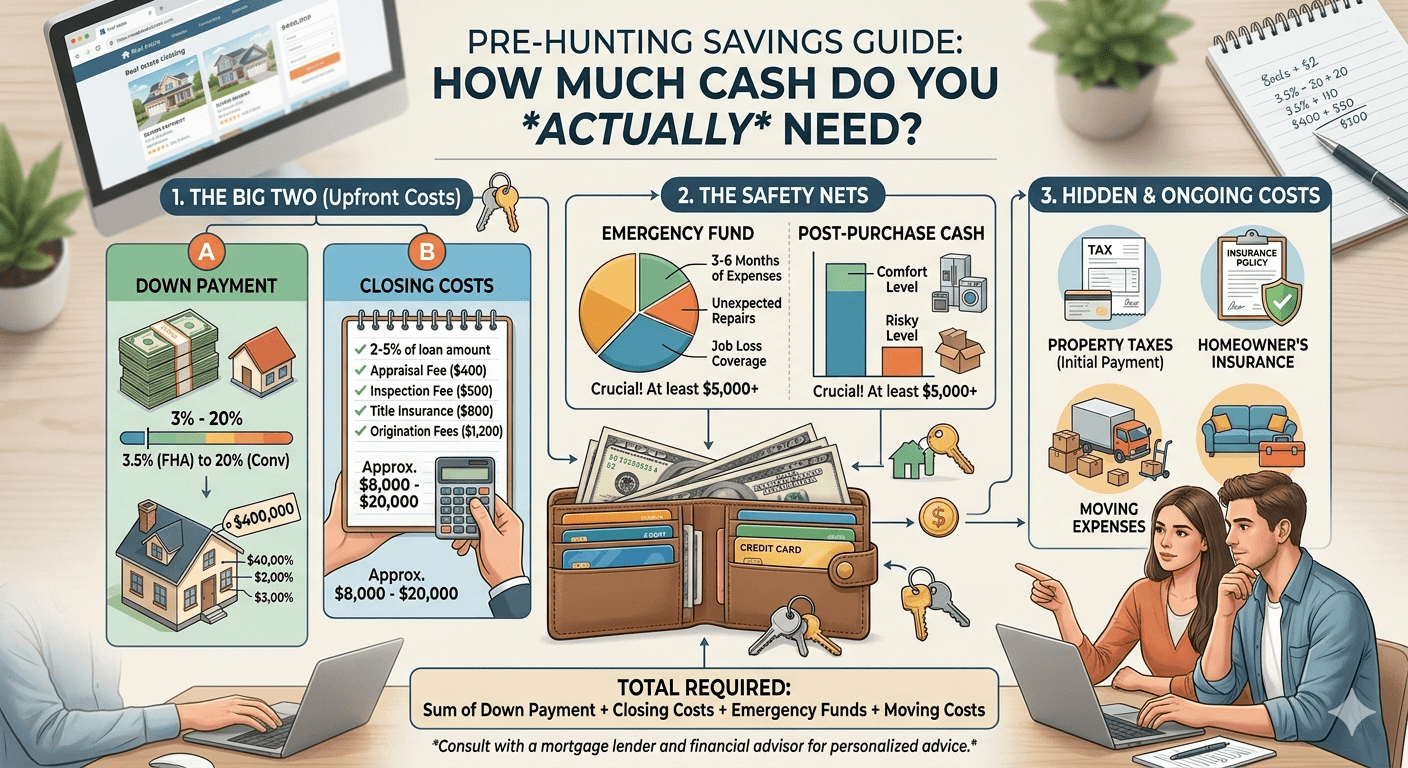
The Number Everyone Quotes Isn't the Number You'll Need
Ask most people how much cash you need to buy a house, and they'll answer with a down payment percentage. That's the biggest single number, but it's really only one line on a longer list, and several of the other items on that list have their own timing requirements that can catch a buyer off guard mid-search, the way Chris's earnest money deadline did.
The Full Cash Checklist, Before You Even Make an Offer
Proof of funds. Before a seller takes your offer seriously, and before a lender finalizes your loan, you'll need to show documented, "seasoned" funds, generally meaning money that's been sitting in your account for at least 60 days rather than a large, unexplained deposit that showed up last week. A sudden large deposit, even a legitimate one, tends to trigger a request for documentation explaining where it came from.
Earnest money deposit. Typically 1 to 3 percent of the purchase price, due by wire within a few days of your offer being accepted, well before closing. This money does eventually count toward your down payment and closing costs, but it needs to exist as immediately accessible, liquid cash the moment your offer is accepted, which is exactly the piece that surprised Chris.
The down payment itself. The number everyone already plans around, but worth remembering it's due at closing, not the moment you start looking, which means the rest of this checklist has to sit alongside it rather than eating into it.
Inspection and appraisal fees. Usually a combined few hundred to just over a thousand dollars, paid directly to the inspector and appraiser during escrow rather than financed into your loan. This is genuinely additional cash spent during the process, not credited back to you at closing the way earnest money is.
Closing costs. Generally 2 to 5 percent of the purchase price, covering title, escrow, lender fees, and more. We break this down in full detail in Part 5 of our buying guide, which covers the complete cost picture at the closing table.
Moving costs. Easy to forget entirely while focused on the transaction itself. A truck rental, movers, or a cross-town move can run anywhere from a few hundred dollars to several thousand, depending on distance and how much help you hire.
A post-close reserve. Not spent during the transaction, but critical to have sitting untouched afterward. We covered why this matters, and how easily it gets accidentally drained, in what financial readiness actually means.
Chris's Actual Numbers
Laid out in full, example figures throughout: on his $600,000 house, Chris's down payment and closing costs together came to $78,000. On top of that, $1,200 in inspection and appraisal fees came due separately during escrow, genuinely additional cash rather than money credited back to him. Add a modest moving budget of $2,000 to $4,000, and his true total cash need landed somewhere between $81,200 and $83,200, roughly $21,000 to $23,000 above the $60,000 figure he'd originally been treating as his entire savings target.
None of the additional pieces were individually large. Together, and with the earnest money's tight timing specifically, they were enough to catch him off guard at exactly the moment he most wanted the process to go smoothly.
Why Timing Matters as Much as the Total
It's not just about having enough saved. It's about having the right portion of it genuinely liquid and ready to move quickly, which is a different question than whether the total exists somewhere across your accounts. Funds tied up in a retirement account, invested in the market, or sitting overseas can all be real money that's still slow or complicated to access on a three-day wire deadline. If any portion of your savings falls into one of those categories, it's worth talking to a loan officer well before you start touring houses about what needs to be liquid, documented, and seasoned by the time you're ready to write an offer, rather than discovering the gap the same week Chris did.
FAQ
Q1. Do I lose my earnest money if the deal falls through? It depends on the reason and your contract's contingencies. Money is typically protected if you cancel for a reason covered by a contingency, like a failed inspection or appraisal, but can be at risk if you back out for a reason the contract doesn't cover.
Q2. Can family gift funds count toward any of this? Often yes, particularly toward the down payment, but gift funds generally require their own documentation, typically a signed gift letter and a paper trail showing the money's source, so it's worth planning that conversation early rather than during a tight escrow timeline.
Q3. What if my savings are mostly in investments, not cash? That's common and workable, but liquidating investments takes time and can trigger tax consequences, so it's worth discussing a realistic timeline with a financial advisor and loan officer well before you plan to make an offer.
Q4. Is it better to save more than this checklist suggests? Generally yes. Treat this list as the floor, not a target to hit exactly, since unexpected costs during a real transaction are common enough that a modest cushion above the checklist total tends to reduce a lot of unnecessary stress.
Quick Check: How Much Cash Do You Need?
Q1. What is typically due within a few days of an accepted offer, well before closing?
(a) The full down payment
(b) Earnest money deposit
(c) Moving costs
B
Earnest money is typically due by wire within a few days of an accepted offer, well ahead of the closing date itself.
Q2. (T/F) Inspection and appraisal fees are usually financed into the mortgage loan.
F — Inspection and appraisal fees are generally paid directly, out of pocket, during escrow, not rolled into the loan amount.
Q3. What does "seasoned funds" generally mean to a lender?
(a) Money that's been sitting in your account for a documented period, generally around 60 days
(b) Money recently borrowed from a friend
(c) Money kept in cash at home
A
Seasoned funds generally means money documented as sitting in an account for a set period, often around 60 days, rather than a sudden unexplained deposit.
Q4. In Chris's example, roughly how much higher was his true total cash need compared to his original down payment savings goal?
(a) About $500
(b) About $200,000
(c) About $21,000 to $23,000
C
Roughly $21,000 to $23,000 above his original $60,000 down payment target, once earnest money timing, inspection and appraisal fees, closing costs, and moving costs were all accounted for.
Q5. What does the article recommend for savings held in investments or overseas accounts?
(a) Discuss a realistic liquidity timeline with a loan officer well before making an offer
(b) Ignore the timing issue entirely
(c) Wait until after closing to think about it
A
Discussing liquidity timing with a loan officer well in advance helps avoid the kind of last-minute scramble Chris experienced with his earnest money deadline.
About the author: I'm a licensed real estate agent practicing in California. This article is part of NITU Path, Chapter 2, a series written to walk first-time buyers through their entire homeownership journey.
This article is for general informational and educational purposes only and is not financial or lending advice. Costs, fee amounts, and timing requirements vary by transaction, lender, and location. Consult a loan officer and your agent about your specific situation.
Back to Magazine