Investor
Waiting to inherit a house is usually cheaper than being given it early, and California adds its own rules on top. Here's the plain version of how it actually works.
In short: A house that passes to a child after a parent's death is usually treated far better by the tax system than the same house given away while the parent is still alive, because of a rule called the step-up in basis. California adds a second, separate rule on top of that: a child usually only keeps the parent's old, low property tax bill if they actually move into the house within a year. Without a trust, a house worth more than $750,000 typically has to go through probate, a court process that can cost tens of thousands of dollars in fees alone. And almost no family needs to worry about a federal "death tax," since that only applies above $15 million per person. The real costs here are avoidable. They just have to be planned for before someone dies, not after.
Helen and Robert bought their house in Whittier back in 1995 for $220,000. It's worth about $1,450,000 now. Their daughter Julia has started asking, gently, what the plan is for the house someday. The honest answer is that there isn't one yet, no trust, no written plan, just an assumption that it'll all sort itself out. It won't, not automatically, and the way it actually plays out depends on decisions the family hasn't made yet.

The Rule That Changes Everything
Here's the single most important thing to understand, and it's simpler than it sounds. When someone inherits a house after the owner dies, the IRS resets what that house is considered to have cost, for tax purposes, to whatever it's worth on the day the owner died. This is called a step-up in basis, and it can erase decades of built-up gain in an instant.
Compare the two paths for Helen and Robert's house. If they sold it themselves today, the gain would be measured against their original $220,000 purchase price, coming out to roughly $1,135,000. Even with the $500,000 exclusion married couples get on a primary home, about $635,000 of that gain would still be taxable, an illustrative federal tax bill of roughly $127,000. If Julia inherits the house instead, after they've passed, her new cost basis becomes whatever the house is worth on that day, close to $1,450,000. If she turned around and sold it soon after for about the same price, her taxable gain would be close to zero. Same house, same value, a completely different tax outcome, just because of who sold it and when.
Why Gifting the House Early Usually Backfires
Because of that difference, it might seem like the safest move is for Helen and Robert to just give Julia the house now, while they're both healthy, rather than leaving it to chance later. Tax-wise, that's usually the more expensive choice, not the safer one.
A gift made while the giver is alive does not get a step-up in basis. Julia would inherit her parents' original $220,000 basis instead, carried over exactly as it is. If she later sold the house for around $1,450,000, her taxable gain would be about $1,135,000, an illustrative tax bill near $227,000, nearly double what it would have been if she'd simply waited and inherited the house instead. Families still gift homes early for real, non-tax reasons: to sidestep a future disagreement, to help an adult child buy in sooner, to keep control of the process while everyone's still around to talk it through. Those are legitimate reasons. They're just worth weighing against a tax bill that timing alone could cut roughly in half.
California's Own Rule Is Separate, and Stricter
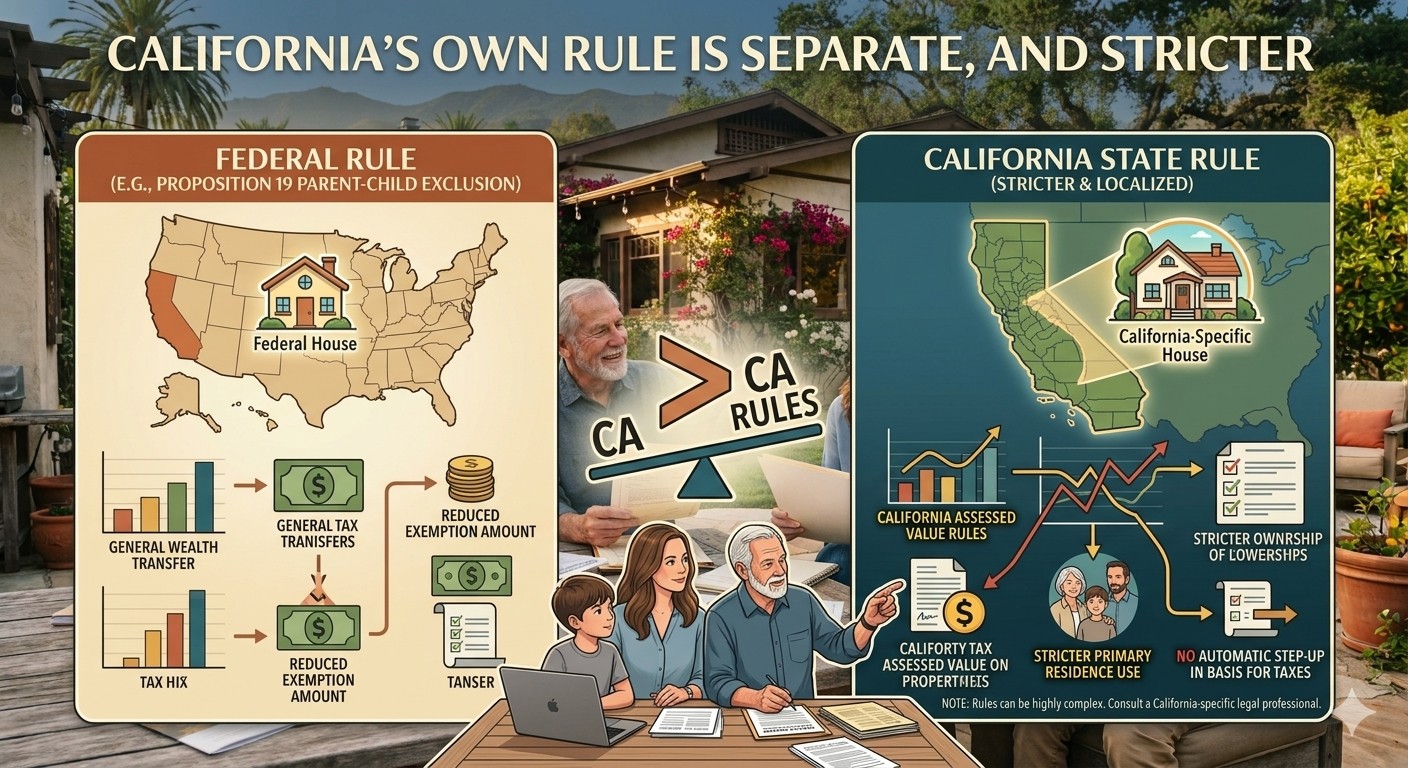
Capital gains tax and property tax are two completely different systems, and California's rules for the second one catch a lot of families off guard.
Inheriting a house doesn't automatically mean inheriting the parents' old, low property tax bill. Under a law called Proposition 19, a child generally has to move into the house and make it their own primary residence within one year of the transfer to keep anything close to that old rate. If Julia does that, the numbers work out well for her family specifically: their home's assessed value has only grown to about $406,470 under the state's 2 percent annual cap, and Prop 19 currently allows up to about $1,044,586 on top of that assessed value before any extra tax kicks in. Since $1,450,000 falls just under that combined cutoff, Julia would keep her parents' full assessed value and a property tax bill of around $372.60 a month, instead of what full reassessment would charge.
If Julia doesn't move in, whether because she keeps the house as a rental, already owns her own home, or simply doesn't act in time, the county resets the property's assessed value to its full market price the day her parents died. That would push the same house's property tax to roughly $1,329.17 a month, more than three times as much, for the exact same house, with no other change except who's living in it.
The Court Process Most Families Don't Expect
Without a trust, there's a third system that gets involved, and it's the one families hear the least about ahead of time: probate.
California lets a primary residence worth $750,000 or less skip most of that process through a simplified court filing. Helen and Robert's house, at roughly $1,450,000, is past that threshold, which means it would typically go through full probate unless the family sets up a trust first. Probate fees in California are set by state law as a percentage of the house's full value, not what's actually owed on any mortgage. On a $1,450,000 house, that works out to about $27,500 for the estate's attorney, and often another $27,500 for the executor doing the same required work, for a combined total near $55,000 before Julia ever receives the keys. A revocable living trust is the tool most families use to avoid this step entirely, and it's usually far cheaper to set up while everyone's healthy than to deal with after the fact.
The Number Most People Get Wrong
A lot of families worry about a federal "death tax" eating into what they leave behind, and for almost everyone, that worry doesn't match reality anymore.
As of 2026, the federal estate tax only applies to estates worth more than $15 million for an individual, or $30 million for a married couple, a threshold that was recently made permanent rather than set to shrink back down. Unless a family's total assets add up to eight figures, the federal government doesn't take a cut of an inheritance at all. California itself has no separate state estate tax or inheritance tax, and hasn't for decades. The real costs in a story like Helen and Robert's were never the federal estate tax to begin with. They're the property tax reset and the probate process, both of which are avoidable with the right paperwork done early. We've looked at the sell-side version of this same exclusion math in what to actually do with your first home when you move up, and at Prop 19's other major provision, the one that helps older homeowners sell and buy a replacement home, in what's actually different the second time you buy in California.
Weighing It Honestly
None of this requires Helen and Robert to do anything complicated. It requires them to actually do something, which is a different thing entirely from assuming it'll sort itself out.
A trust would let the house skip probate and its roughly $55,000 in combined fees. Waiting to pass the house down after they're gone, rather than gifting it now, keeps the step-up in basis intact and roughly halves what Julia would owe if she ever sold. And making sure Julia knows, ahead of time, that she needs to move in within a year and file the right form to keep the family's property tax rate isn't something anyone can fix after the fact. Most of the expensive outcomes in a story like this one don't come from bad luck. They come from a conversation the family kept putting off.
Quick Check: Passing Down a House in California
Q1. Under California's Prop 19, what does a child generally need to do to keep a parent's old, low property tax bill on an inherited home?
(a) Move into the home and make it their own primary residence within one year of the transfer
(b) Rent the home out within one year
(c) Nothing, it transfers automatically
A
Prop 19's parent-child exclusion generally requires the child to move in and make the home their own primary residence within one year of the transfer.
Q2. What happens to a house's cost basis when a child inherits it after a parent's death?
(a) It's automatically reduced to zero
(b) Above $15 million per individual ($30 million for a married couple)
(c) It applies to every estate that includes real estate
C
Inherited property gets a step-up in basis, resetting its cost basis to fair market value on the date of the owner's death.
Q3. As of 2026, at what point does the federal estate tax start applying?
(a) Above $1 million per individua
(b) Above $15 million per individual ($30 million for a married couple
(c) It applies to every estate that includes real estate
B
The federal estate tax exemption is $15 million per individual, or $30 million for a married couple, as of 2026, a threshold recently made permanent.
Q4. (T/F) If a child inherits a house and sells it soon after for close to its value on the date of death, they typically owe a large capital gains tax.
F — Because of the step-up in basis, a child who sells soon after inheriting typically owes little to no capital gains tax, since there's been little to no gain since the date of death.
Q5. How are California's statutory probate fees calculated?
(a) As a flat fee regardless of the estate's value
(b) Only on the amount of cash in the estate
(c) As a percentage of the house's full value, not the equity left after any mortgage
C
California's statutory probate fees are calculated as a percentage of the estate's gross value, including the full value of any real estate regardless of what's still owed on it.
About the author: I'm a licensed real estate agent practicing in California. This article is part of NITU Path, Chapter 7, a series written to walk buyers through their entire homeownership journey.
This article is for general informational and educational purposes only and is not tax, legal, or financial advice. Estate planning, probate, and property tax rules vary by situation and change over time. Consult a licensed estate planning attorney, tax professional, or financial advisor about your specific situation.
Sources:
Back to Magazine