First Home Buyer
Clearing the minimum score to qualify and getting a genuinely good rate are two different numbers, and the gap between them can cost tens of thousands of dollars over the life of a loan.
In short: There's a minimum credit score to qualify for a loan at all, and a separate, higher score where you actually get good pricing. Conventional loans typically start around 620, but the best rates generally don't show up until somewhere near 740. On a typical California loan size, that gap can mean hundreds of dollars a month and well over $100,000 in extra interest across a 30-year loan. Clearing the minimum gets you in the door. It doesn't tell you what you're actually paying to be there.
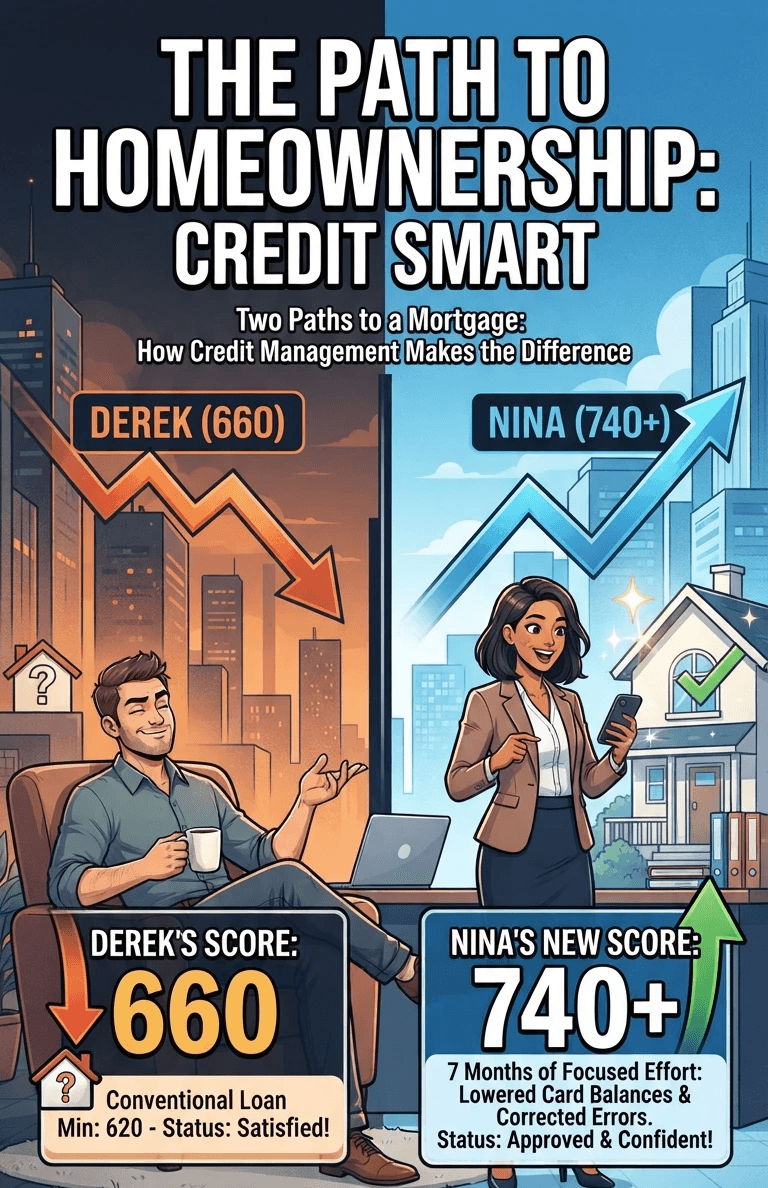
Derek got pre-approved with a 660 credit score, comfortably above the 620 floor most conventional lenders quote, and felt genuinely good about it walking out of that first meeting. What his loan officer didn't spell out clearly, and what Derek didn't think to ask, was where 660 actually landed him on the lender's rate sheet. It wasn't the worst tier. It also wasn't close to the best one, and the difference between those two tiers, on the size of loan he was taking out, came to a few hundred dollars every month for the next 30 years.
His coworker Nina ran into the same conversation about a year before she planned to buy, and she treated it differently. Her score sat around 664 at the time, and rather than accepting that as good enough, she spent seven months paying down credit card balances and correcting an old collection account that had never actually been hers. By the time she applied, her score was past 740, and she qualified for meaningfully better pricing than Derek did on an almost identical loan.
The Minimum Isn't the Real Question
Most conversations about credit scores and home buying focus on the minimum required to qualify at all, and that number matters. But it's really only the first of two separate questions. The second, more important one for anyone with any flexibility on timing is: what score actually gets you good pricing, not just approval.
Those are different numbers, often by more than 100 points, and the gap between them is where a lot of real money quietly gets left on the table by buyers who stop improving their credit the moment they clear the minimum.
Minimums by Loan Type
Here's where the floor actually sits for the most common loan types, illustrative figures throughout:
Loan Type | Typical Minimum Score |
|---|---|
FHA | 580 with 3.5% down; 500-579 possible with 10% down |
Conventional | 620 or higher |
VA | No official minimum; lenders typically want 580-620 |
USDA | Usually around 640 |
Jumbo | 700-740 or higher |
Treat these as a floor, not a guarantee. Individual lenders frequently apply their own stricter requirements on top of the official program minimum, and your actual approval still depends on the rest of your financial picture, including debt-to-income ratio, down payment size, and income stability.
The Real Cost Curve
This is the part that actually matters once you've cleared whichever minimum applies to your loan type. As of mid-2026, average rates by credit score tier looked roughly like this:
Credit Score | Average Rate |
|---|---|
760-850 | 6.70% |
700-759 | 6.95% |
680-699 | 7.07% |
660-679 | 7.11% |
640-659 | 7.21% |
620-639 | 7.36% |
On a $650,000 loan, roughly typical for a lot of California purchases, the difference between the top tier and the bottom tier works out to about $288 a month, and over $103,000 in additional interest across a 30-year term. That's the entire gap between Derek's 660 and Nina's 740-plus, on loans of a similar size.
Notice how the tiers move in relatively small increments too. Nina didn't need a perfect score to see a real improvement. Moving from the low 660s into the 700s alone would have closed a meaningful part of that gap, even before reaching the top tier.
Why the Two Numbers Get Confused
It's an easy mix-up to make, because most of what gets published online focuses on "what's the minimum to buy a house," which reads like the finish line. In practice, it's closer to the starting line. A score that clears the minimum gets you a loan. It doesn't tell you whether that loan is priced well, and a lot of buyers only discover the actual rate tiers once they're already sitting with a loan officer, the same way Derek did.
If you have any real flexibility on your purchase timeline, even just a few months, it's worth asking a loan officer directly where your current score lands on their rate sheet, not just whether you qualify. That single question is what separated Derek's and Nina's outcomes more than anything else.
What Actually Moves the Number
The fastest, most reliable lever for most people is credit utilization, meaning how much of your available revolving credit you're actually using. Paying down credit card balances, even without paying them off entirely, tends to move a score faster than almost anything else, often within one or two billing cycles. Correcting genuine errors on your credit report, like the collection account that wasn't actually Nina's, can also produce a real jump once resolved. Opening new credit accounts or making large purchases on credit in the months before you apply tends to work against you, even if you pay everything on time, since it can temporarily lower your average account age and add a hard inquiry right when a lender is evaluating you.
None of this happens overnight, which is exactly why the conversation with a loan officer is worth having as early as possible, ideally before you're deep into house hunting rather than after you've already found a house you love.
FAQ
Q1. Can I get a mortgage with a score below 600? Possibly, particularly through FHA with a larger down payment, but options narrow quickly below that range and pricing gets meaningfully worse. It's worth a direct conversation with a loan officer about your specific score rather than assuming you're excluded.
Q2. Is 740 a magic number I need to hit exactly? Not exactly, but it's commonly where conventional pricing tiers top out, meaning scores above that point generally don't unlock much additional improvement. The bigger, more common wins are usually moving out of the lowest tiers into the middle ones.
Q3. How long does it actually take to raise a credit score meaningfully? It varies, but paying down revolving balances can show measurable movement within one or two billing cycles, while resolving report errors or building longer account history can take several months to a year. Nina's seven-month timeline is a realistic, not unusually fast, example.
Q4. Does my score affect down payment assistance programs too? Some down payment assistance programs, including several we cover in what first-time buyer programs are available in California, carry their own credit requirements on top of the base loan program's minimum, so it's worth confirming a specific program's threshold directly rather than assuming your score for a standard loan automatically qualifies you.
Quick Check: Credit Score and Home Buying
Q1. What is the typical minimum credit score for a conventional loan?
(a) 500
(b) 620
(c) 740
B
Conventional loans typically require a minimum credit score around 620, though individual lenders may set it higher.
Q2. (T/F) Clearing a loan program's minimum credit score guarantees you the best available interest rate.
F — Clearing the minimum only qualifies you for a loan; actual pricing depends on which rate tier your score falls into, often a much higher threshold.
Q3. In the worked example, roughly how much extra total interest did the lowest credit tier pay compared to the highest, on a $650,000 loan?
(a) About $103,000
(b) About $5,000
(c) About $500,000
A
Roughly $103,000 in additional total interest over a 30-year term on a $650,000 loan, comparing the top and bottom credit tiers.
Q4. What is one of the fastest ways to improve a credit score before applying?
(a) Opening several new credit cards
(b) Paying down revolving credit card balances
(c) Ignoring your credit report entirely
B
Paying down revolving credit card balances tends to move a score faster than almost any other single action, often within one or two billing cycles.
Q5. According to the article, what should a buyer with flexible timing ask a loan officer?
(a) Only whether they qualify
(b) Nothing, since the minimum is the only number that matters
(c) Where their current score lands on the rate sheet, not just whether they qualify
C
Asking where your score actually lands on the rate sheet, not just whether you qualify, is the question that separates a good rate from just an approval.
About the author: I'm a licensed real estate agent practicing in California. This article is part of NITU Path, Chapter 2, a series written to walk first-time buyers through their entire homeownership journey.
This article is for general informational and educational purposes only and is not financial or lending advice. Credit score requirements and rate tiers vary by lender and change over time; the figures in this article are illustrative examples as of 2026. Consult a loan officer or credit counselor about your specific situation.
Sources:
Back to Magazine