Home Owner
The house didn't change. Your life did, and figuring out what to actually do about that gap is a different question than the one most people start asking.
In short: A home that was genuinely right for you at one point can stop fitting, not because anything about the house changed, but because your life did. Before deciding to sell, it's worth separating the decision into two honest questions: what has actually changed, and which of the real paths forward, staying and adapting, selling and moving, or renting it out and buying elsewhere, actually makes sense once you run the numbers rather than just the feeling.
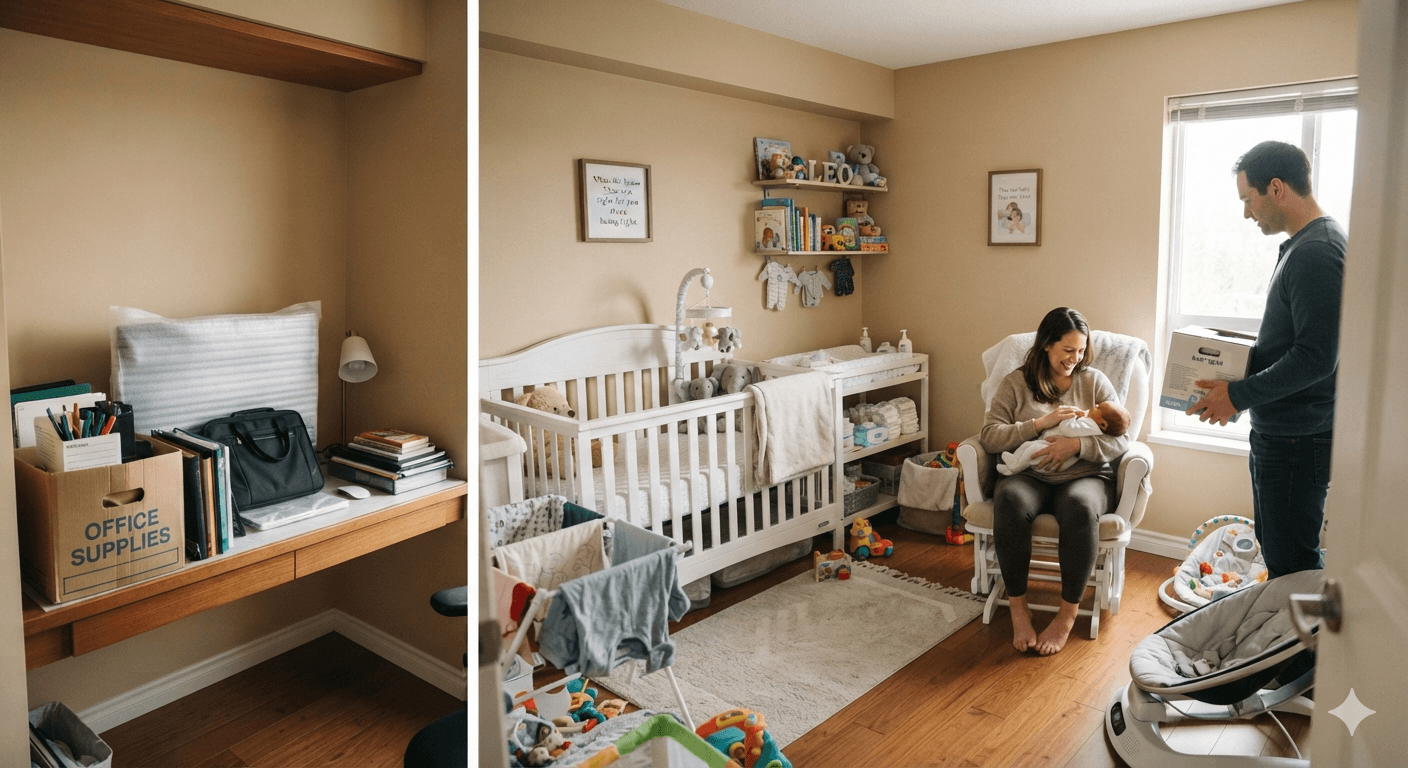
Claire and Ben bought their two-bedroom condo in 2021, locking in a 3.2 percent rate that felt like a footnote at the time and now feels like the best financial decision they've ever made. It was exactly right for two people starting out, close to both of their jobs, with a spare room Ben used as a home office. Four years later, with their third child on the way and that home office now doubling as a nursery, the same condo that once felt spacious started to feel like it was closing in around them.
Nothing about the condo itself had changed. Their life had, and that gap between the two is really what this entire chapter is about.
The Signs Worth Paying Attention To
A house stops fitting for reasons that fall into a fairly predictable set of categories: a growing family that's outgrown the bedrooms or the yard, a shift to remote or hybrid work that suddenly makes a dedicated home office non-negotiable, an aging parent who needs to move in, a commute that's become unsustainable after a job change, or the opposite direction entirely, an empty nest where a house that once felt full now feels like more space and upkeep than two people actually need.
None of these signs mean you made the wrong decision when you bought. They mean the decision that was right for a specific season of your life is now being asked to serve a different one, which is a completely different problem to solve.
Three Real Paths Forward
Stay and adapt. Renovate, add on, or reconfigure the space you already have. This keeps your existing mortgage rate intact, which matters more than it used to in a higher-rate environment, and avoids the cost and disruption of moving entirely.
Sell and move up. Trade your current equity for a home that actually fits where your life is now. This is often the first option people consider, and it's genuinely the right one for a lot of situations, particularly when the space gap is large or your current home simply can't be adapted.
Rent it out and buy elsewhere. Keep the current home as an income property while purchasing a new primary residence. This path works best for owners with strong equity and the appetite to become a landlord, and it's worth at least considering before ruling it out, especially if your current mortgage rate is well below today's market.
Claire and Ben's Actual Numbers
Here's what running the numbers actually looked like, example figures throughout. Their current mortgage balance is $420,000 at that locked-in 3.2 percent rate, putting their monthly principal and interest payment around $1,816.
Staying and adding on: A $150,000 addition, financed separately at today's higher rate on just that portion, adds roughly $1,231 a month on top of their existing payment, for a combined monthly housing cost of about $3,048. Their original low rate on the bulk of the loan stays untouched.
Selling and moving up: Their current home is worth about $700,000. After paying off the remaining balance and roughly 6 percent in selling costs, they'd walk away with about $238,000 in net equity. Rolling that into a $850,000 home at today's rate would mean a new loan of about $612,000, and a monthly payment of roughly $3,969, nearly $2,150 more than what they pay now, and about $922 more per month than the renovation path, close to $11,000 a year in additional housing cost for the same amount of added space.
The gap exists because moving means giving up their locked-in rate on the entire loan balance, not just financing the additional space they actually need, a dynamic we covered directly in why locked-in low mortgage rates are keeping so many owners from moving. Renovating lets them add square footage at today's rate while keeping yesterday's rate on everything they already have.

It's Not Only About the Math
The renovation path won in Claire and Ben's numbers, but that's not a universal answer, and the math isn't the only input that matters. Renovating means living through construction, which is genuinely disruptive with young kids in the house. Moving means a new school district, a new commute, and a new neighborhood, changes that carry real weight beyond whatever the monthly payment comparison shows. A family whose space gap can't realistically be solved by an addition, or whose current location no longer works at all, may reasonably choose to move even at a real premium, because the thing that actually needs to change isn't just square footage.
This is really the same question we raised back in the life you're building should decide the house you buy: the right decision follows from an honest look at where your life is actually headed, not from whichever option looks better on a spreadsheet in isolation.
FAQ
Q1. How do I know if renovating is even possible for my situation? Start with a conversation with a contractor or architect about your lot, your local zoning rules, and what your specific home can realistically accommodate. Some homes and lots simply can't add the space a growing family needs, which narrows the decision considerably.
Q2. Does it ever make sense to move even with a much higher rate? Yes, particularly when the space or location gap is large enough that no reasonable renovation could close it, or when your current home's location itself no longer works, not just its size.
Q3. What if I can't decide between renting my current home out and selling it? That decision generally comes down to whether you're financially and personally ready to be a landlord, and whether the numbers on rental income versus your locked-in mortgage payment actually pencil out as a real investment, not just a way to avoid selling.
Q4. Is there a way to estimate renovation costs before committing? Getting multiple contractor quotes early is worth it, since renovation costs vary enormously by scope, region, and what's actually possible on your specific property. Treat any early estimate as a starting point for a real financial comparison, not a final number.
Quick Check: When Your House Stops Fitting
Q1. What is the first honest question to ask when a home no longer feels like it fits?
(a) What has actually changed in your life (b) What color to repaint the walls
(b) What color to repaint the walls
(c) Whether your neighbors have moved recently
A
The first honest question is what has actually changed in your life, since that determines which of the real paths forward is worth pursuing.
Q2. (T/F) A home no longer fitting your life always means the original decision to buy it was a mistake.
A
F — A home no longer fitting reflects a change in life circumstances, not necessarily an error in the original decision to buy it.
Q3. What are the three general paths forward described in the article?
(a) Sell immediately, refinance, or do nothing
(b) Stay and adapt, sell and move up, or rent it out and buy elsewhere
(c) Only ever sell and move
B
Staying and adapting, selling and moving up, and renting the current home out while buying elsewhere are the three general paths covered.
Q4. In the worked example, why did moving cost significantly more per month than renovating?
(a) The new home had a smaller square footage
(b) Renovation loans always have lower rates than mortgages
(c) Moving meant giving up the locked-in rate on the entire loan balance, not just the added space
C
Moving means financing the entire new loan at today's rate, giving up the locked-in rate on the whole existing balance rather than just the additional space needed.
Q5. According to the article, what's one reason moving might still make sense despite a higher rate?
(a) A space or location gap too large for any renovation to solve
(b) Moving is always cheaper in the long run
(c) Renovation is never worth considering
A
When the space or location gap is too large for a realistic renovation to close, moving can still make sense even at a real rate premium.
About the author: I'm a licensed real estate agent practicing in California. This article is part of NITU Path, Chapter 6, a series written to walk buyers through their entire homeownership journey.
This article is for general informational and educational purposes only and is not financial or lending advice. Renovation costs, mortgage rates, and market conditions vary by property, lender, and location, and the figures here are illustrative examples, not guarantees. Consult a licensed lender, contractor, or financial advisor about your specific situation.
Back to Magazine