Investor
Real estate investing isn't one strategy. It's a different game depending on where you live. Here's the regional math that led me, as a California-based agent, to flipping instead of buy-and-hold.
Why I Chose House Flipping Over Rental Investing While Living in California
A few years into working as a real estate agent, I reached the point most agents eventually reach: the sense that I should be investing, not just helping other people do it. My first instinct was the conventional one. Buy a rental property, hold it for years, let the tenants pay down the mortgage while the equity builds quietly in the background. It's the advice everyone gives. When I actually ran the numbers as someone living and working in California, though, that picture didn't hold up the way I expected. I ended up somewhere else entirely: house flipping, now run through a family LLC. Here's the reasoning that got me there.
Real Estate Investing Isn't One Strategy. It Changes by Region.
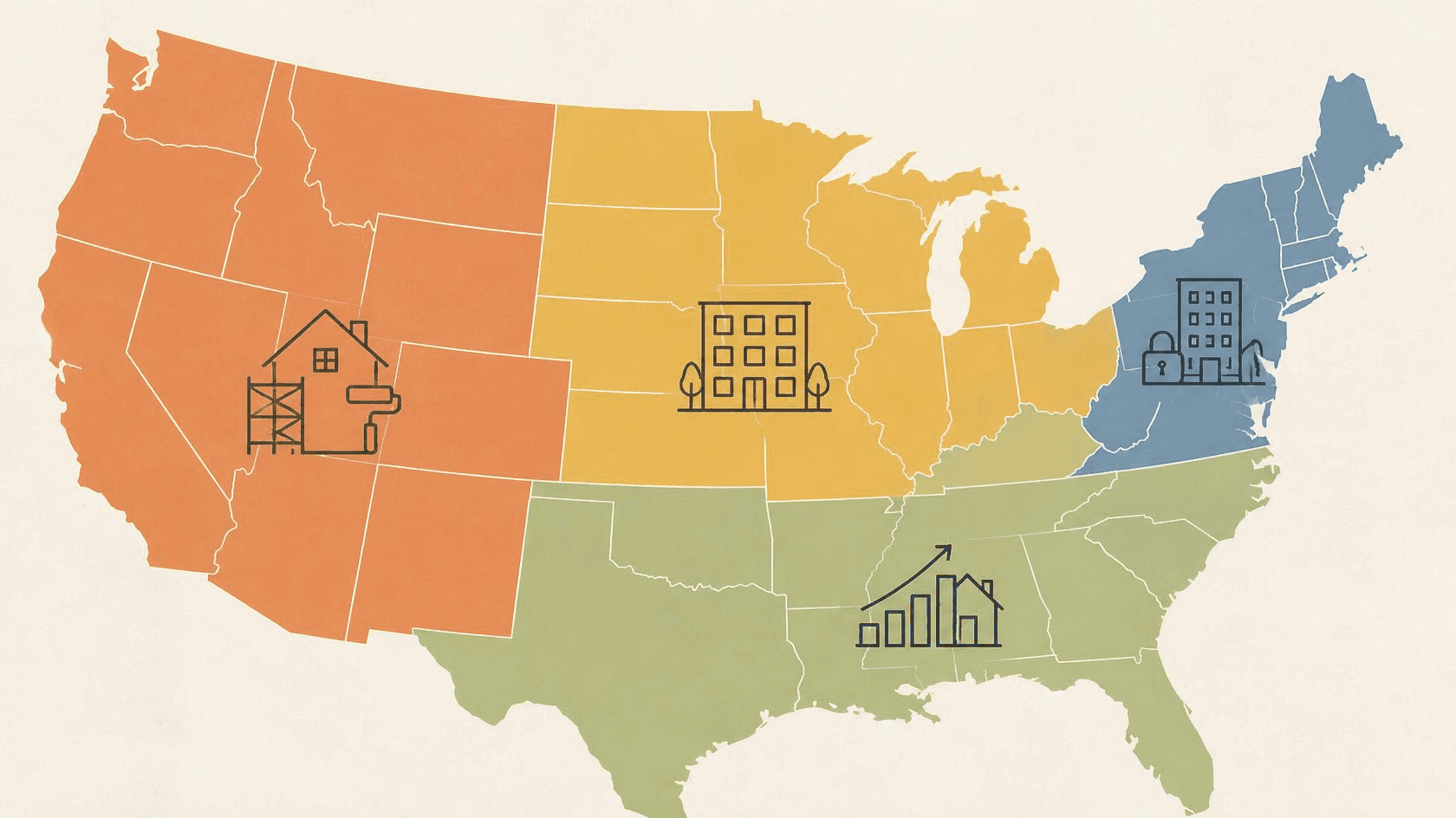
The first assumption worth breaking is that "real estate investing" describes a single approach. It doesn't. The right strategy depends almost entirely on where the property sits, and the clearest way to see why is a simple number: the rent-to-price ratio, what a property rents for each month as a percentage of what it costs to buy.
In coastal markets like California, that ratio typically runs somewhere between 0.3 and 0.5 percent. A $650,000 house renting for around $2,900 a month works out to about 0.45 percent, which is thin enough that once you subtract the mortgage, taxes, and upkeep, there's rarely much real cash flow left over. That's exactly why flipping, buying an undervalued property and forcing appreciation through renovation over a short window, tends to make more financial sense on the coast than holding for rental income does.
The Midwest runs the opposite way. Rent-to-price ratios there commonly land between 0.7 and 1.1 percent. A $225,000 duplex bringing in a combined $1,950 a month comes out to about 0.87 percent, nearly double the coastal figure. Purchase prices are low enough that even with a mortgage in place, real monthly cash flow survives, which is why cities like Indianapolis, Kansas City, and Cleveland have become the go-to markets for investors buying multi-unit properties and holding them for years.
The South, particularly the Sun Belt states, sits somewhere between the two. Places like Texas, Florida, and Georgia combine purchase prices well below California's with steady in-migration from higher-tax, higher-cost states, which keeps rental demand climbing. Most of these states are also landlord-friendly, with eviction timelines running 30 to 60 days and little in the way of rent regulation, so investors there can chase cash flow and population-driven appreciation at the same time. The one caveat worth flagging: property taxes in a state like Texas can run 1.9 to 2.7 percent, high enough that it needs to be built into the return calculation, not treated as an afterthought.
The Northeast, oddly, resembles the West Coast more than it resembles the Midwest. Cities like New York and Boston carry high enough price tags that pure rental cash flow rarely pencils out, which pushes investors there toward long holds and appreciation, much like California. But the Northeast carries a variable the West doesn't have to think about: rent control. Massachusetts has a ballot measure heading to voters in November 2026 that would cap rent increases, and unlike most rent-control structures, that cap wouldn't reset when a tenant moves out, a detail that makes the regulatory environment there notably harder to underwrite around.
So Why Flipping, Not Rentals, for Me

Once I laid the picture out this way, the answer became fairly obvious. I live in California, and I plan to keep working and building my business here, which meant there was no real reason to go manage rental properties remotely in the Midwest or the Sun Belt. It made far more sense to work the market I already know best, the one where I actually understand local pricing well enough to spot something undervalued before someone else does.
Here's what that math actually looks like. Take a property purchased at $582,000, with a $68,000 renovation budget, targeting an after-repair value (ARV) of $785,000. Add roughly $37,875 in holding costs over a six-month renovation, covering loan interest, property taxes, and insurance, plus another $54,950 in selling costs at closing, about 7 percent of the ARV between agent commission and closing fees. All in, total costs come to about $742,825, leaving a net profit of roughly $42,175, a return of about 5.7 percent on capital deployed. Run two of those cycles in a year, and the annualized return lands somewhere around 11 percent, before taxes, and with real variance from one property to the next.
What matters more than the specific percentage is the timeline it's earned on. That profit shows up in six months, not the several years a rental typically needs to build comparable equity. In a market like California, where capital tied up in a property carries real opportunity cost, that turnaround speed is itself a competitive advantage. It also helps that years of working as an agent gave me a feel for local pricing and a network that surfaces undervalued listings before they're widely known, an edge that's much harder to replicate analyzing properties in a market I've never set foot in.
The Takeaway
There's no single right answer in real estate investing. What is clear is that where you live, and which market you actually understand, does most of the work in deciding which strategy fits. In a high-price, low-rent-ratio market like California, a short flipping cycle can make more sense than a long-term hold. In the Midwest or the Sun Belt, the opposite is often true, and multi-unit buy-and-hold investing wins out. For me, investing in the market I know best, in the way I'm actually equipped to execute it, meant house flipping.
This article is for general informational purposes only and is not investment or tax advice. Real estate investment outcomes vary significantly by region, market conditions, and individual financial circumstances. Consult a licensed professional before making investment decisions.
Back to Magazine