First Home Owner
The percentage everyone quotes is real, but it hides more than it explains. Here's what actually goes into that number, and a calculator to make it personal.
In short: A buyer's closing costs in California typically run 2 to 5 percent of the purchase price. A seller's run higher, 6 to 10 percent, once agent commission is included. Those ranges are true and also not very useful on their own, because the actual number depends on whether you're financing or paying cash, which side of the deal you're on, which part of the state you're in, and sometimes which specific city. Below is the full breakdown, two worked examples, and a calculator that turns your own numbers into a personalized estimate.
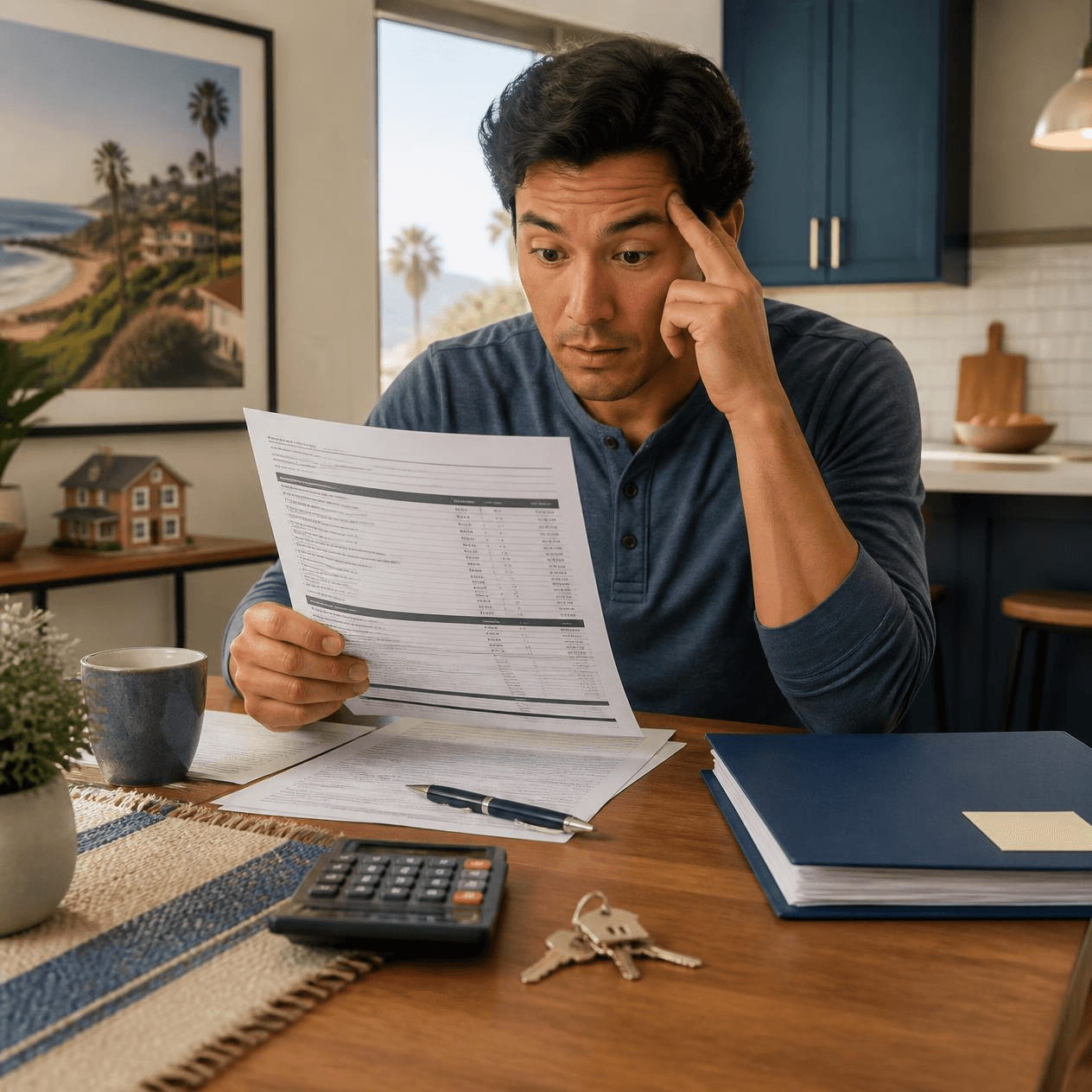
Daniel opened his estimated closing disclosure four days before signing and did a double take. He'd budgeted for the down payment. He'd budgeted, loosely, for "some closing costs." The actual number on the page was bigger than the loose version in his head, and he couldn't immediately tell which of the dozen line items were normal and which ones he should be asking his lender about.
That gap, between the one-line summary everyone repeats and the itemized list that actually shows up on paper, is what this article is for.
Why the Percentage Everyone Quotes Isn't the Whole Story
"Two to five percent" is accurate for a financed buyer in California. It's also an average sitting on top of a dozen fees that don't all move the same way. Some scale directly with the purchase price. Some are flat regardless of whether the home costs $400,000 or $2 million. Some only apply if you're financing. Some only apply depending on which half of the state you're standing in. A single percentage can't hold all of that, which is exactly why two buyers on identical-priced homes can end up with noticeably different totals.
What a Buyer Typically Pays
For a financed purchase, a buyer's closing costs generally include a loan origination fee (roughly 0.5 to 1 percent of the loan amount), an appraisal, a home inspection, lender's title insurance (roughly 0.2 to 0.5 percent of the loan), half of the escrow fee, recording fees, prepaid daily interest, a year of prepaid homeowner's insurance, and several months of property tax held in an impound account.
Here's what that looks like on an actual number. Take a $650,000 home in Riverside County, financed with 10 percent down, a $585,000 loan. The origination fee runs about $4,387.50. Lender's title insurance comes to about $2,047.50. Fifteen days of prepaid interest adds roughly $1,625.18. A three-month property tax impound adds about $1,787.50. Add the appraisal, inspection, escrow share, recording fees, and a year of homeowner's insurance, and the total lands at about $13,377.68, or 2.06 percent of the purchase price, right in line with the range everyone quotes, just with an actual number attached to it this time.
Paying cash removes several of these entirely: no origination fee, no lender's title insurance, no prepaid interest, no impound account, since none of those exist without a loan behind them.
What a Seller Typically Pays
A seller's list looks different, and it's where the "6 to 10 percent" figure comes from, mostly because it includes agent commission. Setting commission aside, since it's separately negotiated and varies by listing agreement, a seller in California typically pays California's documentary transfer tax, half the escrow fee, the deed recording fee, a natural hazard disclosure report, and, depending on the region, the owner's title insurance premium.
On a $1,200,000 sale in the city of Los Angeles, the transfer tax alone is worth walking through, because it has two layers. The county charges $1.10 per $1,000 of price, about $1,320 here. The city of Los Angeles adds its own tax on top, $4.50 per $1,000, about $5,400. That's $6,720 in transfer tax before anything else is counted, and it's a cost that simply doesn't exist in a city without its own add-on rate. Add escrow, recording, the disclosure report, and owner's title insurance under the Southern California custom described below, and the seller's total here comes to about $15,020, or 1.25 percent of the price, not counting whatever commission was negotiated separately.
The One Rule That Flips Depending on Where You Are
Here's a detail that catches people off guard when they've bought or sold in a different part of the state before: who pays for owner's title insurance isn't set by law. It's set by regional custom, and the custom runs in opposite directions.
In Southern California, Los Angeles, Orange, San Diego, and Riverside counties among them, it's customary for the seller to pay the owner's title insurance premium. In Northern California, the Bay Area and Sacramento region, it's customary for the buyer to pay it instead. Either party can negotiate a different arrangement in the purchase contract, but going in expecting the local default, rather than being surprised by it at the closing table, is worth knowing ahead of time.
The City Add-On Nobody Warns You About
Beyond the county's statewide $1.10 per $1,000 documentary transfer tax, a handful of California cities layer their own tax on top, and the rates aren't uniform. Los Angeles adds $4.50 per $1,000 on every sale, plus a separate, much steeper surtax under Measure ULA on sales above $5.4 million, sometimes called the "mansion tax." Santa Monica adds $3.00 per $1,000. San Francisco charges $7.50 per $1,000 in place of a separate county rate, since the city and county are consolidated there. Plenty of California cities have no add-on at all. The only way to know for certain is to check the specific city a property sits in, which is exactly what the calculator below does.
Run Your Own Numbers
Try the calculator: ➡️California Closing Cost Calculator
What the Calculator Won't Show You
Even a personalized estimate has real limits, and it's worth being upfront about them rather than implying more precision than exists. It doesn't include real estate agent commission, which is negotiated separately in the listing agreement and varies deal to deal. It doesn't include the prorated property tax credit or charge tied to your specific closing date, which is usually small but genuinely depends on the calendar. It doesn't include ongoing monthly PMI, since that's a recurring cost rather than a one-time closing charge. And it only covers the handful of cities with well-documented add-on transfer taxes; several others, Berkeley and Culver City among them, charge their own rate that isn't built into this version, so confirming with your escrow officer is still the last, necessary step.
Weighing It Honestly
None of these fees are hidden, exactly. They're disclosed, itemized, and sitting right there on the closing disclosure days before signing, the way Daniel found them. What's missing isn't disclosure. It's a sense of scale ahead of time, so the total on that page confirms a number you already had in mind instead of replacing it with a bigger one at the worst possible moment to be surprised. We've walked through the fuller cash-to-close picture, down payment and closing costs together, in what a buyer found at the final walk-through, and covered how much to have saved before you even start touring homes in how much cash do you actually need saved before house hunting.
Quick Check: California Closing Costs
Q1. Roughly what percentage of the purchase price do a financed buyer's closing costs typically run in California?
(a) 10 to 15 percent
(b) 15 to 20 percent
(c) 2 to 5 percent
C
A financed buyer's closing costs in California typically run 2 to 5 percent of the purchase price.
Q2. Which of these costs disappears entirely for a buyer paying cash instead of financing?
(a) Prepaid interest on the loan
(b) The home inspection fee
(c) The natural hazard disclosure report
A
Prepaid loan interest disappears entirely for a cash buyer, since it only exists in connection with a mortgage.
Q3. What determines who customarily pays for owner's title insurance, the buyer or the seller?
(a) Regional custom, which differs between Southern and Northern California
(b) State law, which is identical statewide
(c) The buyer's credit score
A
Who customarily pays owner's title insurance is set by regional custom, not state law, and the default runs in opposite directions in Southern versus Northern California.
Q4. (T/F) Every California city charges the same documentary transfer tax rate, with no city-level variation.
F — California cities are not uniform; several, including Los Angeles, Santa Monica, and San Francisco, charge their own additional transfer tax on top of the county rate, while many others charge none.
Q5. What is one major cost that a personalized closing cost calculator typically does NOT include?
(a) The escrow fee
(b) Recording fees
(c) Real estate agent commission, since it's negotiated separately
C
Real estate agent commission is negotiated separately in the listing agreement and generally isn't included in a standard closing cost estimate.
About the author: I'm a licensed real estate agent practicing in California. This article is part of NITU Path, Chapter 4, a series written to walk buyers through their entire homeownership journey.
This article, and the calculator linked above, are for general informational and educational purposes only and are not financial, legal, or tax advice. Fees, tax rates, and regional customs vary by lender, title company, escrow office, and city, and can change over time. Confirm final figures with your agent, lender, and escrow officer before closing.
Sources:
805 Title — California Closing Costs, Buyer & Seller Breakdown
List With Clever — California Real Estate Transfer Taxes: An In-Depth Guide
Keep Learning
Back to Magazine