First Home Buyer
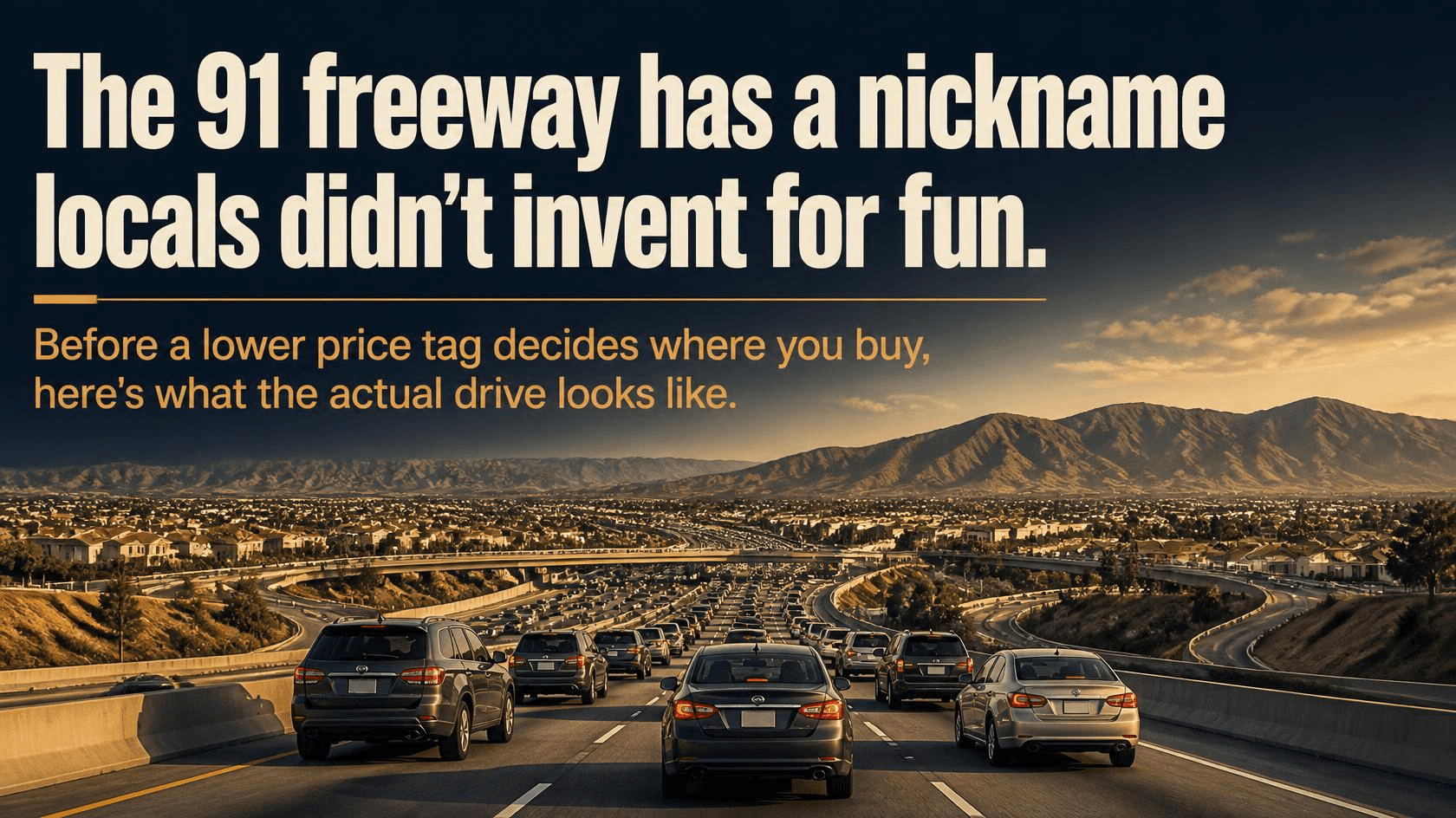
The 91 freeway has a nickname locals didn't invent for fun. Before a lower price tag decides where you buy, here's what the actual drive looks like.
In short: Roughly 280,000 people a day drive the stretch of the 91 freeway between Riverside County and Orange County, a corridor regularly ranked among the worst commutes in the country. Locals just call it the Corona Crawl. A drive that takes 50 minutes off-peak can stretch past 90 minutes during rush hour, and that gap alone adds up to hundreds of extra hours a year. None of that traffic disappears once you cross into LA either, a metro area where the average driver already loses 87 hours a year to congestion. None of this means don't buy in the Inland Empire. It means run the actual commute, at the actual time, before the lower price tag makes the decision for you.
Six lanes of brake lights, barely moving, somewhere between Corona and the Orange County line. It happens most weekday mornings, and it happens again most weekday evenings, going the other direction. Locals gave it a name years ago: the Corona Crawl. It's not an exaggeration. It's a predictable, near-daily event on one of the most congested stretches of freeway in the country, and it's the part of Inland Empire home buying that a lower price tag can make easy to forget about.

The Numbers Behind the Reputation
The 91 freeway between Riverside County and Orange County isn't just locally famous. It's been ranked among the worst commutes in the nation, carrying an estimated 280,000 vehicles a day through a corridor that was never built for that kind of volume. A $1.4 billion widening project finished back in 2017 helped, particularly on the eastbound side, but the westbound crawl into Orange County during the morning commute, and the reverse in the evening, remains a defining feature of life for anyone driving that route regularly. The roughest stretch sits near Green River, at the western edge of Riverside County, where merging traffic backs up well before the county line.
What the Actual Drive Times Look Like
Here's what the numbers actually show for a few Inland Empire cities driving into downtown LA. From Riverside, the drive runs about 50 minutes off-peak, stretching to 75 to 100 minutes during rush hour. From Corona, it's a similar 50 minutes off-peak, but rush hour can push past 110 minutes. Rancho Cucamonga and Fontana run slightly shorter, 45 to 50 minutes off-peak, 65 to 100 minutes at rush hour. Leaving before 6:45 a.m. can shave 20 to 25 minutes off any of these, which tells you almost everything about how much of this delay comes down to timing rather than distance.
Run the math on a typical commute, say, 90 minutes each way during rush hour instead of 50 off-peak, and it adds up fast. Commuting at rush hour instead of off-peak hours adds roughly 333 hours a year to a five-day-a-week commute. That's the equivalent of more than eight extra 40-hour work weeks, spent sitting in a car, purely because of what time you left the house.
The Express Lane Trade-Off
The 91 Express Lanes, running from the Orange County line to the I-15 interchange near Corona, offer a way to buy back some of that time. Tolls run anywhere from $3 to $12 per trip depending on the time of day, and a commuter using them daily can expect to pay somewhere between $1,000 and $6,000 a year, depending on how often and how aggressively they use them. A commuter paying a midpoint toll both directions, every workday, would spend around $3,750 a year for a faster, more predictable trip. Whether that trade makes sense depends entirely on what an hour of your time is actually worth to you, and how much that math changes if your employer allows even two or three remote days a week.
Traffic Doesn't End at the County Line
It's worth being clear that the 91 corridor is a specific, unusually bad bottleneck, not a stand-in for LA traffic as a whole. Still, once an Inland Empire commuter actually reaches LA job centers, the congestion doesn't disappear. Los Angeles ranks as the fourth most congested city in the country, with the average driver there losing about 87 hours a year to traffic, behind Chicago's 112, New York's 102, and Philadelphia's 101, but still a substantial number on its own. An Inland Empire commute effectively stacks a brutal freeway bottleneck on top of an already congested destination, which is exactly why the total time cost tends to run higher than either number looks on its own.
What This Actually Means for Buyers
None of this is a reason to rule out the Inland Empire. It's a reason to test the actual commute before signing anything, not just once, but at the time you'd genuinely be driving it. A Saturday afternoon drive-by tells you almost nothing about a Tuesday morning on the 91. If the job allows hybrid or remote days, the math on a longer commute changes completely, since two commuted days a week is a very different proposition than five. And for anyone working near a Metrolink line, the train is worth pricing out as a real alternative, not just a backup: a trip from the Riverside-Downtown station runs roughly 100 to 120 minutes door to door including walking and transfer time, competitive with a bad rush-hour drive and without the driving itself. We've covered the fuller financial trade-off between buying in Riverside County versus staying closer to the coast, commute cost included, in Orange County vs. Riverside County, and what daily life in the region looks like beyond the drive itself in what is California's Inland Empire like.
Weighing It Honestly
The price gap between an Inland Empire home and a comparable one closer to the coast is real, and for a lot of buyers, it's the difference between buying now and waiting years. The commute is just as real, and it's a cost that shows up every single workday, not just once at closing. The honest version of this decision isn't "Inland Empire good" or "Inland Empire bad." It's knowing, specifically, what the drive costs in time or in toll money, at the hours you'd actually be driving it, before the lower price tag quietly makes the decision on its own.
Quick Check: Commuting from the Inland Empire to LA
Q1. Roughly how many vehicles travel the 91 freeway corridor between Riverside County and Orange County each day?
(a) About 28,000
(b) About 280,000
(c) About 2,800,000
B
An estimated 280,000 vehicles travel the Riverside County to Orange County stretch of the 91 freeway each day.
Q2. What does leaving before roughly 6:45 a.m. typically do to an Inland Empire commute into LA?
(a) It can shave 20 to 25 minutes off the drive
(b) It has no measurable effect
(c) It typically adds 30 minutes to the drive
A
Leaving before about 6:45 a.m. can shave roughly 20 to 25 minutes off an Inland Empire commute into LA, since so much of the delay comes down to timing rather than distance.
Q3. What is true about the 91 Express Lanes?
(a) They are free to use at all times
(b) They only operate on weekends
(c) Tolls range from about $3 to $12 per trip depending on the time of day
C
The 91 Express Lanes charge tolls that range from roughly $3 to $12 per trip depending on the time of day.
Q4. Where does Los Angeles rank nationally for traffic congestion, and roughly how many hours does the average driver there lose to it per year?
(a) First nationally, with over 150 hours lost
(b) Fourth nationally, with about 87 hours lost
(c) Los Angeles has no meaningful congestion
B
Los Angeles ranks fourth nationally for traffic congestion, with the average driver losing about 87 hours a year to it.
Q5. (T/F) A weekend afternoon test drive is a reliable way to judge what a weekday rush-hour commute on the 91 freeway will actually feel like.
F — A weekend drive tells you very little about a weekday rush-hour commute; traffic patterns on corridors like the 91 change dramatically based on the time and day.
About the author: I'm a licensed real estate agent practicing in California. This article is part of NITU Path, Chapter 3, a series written to walk buyers through their entire homeownership journey.
This article is for general informational and educational purposes only and is not financial or relocation advice. Commute times, toll rates, and traffic conditions change over time and vary by specific route and departure time. Test your own actual commute before making a purchase decision based on it.
Sources:
Back to Magazine