First Home Buyer
Riverside County homes cost roughly half of Orange County's — but the savings on paper aren't the same as the savings in real life. Here's the full trade-off first-time buyers need to run before choosing.
A companion piece to our How to Buy a House in the US series and our earlier look at seller's vs. buyer's markets in Southern California — this one tackles the trade-off a huge number of Orange County renters eventually run into: buy small here, or buy bigger an hour east.
Jason and Priya spent almost a year looking at condos in Orange County before a friend suggested they widen the search east. In Eastvale, in Riverside County, their budget stretched from a one-bedroom condo to a four-bedroom new-construction house with a two-car garage and a yard — for less money than the OC condo would have cost. It felt like they'd found the answer everyone in their situation was looking for, and they closed on the house eight months ago feeling like they'd won.
Jason's commute to his job in Irvine turned that math upside down. On a good day, the drive up the 91 freeway runs 45 minutes. On a bad day — and in Southern California, bad days on the 91 are the rule more than the exception — it stretches past 90 minutes each way. By his own rough count, he's spending close to two extra hours a day in the car compared to what an Orange County commute would have looked like, which works out to something like 400 hours a year, or ten full 40-hour work weeks, sitting in traffic he wouldn't have had if he'd bought smaller and stayed put.
They don't regret buying the house — the equity is real, and the space is real. But when they ran the numbers honestly, months in, the "savings" from buying in Riverside were smaller than they'd assumed, once gas, wear on the car, and Jason's sanity got factored in. That's the trade-off this article is actually about, and it deserves a more honest accounting than "Riverside is cheaper."
Before we begin: every price, tax, and cost figure in this article reflects Southern California market data as of mid-2026, sourced and cited at the end of this piece. Prices, Mello-Roos rates, and commute times vary enormously by specific city and even by neighborhood — verify current numbers for your exact target area with your agent.
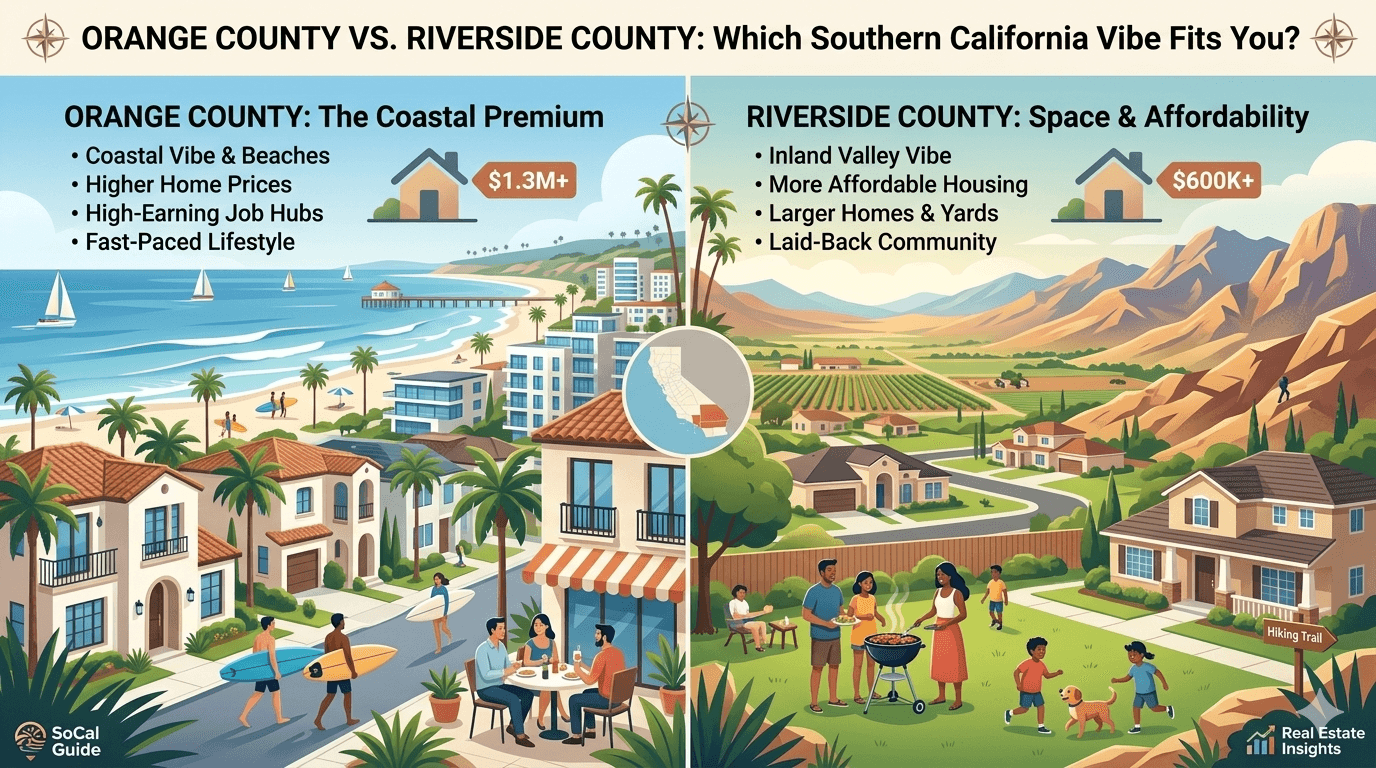
The Basic Trade, Honestly Stated
Orange County is expensive because of what it offers: proximity to the coast, a strong local job market, established infrastructure, and — for many first-time buyers — a shorter or nonexistent commute to work. Riverside County, and the Inland Empire more broadly, is cheaper because it offers less of that by default: more distance from the coast and from the region's densest job centers, though a growing local economy of its own, newer housing stock, and considerably more space for the same dollar.
Neither county is objectively the right choice. The right choice depends on where your job actually is, how much you value space versus proximity, and whether you're willing to treat your commute as a real cost with a real dollar figure attached to it — which most first-time buyers, understandably, don't do until they're already living it.
What Your Money Actually Buys
The price gap between the two counties is not subtle. Orange County's countywide median sits around $1,250,000, while Riverside County's typical home value runs closer to $600,000 to $630,000 — meaning a comparable purchase can cost roughly half as much an hour east.
City | County | Typical Price Range |
|---|---|---|
Irvine / Tustin (condo) | Orange | $650K–$850K |
Anaheim / Orange (condo) | Orange | $550K–$700K |
Fontana | Riverside/San Bernardino border | $480K–$620K |
Ontario | San Bernardino (IE) | $520K–$700K |
Eastvale | Riverside | $550K–$720K |
Murrieta | Riverside | $550K–$750K |
Corona | Riverside | $550K–$750K |
For a similar monthly payment, an Orange County budget often lands you a one- or two-bedroom condo, while the same budget in Riverside County or the broader Inland Empire can buy a new four-bedroom, single-family house with a yard and a two-car garage. That's the appeal, and it's real — it's also only half the comparison.
Q. Roughly how does Orange County's countywide median home price compare to Riverside County's?
(a) About the same
(b) Roughly double
(c) Roughly one-third higher
B
Orange County's median runs roughly double Riverside County's, around $1,250,000 versus $600,000–$630,000.
The Mello-Roos Surprise — In Both Directions
A common assumption is that Mello-Roos, the special property tax that funds infrastructure in newer developments (covered in more detail in Part 2 of our series), is an Inland Empire problem. It isn't, and this is worth correcting directly: Mello-Roos shows up wherever new master-planned construction shows up, and that includes plenty of Orange County. Irvine, Rancho Mission Viejo, and Ladera Ranch all carry significant Community Facilities District taxes on newer homes, right alongside newer developments in Eastvale, Corona, and other parts of Riverside County.
Typical annual Mello-Roos charges in newer master-planned communities — whether in Orange County or the Inland Empire — run roughly $3,000 to $6,000 a year, sometimes more in the largest, newest districts, and these charges are tied to the property itself rather than its assessed value, so they don't shrink as a percentage the way a mortgage payment effectively does over time with income growth. The honest takeaway isn't "avoid Riverside because of Mello-Roos." It's "check for Mello-Roos on any new-construction home, in either county, because the newer and larger the development, the more likely it is to be there."
The Line Item Most Buyers Forget to Budget: The Commute
This is where Jason and Priya's story becomes the useful part of this comparison, because the commute cost is real money, not just an inconvenience, and it rarely makes it into a first-time buyer's spreadsheet next to the mortgage payment.
A daily commute from the Corona or Eastvale area into central Orange County job centers like Irvine — a common pattern for Riverside County buyers who work in OC — runs somewhere around 40 miles each way, and at roughly 26 miles per gallon and current California gas prices, that adds up to something in the neighborhood of $300 a month in fuel alone, before wear, maintenance, and the extra depreciation of putting significantly more miles on a car every year. That number doesn't include the cost of Jason's time, which is harder to put a dollar figure on but isn't free either — those extra 400 hours a year are 400 hours not spent with family, not spent working extra hours at a job, not spent doing anything else.
None of this means the commute automatically erases the savings of buying in Riverside County. It means the savings need to be measured net of the commute, not gross, and that a buyer whose job is genuinely centered in Orange County should run that math before assuming a bigger house an hour away is the better financial decision.
Q. What was the main hidden cost that changed Jason and Priya's view of their Riverside County purchase?
(a) Property tax increases
(b) Daily commute into OC
(c) HOA dues
B
The daily commute into Orange County, which added significant time and fuel cost that hadn't been part of their original comparison.
Running the Actual Numbers
Here's what this looks like for a household earning $135,000 a year, comparing a realistic Orange County condo purchase against a realistic Riverside County single-family purchase, example figures throughout:
OC Condo ($650,000) | Riverside SFH ($600,000) | |
|---|---|---|
Down payment (10%) | $65,000 | $60,000 |
Monthly principal & interest | $3,564 | $3,290 |
Monthly property tax | $677 | $625 |
Monthly insurance | $95 | $150 |
Monthly HOA | $650 | $0 |
Monthly Mello-Roos | $0 | $283 |
Total monthly housing cost | $4,986 | $4,348 |
Resulting DTI | 44.3% | 38.7% |
Added monthly commute cost (fuel only, if commuting to OC) | — | ~$313 |
Effective monthly cost if commuting to an OC job | $4,986 | ~$4,661 |
On paper, Riverside still comes out ahead by roughly $325 a month even after adding fuel costs for a daily OC commute — and the DTI gap is meaningful, with the OC condo pushing close to the ceiling most conventional lenders will approve. But that comparison still doesn't include the commute's time cost, which is exactly the piece that surprised Jason eight months into ownership, and exactly the piece a spreadsheet can't fully capture on its own.
When Each County Actually Makes Sense
Orange County tends to fit better when: your job, or your household's primary job, is genuinely based in OC or somewhere the commute stays short either way, you value proximity over square footage, and you can comfortably manage a higher DTI without stretching your other finances thin.
Riverside County tends to fit better when: your job is remote, hybrid, or already based in the Inland Empire, San Bernardino, or a similarly positioned area, you're prioritizing space and new construction over proximity to the coast, and you've run the real commute cost — fuel, time, wear on your car — into your decision rather than treating the sticker price gap as the whole story.
For a lot of buyers, the honest answer sits somewhere in between: a hybrid work schedule that only requires two or three days a week in the office can make a Riverside County commute genuinely workable in a way a five-day-a-week schedule wouldn't, which is worth discussing candidly with your employer before you commit to either county.
FAQ
Q1. Is Riverside County always the more affordable choice for a first-time buyer? On sticker price alone, almost always — the countywide median runs roughly half of Orange County's. But "affordable" should account for commute costs if your job is in Orange County, since fuel and time costs can meaningfully narrow the gap.
Q2. Does every home in Riverside County have Mello-Roos? No — established, older neighborhoods generally don't. It's concentrated in newer master-planned communities, the same way it is in newer Orange County developments like Irvine or Rancho Mission Viejo. Always ask specifically about a property's Mello-Roos status regardless of which county you're buying in.
Q3. Are first-time buyer assistance programs different between the two counties? Some programs, including certain county and city-level down payment assistance programs, have income limits that vary by county based on local median income. We cover the state-level programs available regardless of county in our First-Time Buyer Programs article — check that alongside any county-specific programs with your lender.
Q4. How bad is the 91 freeway commute, realistically? It has a well-earned reputation as one of the worst commute corridors in Southern California, particularly for Riverside-to-Orange-County traffic during peak hours. Talk to people who currently make that commute, not just a mapping app's off-peak estimate, before assuming a stated drive time.
Q5. Could remote or hybrid work change this whole calculation? Significantly. A household not tied to a daily in-office commute effectively removes the biggest hidden cost from the Riverside County side of this comparison, which is a major reason the Inland Empire's buyer pool has grown alongside more flexible work arrangements.
About the author: I'm a licensed real estate agent practicing in California. This article is part of a series written for first-time buyers navigating their first American home purchase.
This article is for general informational purposes only and is not legal, tax, or financial advice. All figures are illustrative examples; actual prices, Mello-Roos rates, and commute times vary by specific property and change over time. Verify current numbers for your target area with your agent.
Sources:
Back to Magazine