First Home Buyer
The amount your lender approves and the amount you can actually afford are two different numbers. The Mello-Roos trap in Irvine new construction, the buyer who talked too much at an open house — California field stories on choosing a buyer agent, setting a monthly housing budget, and searching smart.
How to Buy a House in the US, Part 2 — Your Approval Amount Is Not Your Budget
[How to Buy a House in the US — The Series] Part 1: Financial Prep & Pre-Approval (link) Part 2: Finding an Agent, Setting a Budget, Searching for Homes (you are here) Part 3: Writing an Offer, Negotiating, and Escrow (link) Part 4: Inspection, Appraisal, and Underwriting (link) Part 5: Closing, Moving In, and the Full Cost Breakdown (link) ★ The Whole Process at a Glance (link)
If You're Short on Time
Your lender's approval limit is not your budget. Set your budget by monthly housing cost (PITI) — principal and interest, property tax, insurance, HOA, and maintenance combined — not by purchase price. And in California new-construction communities, check for Mello-Roos, a special tax that can quietly rewrite your math.
Before touring homes, choose a Buyer Agent who represents only you — and sign a written agreement. Since the 2024 rule changes, having that conversation first is the standard.
The friendly agent greeting you at an open house works for the seller. Your ceiling price and your urgency belong to your own agent, and no one else.
Now the stories.
Before we begin: Every rate, tax figure, and cost in this article is an example. Actual terms vary with your situation, location, and timing. The stories are drawn from real consultations, reconstructed to protect privacy.
The Spreadsheet and the Irvine Condo — The Approval-Limit Trap
The Fullerton couple in Part 1 skipped preparation entirely and paid for it. This story runs the opposite direction — a couple who prepared carefully and still nearly walked into a trap of a different kind.
A dual-income couple in their thirties came to me with a $940,000 pre-approval in hand, targeting a new condo in Irvine listed at $915,000. The husband had even built a spreadsheet: principal and interest around $4,580, property tax figured at "1.1 percent, since it's California," about $840 a month, add insurance and HOA, and they'd land near $5,900 monthly. They were approved. Problem solved, they figured.
Then we pulled the listing's tax records together, and the numbers told a different story. The community sat inside a Mello-Roos district, a special assessment attached to certain newer California developments, and the effective tax rate ran closer to 1.8 percent. Property tax alone came to about $1,400 a month, $570 more than the spreadsheet said. Stack the $410 HOA on top, and the true monthly cost cleared $6,500. The loan itself would have been approved without a hitch. But laid against their savings plan and their family plans, this was a house they could technically afford and barely breathe under.
Here's the twist. The couple didn't just lower their sights from Irvine to somewhere cheaper — they changed what they were even measuring, shifting the target from a price to a number: monthly housing under $5,500. Searching by that measure instead turned up a seven-year-old townhome in Tustin. Similar price, but no Mello-Roos and a lower HOA, so for the same money, they moved into a house with an extra bedroom and actual room to save. The moment you budget by monthly cost instead of purchase price, you start seeing entirely different houses. That's the whole point of this article.
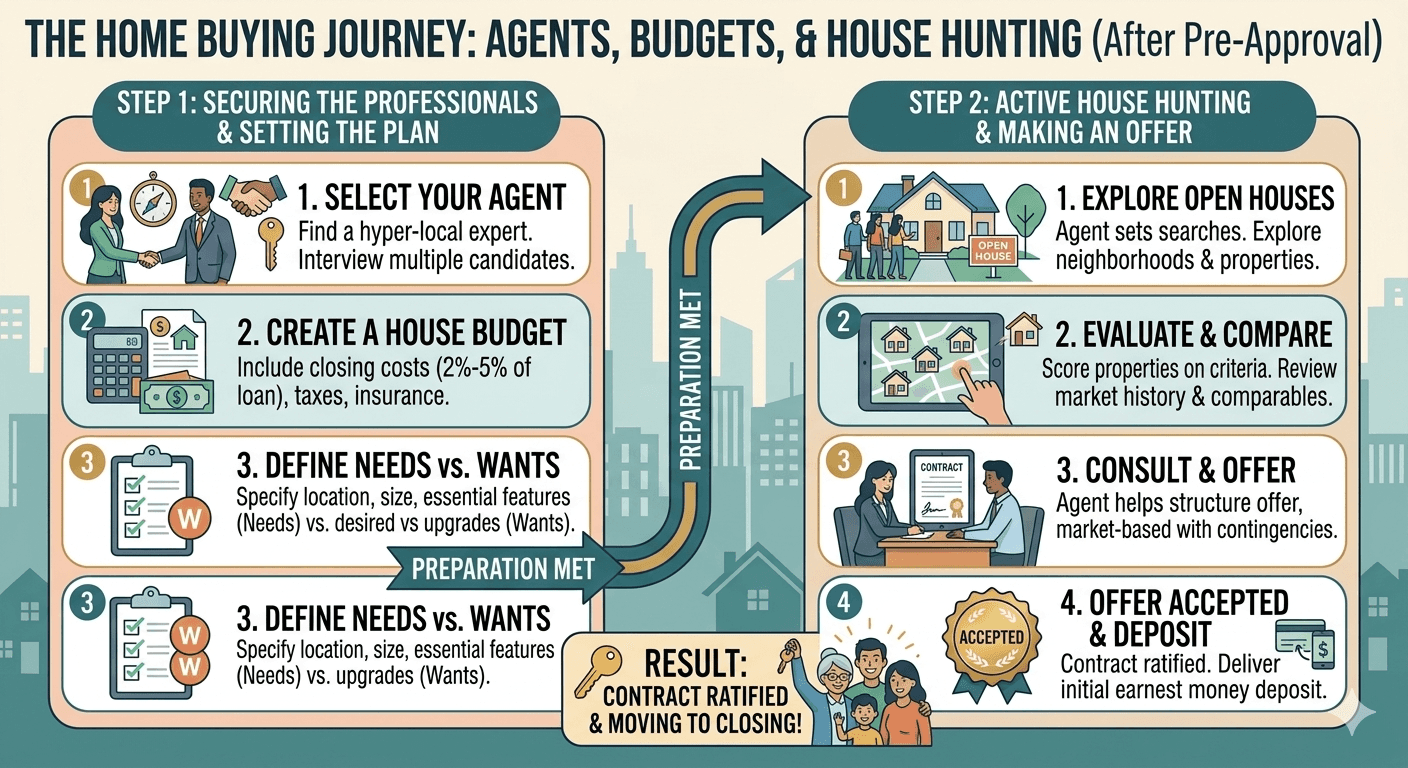
Step 3. Finding the Person in Your Corner — The Buyer Agent
American Deals Have Two Agents
A typical US transaction involves two agents: the Listing Agent, who represents the seller, and the Buyer Agent, who represents you. If you're used to one licensed broker standing between both sides, this split matters more than it looks, because each agent is legally obligated to fight for their own client alone, not to split the difference between everyone in the room.
Miss this, and mistakes follow. At an open house in La Crescenta, I once overheard a buyer tell the listing agent, "We could go up to $1.2M if we had to — we really need this school district, and we want to close before the school year starts." It sounds like friendly small talk. It was actually handing over the entire negotiation, because that agent's legal duty is getting the best deal for the seller, and "this buyer can pay more and is in a hurry" is exactly the information that duty feeds on.
What a Buyer Agent Actually Does for You
Finds listings that match your criteria and schedules showings
Analyzes recent comparable sales to advise your offer price
Writes and negotiates the offer on your behalf
Manages the inspection, appraisal, escrow timeline, and every deadline after you're under contract
For a first-time buyer, think of your agent as the navigation system for the whole journey.
How to Vet an Agent
Do they actively work in your target neighborhood? Even within LA, the Koreatown condo market and the South Bay single-family market behave like different worlds
Have they worked with first-time buyers?
Do they respond quickly and translate jargon into plain language?
If you need Korean, are they genuinely bilingual?
One tip from inside the business: the easiest revealing question to ask is "have you ever told a client not to buy a house?" An agent who can talk you out of a deal is an agent who puts clients ahead of commissions.
The 2024 Compensation Changes — the Written Agreement Comes First
It used to work like this: the seller paid a commission, part of it flowed to the buyer's agent, and buyers felt like their representation was essentially free. After the 2024 NAR, or National Association of Realtors, settlement, the rules changed, and the essentials come down to three things. Signing a written Buyer Representation Agreement before touring homes became the standard, a document stating what your agent does and what they're paid. Buyer agent compensation is now negotiated directly between you and your agent. And in practice, offers are still frequently structured so that the seller covers the buyer agent's fee anyway.
For buyers, the practical change is this: the money conversation now happens up front instead of staying invisible. Before signing, ask two questions — what is the fee, and what happens if the seller won't cover it? An agent who bristles at those questions has answered a third question for you.
Step 4. Setting Your Budget — The Number Your Lender Won't Mention
Approval Limit ≠ Your Budget
Your lender computes a maximum from paperwork alone. It knows nothing about your family's living costs, the kids' academy fees, help for your parents, or the annual flight home. Like the Irvine couple, set your budget below your approval limit — not "the amount you can buy," but "the amount you can live on and still save."
What Makes Up the Monthly Payment — PITI and Beyond
An American housing payment is more than principal and interest. The core four go by PITI, with two more depending on the property.
Item | Notes |
|---|---|
P&I (Principal & Interest) | Your mortgage payment. Fixed for the life of a 30-year fixed loan |
Property Tax | In California, Prop 13 keeps the base at 1% plus local add-ons — effective rates around 1.1–1.3% are common, but Mello-Roos districts can exceed 1.8% (examples) |
Homeowners Insurance | Required by your lender. Premiums have jumped in California's wildfire-affected areas |
HOA Dues | Condos, townhomes, some planned communities. Many houses have none |
PMI (Mortgage Insurance) | When your down payment is under 20% (see Part 1) |
Maintenance | Not monthly, but inevitable. Setting aside ~1% of the home's value per year is a common rule of thumb (example) |
Let's Run One Together (Example)
Take a $715,000 house, 20 percent down, 30-year fixed at an example rate of 6.4 percent. The loan comes to $572,000, with P&I around $3,580 a month. Add property tax at an assumed 1.15 percent effective rate, about $685 a month, plus insurance around $135, and with no HOA and no PMI, you land at roughly $4,400 a month, plus whatever you're setting aside for maintenance.
The same price in a Mello-Roos community would add hundreds more per month on top of that. That's why the habit worth building is re-running the monthly number for every listing, tax history and HOA included, rather than trusting the sticker price to tell you anything useful on its own. You'll find tax records on the listing page and the county Assessor's site, and your agent can pull exact figures on request.
Step 5. Searching — The Checklist Behind the Search Bar
Where Homes Are Listed
US listing data lives in the MLS, or Multiple Listing Service, an agents-only database, and Zillow, Redfin, and Realtor.com are simply the public windows into it. Compared to what many buyers are used to, the transparency here is remarkable — sale histories, tax records, past listing attempts, all public. The usual rhythm is browsing online yourself while your agent sets up a live MLS feed matched to your criteria in the background.
The Filters That Matter More Than the Filters
School district moves home prices in America more than almost any other single factor, but don't stop at the rating number — even within one city, elementary, middle, and high school assignments can split block by block, so verify the assigned schools by the exact address rather than the neighborhood name. Southern California, meanwhile, runs on cars, and your map app's "depart Tuesday 8 a.m." simulation is a far better guide than the raw mileage — one freeway's difference can mean thirty minutes each way. Size and layout obviously matter too — beds, baths, square footage.
New construction and older houses each come with their own tradeoffs. New builds mean fewer repairs but higher prices and possible Mello-Roos, while older houses give you more space per dollar but may carry roof, plumbing, and electrical projects waiting in the wings. There's no universal answer here — the real question is whether surprise repair bills fit your temperament and your reserves, not which option sounds better on paper.
A few more things worth checking before you fall for a listing:
HOA: look past the monthly amount to the rules (rental caps, pets, parking) and the association's finances. An underfunded HOA can hit owners with a Special Assessment down the road.
Insurability: in parts of California, wildfire-zone properties have become hard or expensive to insure. For houses near hillsides or canyons, get an insurance quote before you write the offer, not after.
The neighborhood itself: visit by day and by night, weekday and weekend. A street that's quiet on Saturday afternoon can be a parking battle on Tuesday evening.
Step 6. Touring Houses — What the Photos Don't Tell You
Open Houses and Private Showings
An Open House puts the home on public display, usually on weekends, no appointment needed, while a Private Showing means your agent books a dedicated visit where you can actually take your time. At open houses, keep the one rule from earlier close at hand: the agent hosting works for the seller. Your budget, your circumstances, your urgency — save all of it for your own agent.
What to Check During a Visit
The professional inspection comes after you're under contract, covered in Part 4, but big problems tend to leave visible traces well before that. Here's roughly the order I walk buyers through a house in: the roof first, checking for curled or missing shingles, since replacement is a big-ticket item; then the HVAC, its age and whether it actually runs, because a second floor without air conditioning in a Southern California summer is harder than it sounds; then plumbing, checking water pressure and leak stains under sinks; electrical, since certain older panels can be genuinely hard to insure; windows, watching for fogged double panes that signal a broken seal; and the foundation, where large cracks or doors that won't close can point to settling.
Beyond that, water stains on a ceiling or wall, or one oddly fresh patch of paint, are worth a second look, and so are chewed wood or sawdust-like frass, both common signs of termites in Southern California. Musty odors matter too, and so, oddly, does the opposite — heavy air freshener or candles can sometimes be covering for whatever the smell was meant to hide. And keep an eye out for unpermitted additions, like a garage conversion or a bolted-on room without permits, since those can haunt you later at insurance, resale, and appraisal alike.
After three or four houses, they all blur together, so photograph each one and leave yourself a one-line note. And even when you think this is the one, go back once more before you write the offer, ideally at a different time of day.
The House-Hunting Checklist
Talk to two or three buyer agent candidates (ask about fees and contract length)
Review and sign a Buyer Representation Agreement
Set a monthly-housing ceiling — "live and still save," not "maximum approved"
Check tax history, Mello-Roos, and HOA for every serious listing
Near hillsides or canyons? Get an insurance quote first
Verify assigned schools by exact address
At open houses: enjoy the tour, reveal nothing
Part 2 FAQ
Q1. Do I have to pay my Realtor? Since 2024, buyer agent compensation is set in a written agreement between you and your agent. In practice, offers are still frequently negotiated so the seller covers that fee. Before signing, confirm the fee amount and what happens if the seller won't pay it.
Q2. How do I check for Mello-Roos? Look for special assessments in the listing's tax history (listing page or the county Assessor's site), or ask your agent to pull the exact annual amount. For new construction in areas like Irvine or Eastvale, always check. Mello-Roos assessments often have an end date — ask how many years remain.
Q3. How long does the whole process take? The search itself varies (weeks to months), but from accepted offer to closing typically runs 30–45 days on a financed purchase. From financial checkup to keys, three to six months is a realistic overall window.
Q4. Can I buy without an agent? Legally, yes. For a first-time buyer, I don't recommend it. Offer paperwork, contingency management, and deadlines all carry your earnest money as the stake. The fee can feel expensive — until you compare it to what a negotiation mistake costs.
Q5. New construction or an older home? No universal answer. New builds trade higher prices (and possible Mello-Roos and HOA) for fewer repairs; older homes trade repair budgets for space and location. Ask yourself honestly: "How would I feel about a surprise $8,000 repair?" Your answer is your answer.
Coming Up Next
You've got your agent, your budget, and a home you love — now comes the real contest: the Offer. Part 3 covers what goes into an offer, the safety devices called earnest money and contingencies, how to compete when multiple offers land on the same house, and the escrow process that begins the moment a seller signs — including the wire fraud warning every buyer needs to hear.
Next: How to Buy a House in the US, Part 3 (link)
How Much Stuck? — The Part 2 Quiz (10 Questions)
Answers below. Seven or more right and you're ready for Part 3.
Q1. In a US transaction, the agent who represents the buyer is the:
(a) Listing Agent
(b) Buyer Agent
(c) Escrow Officer
B
The Buyer Agent. US deals typically have separate agents for each side
Q2.(T/F) Telling the listing agent at an open house your maximum budget and urgent timeline won't affect your negotiation.
F — The listing agent's duty is the best deal for the seller. That information will be used, and not in your favor.
Q3.Since 2024, the standard first step when working with a buyer agent is:
(a) A verbal agreement
(b) A written Buyer Representation Agreement
(c) An upfront retainer
B
A written agreement, signed before touring, stating services and compensation.
Q4. Which is NOT part of the monthly housing payment (PITI)?
(a) Principal & interest
(b) Property tax
(c) Car insurance
C
Car insurance isn't housing. PITI is principal & interest, taxes, and insurance — plus HOA, PMI, and maintenance as applicable.
Q5. What is the name of the special tax attached to certain newer California developments?
Mello-Roos — a special assessment funding infrastructure in newer development districts; it can raise your effective tax rate substantially.
Q6. In the Irvine story, the biggest gap between the spreadsheet and reality came from:
(a) Rising interest rates
(b) The effective tax rate due to Mello-Roos
(c) An HOA increase
B
The assumed 1.1% rate was actually in the 1.8% range with Mello-Roos — about $570 a month of difference.
Q7. (T/F) Buying at your lender's maximum approved amount is the most financially efficient move.
F — The approval limit is a paperwork maximum. Budget below it, at a monthly number that leaves room to live and save.
Q8. What is the agents-only database that feeds Zillow and Redfin?
The MLS (Multiple Listing Service).
Q9. (T/F) For homes near hillsides or canyons in California, it's wise to get a homeowners insurance quote before writing an offer.
T — Wildfire-zone insurance has become difficult or costly in parts of California; quote first, offer second.
Q10. Which of these can be a "something's being covered up" signal during a home tour?
(a) Freshly mowed grass
(b) Heavy air freshener and one oddly fresh patch of paint
(c) Open curtains
B
Both can mask moisture or odor problems. Flag them for the inspection.
About the author: I'm a licensed real estate agent practicing in California. This series draws on years of working alongside first-time buyers in the field, written for readers navigating their first American home purchase.
This article is for general informational purposes only and is not legal, tax, or lending advice. All figures are illustrative examples; actual terms vary with your financial profile, loan program, state, and timing. Case details have been adjusted to protect privacy.
Back to Magazine