First Home buyer
Don't open Zillow yet. Real failure stories and comeback cases from the California field teach you the true first step of buying your first home in America — checking your finances, understanding DTI and credit scores, and getting pre-approved.
How to Buy a House in the US, Part 1 — Why You Should Open Your Bank Statement Before You Open Zillow
[How to Buy a House in the US — The Series] Part 1: Financial Prep & Pre-Approval (you are here) Part 2: Finding an Agent, Setting a Budget, Searching for Homes (link) Part 3: Writing an Offer, Negotiating, and Escrow (link) Part 4: Inspection, Appraisal, and Underwriting (link) Part 5: Closing, Moving In, and the Full Cost Breakdown (link) ★ The Whole Process at a Glance (link)
If You're Short on Time
Everything in this article comes down to three points.
Buying a house in the US doesn't start with a search. It starts with a financial checkup, because your mortgage capacity is effectively what decides the price range you can shop in.
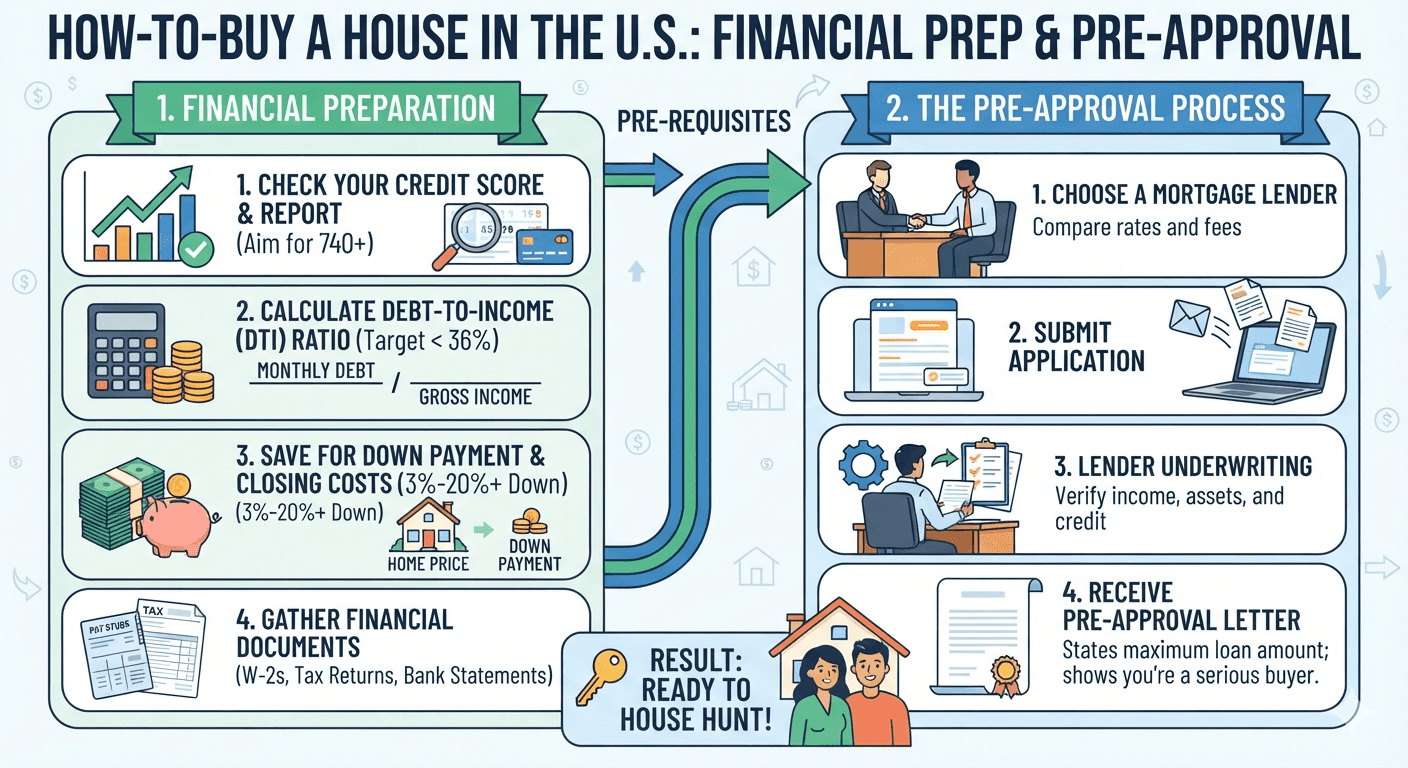
There are four things worth checking before you look at a single listing — your verifiable income, your credit score, your DTI, or debt-to-income ratio, and your down payment alongside an actual emergency fund — and skip any one of them, then start touring homes anyway, and you'll likely end up where I've watched plenty of buyers end up: heartbroken and out of time.
Once you're serious about looking, get pre-approved, ideally by two or three lenders rather than just one, because that single letter changes how sellers treat your offer before you've even made one.
Browsing Zillow Is Fun. The Problem Is What Comes Next
Most people, when they first decide to buy a house in the US, start by opening Zillow. And honestly, browsing American houses is a genuine pleasure — you flip through photos thinking, if I lived here, I'd redo the kitchen like this, put a deck in the backyard. Then one day you find a house you truly love, and you run straight into the question everyone eventually asks: wait, what do I actually need to do to buy this?
The real order, though, runs the other way. Buying a house in the US starts not with finding one, but with taking an honest look at your own finances. If you're used to how things work back home, where buyers often set a rough budget off their existing savings and then go house hunting, this can feel backwards. But in the US, the overwhelming majority of buyers finance their purchase with a mortgage, and how much mortgage you can get is what determines the price range of houses you're actually shopping in.
Let me show you why this order matters, starting with something I watched happen firsthand here in California.
Before we begin: every rate, cost, and ratio in this article is an example, meant to help you follow the concepts rather than serve as a quote. Actual terms vary with your credit profile, loan program, and the state you live in, and for final decisions you should talk to a loan officer or tax professional. The stories here are drawn from real consultations, with details adjusted to protect privacy.
That House in Fullerton — What Happens When You Do Things in Reverse
A few springs ago, at an open house in Fullerton, I met a couple in their thirties. Both had steady jobs, and they'd completely fallen for a single-family house listed at $868,000 — good school district, a real backyard, Korean grocery stores nearby. When they told me they wanted to write an offer, I asked one question first: have you talked to a lender yet?
They hadn't. I connected them with a loan officer that week, and the results stung. The husband's car lease payment, stacked on top of the wife's student loans, pushed their DTI, which I'll explain below, to 51 percent, and approval at that price point simply wasn't going to happen. The house went to another buyer that same weekend.
If the story ended there, it would just be a cautionary tale. But here's the twist: instead of giving up, the couple made a six-month plan. When the car lease ended, they replaced it with a modest used car, and they paid down part of the student loan balance to shrink the monthly payment. Early the following year, they bought a house in the same neighborhood for $815,000 — in better condition than the one they'd lost — walking into escrow calmly with a pre-approval letter in hand, and at a better rate than the one they'd been quoted the first time around.
Do things in reverse order, and you get your heart broken. Do them in order, and the same people end up buying a house in the same neighborhood. That's why this financial-prep piece sits at the front of the series.
Step 1. Before You Look at Houses, Look at Your Finances
If you don't know your own buying power, two problems tend to follow. You waste time falling for houses outside your budget, or, just as often, you hesitate on a house you could actually afford and lose it to someone with more confidence. There's a third problem too: without preparation, you start second-guessing whether you're even allowed to make an offer. Prepare well, though, and the story changes completely — this step costs almost nothing, and it becomes the reference point for everything that follows.
How Does a Lender See My Income? — Income
What a lender looks for is stable, verifiable income. The key word there is verifiable — the standard isn't what you actually earn, it's what you can prove on paper, and the two aren't always the same number.
W-2 employees: you verify income with your W-2, the annual wage statement your employer issues, and recent pay stubs. This is the simplest case by far.
Self-employed: lenders typically underwrite off your last two years of tax returns, and this is where many people get caught. One restaurant owner I worked with in LA had a genuinely thriving business, yet his loan amount came back far lower than he expected. He'd been maximizing deductions for years, so his net income on paper sat well below what he actually took home. If you're self-employed and planning to buy, it's worth coordinating your tax strategy with your CPA about two years out, because tax savings and loan capacity sit on opposite ends of a seesaw.
Commission and bonus income: if commissions make up a large share of your income, lenders usually want to see about a two-year history. Real estate agents like me, and most sales roles generally, fall into this bucket.
One Number That Moves Your Rate — Credit Score
Your credit score in the US, typically a FICO score running 300 to 850, is one of the biggest factors in your mortgage rate. Roughly speaking, scores in the 740s and above position you for the better rates, while anything below 620 starts to thin out your loan options considerably. And your score touches far more than your mortgage — car insurance premiums, apartment applications, all of it — so it's worth maintaining as a matter of everyday life here, not just something you think about once, right before you buy. You can check it right now through your credit card app or a free monitoring service.
Here's a comeback story worth knowing. A nurse in Cerritos, four years into her life in the US, had a thin credit file and a score in the 690s. She came to her consultation nearly resigned, asking, with my score, there's no way, right? Her loan officer took a look and found she qualified for an FHA loan, a government-backed program, with 3.5 percent down. She lives in a townhome in La Mirada today. The most expensive mistake, in my experience, is deciding on your own that your score disqualifies you and walking away before anyone's actually run the numbers.
The One Term You Must Remember — Existing Debt and DTI
Car payments, student loans, revolving credit card balances — any required monthly payment shrinks your loan capacity, and the concept lenders use to measure that is DTI, or debt-to-income ratio. If you take one acronym away from this whole series, make it this one.
DTI = (all monthly debt payments + projected housing payment) ÷ gross monthly income (pre-tax)
Say your gross monthly income is $9,600, your car payment is $520, and your projected housing payment comes to $3,850. Your DTI works out to about 45.5 percent. Programs vary, but many lenders underwrite somewhere inside a 43 to 50 percent range, so this example sits right at the edge — exact thresholds differ by product and lender, but it's close enough to matter. This is precisely the number that tripped up the Fullerton couple, and until you've lived it, it's genuinely hard to appreciate how many percentage points a single car lease can add.
How DTI translates into the monthly housing payment you can actually live with, with the math laid out, is covered in Part 2.
It Doesn't Have to Be 20 Percent — Down Payment
Your down payment is the portion of the price you pay from your own funds rather than the loan. You've probably heard that you need 20 percent down in the US, and plenty of buyers do put down that much, but it isn't a requirement. Conventional loans can go as low as 3 to 5 percent down depending on your profile, and FHA loans as low as 3.5 percent.
Put down less than 20 percent, though, and you'll generally pay PMI, or private mortgage insurance, which adds a bit to your monthly payment. PMI isn't a penalty so much as insurance that offsets the lender's risk when the down payment is small, and once you've built enough equity in the house, you can request to have it removed. So don't conclude that you're not ready just because you haven't saved 20 percent yet. In markets like California, where prices climbed quickly, I've watched more than a few buyers spend years saving toward 20 percent while home prices rose faster than their savings did. Whether buying sooner with less down beats waiting and saving more depends entirely on your situation, and that's exactly the kind of question worth modeling out with a lender rather than guessing at yourself.
Buying the House Is Only the Beginning — Emergency Fund
Pouring every last dollar of savings into the down payment is dangerous. After you buy, the surprise repair bills, moving costs, and furniture purchases arrive in a steady line, and a water heater dying right after closing isn't a sitcom plot — it really happens, and in California, replacing one can run around $2,000 depending on the unit and installer, as an example. Keep several months of living expenses untouched past closing day. Buying a house is the biggest check most of us ever write, and an emergency fund isn't optional here — it's part of the equipment.
One Rule to Follow From This Point Forward
From the moment you decide to buy, don't make any major financial moves. A new car loan, a big credit card purchase, a flurry of new credit applications — all of it can shake your credit score and your DTI, and a new car to match the new house gets the order exactly backwards. This rule stays in force until the day you close, and you'll see why in vivid detail in the underwriting section of Part 4.
Step 2. Talking to Mortgage Lenders
What Is a Mortgage Lender? — It's Not Just Banks
A lender is the institution that finances your purchase, playing the role a bank plays when you'd get a home loan back in Korea — except in the US, banks are only one option among several.
Type | What It Is |
|---|---|
Bank | A retail bank. Some offer rate discounts to existing customers |
Credit Union | A nonprofit financial institution owned by its members — similar to Korea's credit cooperatives. Terms can be surprisingly competitive |
Mortgage Broker | An intermediary who shops multiple lenders' products and matches you with the right loan. Lets you compare several lenders through one point of contact |
Beyond these, non-bank mortgage companies make up a large share of the market too. And a practical note for readers in Southern California: the Korean-American community here has many loan officers who work in Korean, so if English paperwork feels daunting, that's worth exploring first.
What Comparison Shopping Is Actually Worth — Let's Run the Numbers
Aren't the rates all about the same, people ask me constantly. They are not. I've seen one buyer, same profile, same file, come back with quotes of 6.625 percent from lender A, 6.49 percent from lender B, and 6.375 percent from lender C, as an example. On a $610,000 loan, the difference between 6.625 and 6.375 percent comes to roughly $100 a month, which sounds minor until you multiply it across thirty years and watch the interest gap widen into tens of thousands of dollars. For the price of a few phone calls and some paperwork, that's a remarkable return.
Pre-Qualification vs. Pre-Approval — Similar Names, Very Different Weight
This is the distinction first-time buyers mix up most.
Pre-Qualification: a rough estimate — you could probably borrow around this much — based on income and debt figures you state yourself. No documents get verified, which is why you can get one in minutes, and why it carries almost no weight when it counts.
Pre-Approval: the lender actually reviews your documents, income verification, bank statements, a credit check, and issues a written commitment saying we will lend up to this amount. This is the one sellers and listing agents trust.
A rough analogy: Pre-Qualification is checking your estimated limit in a banking app, while Pre-Approval is sitting at the branch desk, handing over your documents, and passing the preliminary review.
Now look at it from the seller's side for a moment. When I represent a listing, there are weekends when multiple offers land at once, and picture two offers with similar terms — one with a solid pre-approval letter attached, one without. You don't need to ask which one the seller wants to sign. A financing collapse mid-escrow costs a seller weeks of lost time, and sellers know it.
Documents to Gather (Typical Examples)
Last two years of W-2s or tax returns
Most recent one to two months of pay stubs
Most recent two to three months of bank statements
Photo ID and Social Security number (SSN)
Statements for other assets (investment accounts, retirement accounts)
Collect everything into a single folder before you start. One set of documents lets you request quotes from two or three lenders at the same time, which makes comparison shopping dramatically faster than doing it one lender at a time.
"Won't Multiple Credit Pulls Hurt My Score?"
This worry alone talks a surprising number of buyers out of comparison shopping. Mortgage-related credit inquiries made within a short window, typically around two weeks, are generally treated as a single inquiry, so rate shopping itself rarely does meaningful damage to your score. Don't let this fear cost you a comparison worth tens of thousands of dollars. Pre-approval itself is free in most cases, though some lenders charge a small credit check fee.
The Getting-Ready Checklist — Things You Can Do Today
Check your credit score (card issuer app or free monitoring service)
List every monthly debt payment (car, student loans, cards)
Estimate your DTI with the formula above
Write down your down payment budget and emergency fund — separately
If self-employed: pull your last two years of returns and check your net income
Start a loan document folder (W-2s, pay stubs, bank statements)
Book consultations with two or three lenders
Part 1 FAQ
Q1. How much cash do I actually need to buy a house in the US? Three buckets: the down payment (3–20%+ of the price), closing costs (roughly 2–5% of the price, as an example), and reserves (moving, repairs, emergency fund). For a $520,000 home with 10% down, that's $52,000 down + roughly $11,000–26,000 in closing costs + reserves. (Examples only — figures vary by region and terms. The full cost breakdown is in Part 5.)
Q2. Do I really need 20% down? No. Many buyers do put 20% down, but conventional loans can allow 3–5% down depending on your profile, and FHA loans 3.5%. Below 20% you'll generally pay PMI, which you can request to remove once you've built enough equity.
Q3. Can I buy with a low credit score? Possibly. As with the Cerritos nurse above, FHA loans can accommodate lower scores. But a lower score means a higher rate — the same house simply costs more each month. If your score is borderline, a few months of credit repair before buying may pay for itself. Don't decide alone; run the scenarios with a lender.
Q4. Do I need a pre-approval just to look at homes? It's not legally required, and open houses are open to everyone. But for private showings and certainly for offers, it's effectively necessary. The right time to get one is the moment you start looking seriously.
Q5. Can I buy a home if I'm not a US citizen? Yes. Green card holders buy with mortgages routinely, as do many work visa holders — and purchasing as a foreign national is possible too. Loan options and terms vary with visa type and US credit history, so work with a lender experienced in these cases.
Coming Up Next
With your finances checked and your pre-approval in hand, the next step is finding the professional who will represent you — and setting your real budget. Part 2 covers how to find a Buyer Agent, how agent compensation changed after 2024, and the difference your lender will never volunteer: why "the amount you're approved for" and "the amount you can comfortably afford" are two very different numbers.
Next: How to Buy a House in the US, Part 2 (link)
How Much Stuck? — The Part 1 Quiz (10 Questions)
Answers are below the quiz. Get 7 or more right, and you're ready for Part 2.
Q.1 What's the first step to buying a home in the US?
(a) Searching Zillow
(b) Checking your financial situation
(c) Visiting open houses
B
Your mortgage capacity is your price range, so the financial checkup always comes first.
Q.2 (T/F) If you're self-employed and business is booming, a low income on your tax returns won't affect your loan amount.
F : Lenders look at verifiable income, meaning your tax returns. Tax savings and loan capacity are a seesaw.
Q3. The DTI formula is:
(a) total assets ÷ total debt
(b) (monthly debt payments + projected housing payment) ÷ gross monthly income
(c) annual salary ÷ home price
B
(monthly debt payments + projected housing payment) ÷ gross monthly income
Q4. Gross monthly income $9,600, car payment $520, projected housing payment $3,850. The DTI is roughly:
(a) ~32%
(b) ~45%
(c) ~58%
B
($520 + $3,850) ÷ $9,600 ≈ 45.5%, right at the edge of many lenders' typical range (roughly 43–50%).
Q5. (T/F) A 20% down payment is legally required to buy a home in the US.
F : Conventional loans can start at 3–5% down and FHA at 3.5%. Twenty percent is a custom, not a law.
Q6. What typically gets added when your down payment is under 20%?
(a) PMI (mortgage insurance)
(b) A property tax surcharge
(c) Mandatory HOA membership
A
PMI. You can request removal once you've built enough equity.
Q7. Between Pre-Qualification and Pre-Approval, which one involves the lender verifying your actual documents and issuing a written letter?
Pre-Approval — issued in writing after document verification.
Q8. When sellers and listing agents review offers, which do they trust?
(a) A Pre-Qualification
(b) A Pre-Approval
(c) The buyer's verbal promise
B
Sellers know what a mid-escrow financing collapse costs them, so they trust offers backed by a pre-approval
Q9. (T/F) Mortgage credit inquiries made within a short window (typically about two weeks) are generally counted as a single inquiry — so there's no need to fear comparing lenders.
T — Rate shopping rarely does meaningful damage to your score.
Q10. Which of these is NOT something to avoid between deciding to buy and closing day?
(a) Financing a new car
(b) A large credit card purchase
(c) Organizing your loan documents into a folder ahead of time
C
Preparing documents early is encouraged. The other two shake your DTI and credit score and put your loan at risk.
About the author: I'm a licensed real estate agent practicing in California. This series draws on years of working alongside first-time buyers in the field, written for readers navigating their first American home purchase.
This article is for general informational purposes only and is not legal, tax, or lending advice. All figures are illustrative examples; actual terms vary with your financial profile, loan program, state, and timing. Case details have been adjusted to protect privacy.
Back to Magazine