First Home Buyer
A young couple waived their appraisal contingency to win a bidding war — then the appraisal came in $33,000 short. A real California story behind how to write a competitive offer, what earnest money and contingencies actually protect, how sellers really decide between offers, and how to avoid wire fraud during escrow.
How to Buy a House in the US, Part 3 — One Piece of Paper Can Save Your Deposit, or Cost It
[How to Buy a House in the US — The Series] Part 1: Financial Prep & Pre-Approval (link) Part 2: Finding an Agent, Setting a Budget, Searching for Homes (link) Part 3: Writing an Offer, Negotiating, and Escrow (you are here) Part 4: Inspection, Appraisal, and Underwriting (link) Part 5: Closing, Moving In, and the Full Cost Breakdown (link) ★ The Whole Process at a Glance (link)
If You're Short on Time
An offer is a document, not a conversation. The moment the seller signs it, that offer becomes your contract — so every term matters, not just the price.
Contingencies are a buyer's seatbelt. Unbuckle it to win a bidding war, and if something goes wrong, you absorb the full impact alone. The question isn't "will waiving this help me win?" It's "can I handle it if I win and things go sideways?"
Once a contract is signed, escrow — a neutral third-party system — holds the money and paperwork. The biggest risk during this window usually isn't the inspection. It's wire fraud.
Let's walk through why, with a real case.
Before we begin: The numbers and timelines here are examples included to help you understand the concepts. Actual terms and practices vary by state, region, and market conditions. This story is drawn from a real transaction, reconstructed to protect privacy.
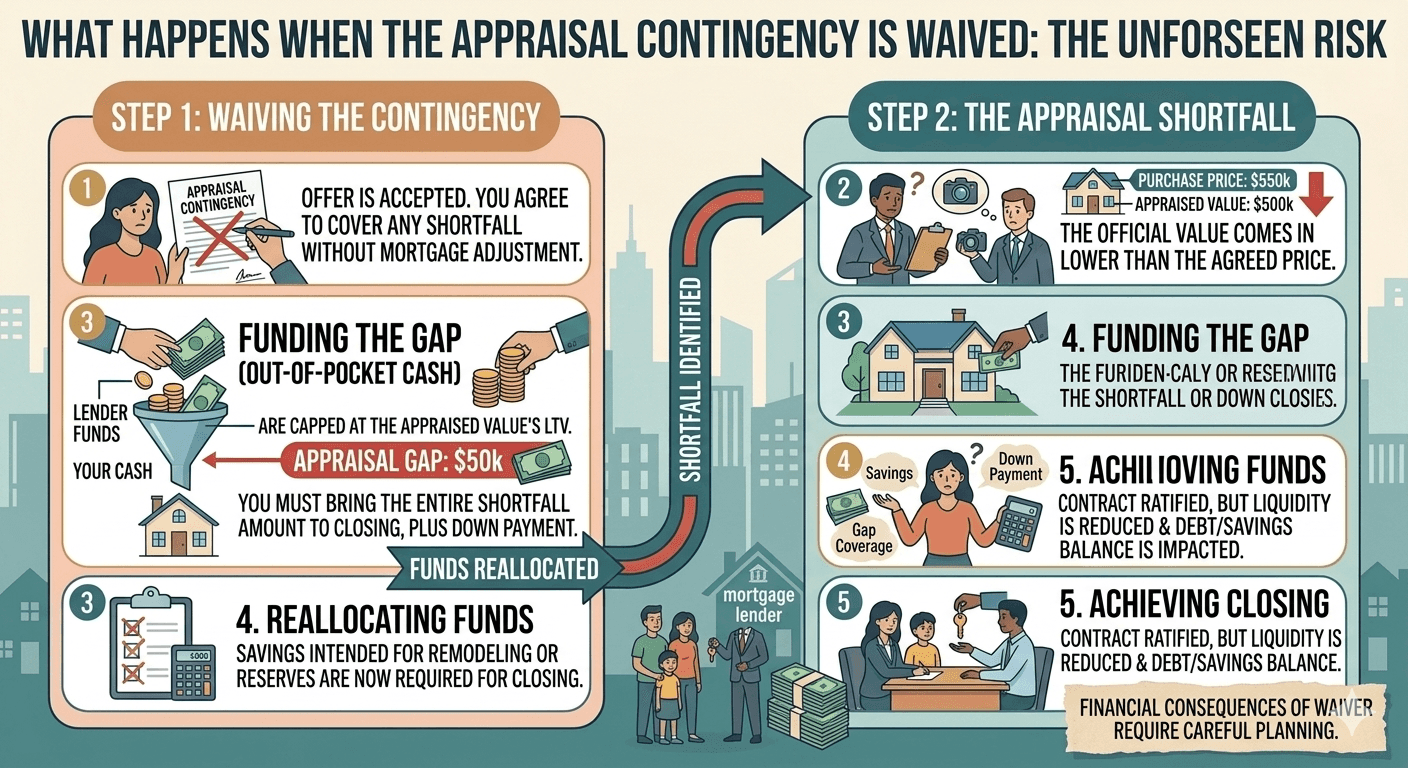
The Buyer Who Waived Their Appraisal Contingency — And What Happened Six Weeks Later
Say you've done your homework from Part 1 and Part 2, set your budget, and finally found a house you love. Then five other offers show up on the same property that same weekend. This happens constantly, and I've watched it play out in person more than once. Let me tell you about a young couple who faced exactly this situation on a house listed at $795,000.
Five offers came in. The couple wanted this house badly, and another agent had told them that dropping the appraisal contingency would make their offer stand out, meaning they'd have no built-in exit if the appraisal came back low. They removed it. Their offer got accepted.
Six weeks later, the appraisal came back at $762,000, not $795,000. In a scenario like this, the lender bases the loan on the lower appraised value, so on an 80 percent loan-to-value structure, the buyers suddenly needed roughly $26,000 in additional cash just to close, as illustrative math. Had the appraisal contingency still been in place, this is exactly the moment they could have renegotiated or walked away with their deposit intact. But they'd already signed that protection away, and they ended up covering the gap with wedding gift money and help from their parents.
Here's the twist that isn't really much of a twist: they still live in that house today, and by most measures, it worked out fine. But the reason I tell this story isn't the happy ending. When they made that decision, they had never actually worked out what would happen if they couldn't find that extra $26,000 — they simply got lucky that they could. Waiving a contingency isn't automatically a mistake. Waiving one without knowing what you're giving up is.
Step 7. Writing an Offer — Six Levers, Not Just One
An Offer Is a Document, Not a Conversation
An offer is a formal written proposal: I will buy this house under these terms. The moment the seller signs, that offer becomes the Purchase Agreement, which is why an offer isn't really about price alone — it's a package of interlocking terms that all move together.
What Goes Into an Offer
Your Purchase Price gets set with your agent's help, using recent comparable sales to land on the right number, and offering above the listing price can feel strange the first time, though in competitive markets it's a common, sometimes necessary, strategy. Your Earnest Money Deposit, or EMD, is the money that signals you're serious, and while amounts vary by region and market, 1 to 3 percent of the purchase price is common as an example — on a $782,000 house, that lands around $18,000. This money doesn't go to the seller directly; escrow holds it, and if the deal closes normally, it's applied toward your down payment.
Your financing terms matter too — whether you're paying cash or financing, and how much, since sellers generally prefer cash offers because there's no financing risk, which is exactly why a strong pre-approval letter makes a financed offer noticeably more competitive. Then there's your closing date, your target completion date, with financed deals commonly running 30 to 45 days, and finally your contingencies, which deserve their own section below, along with any seller credits or repair requests you want built into the offer itself.
Contingencies — Three Seatbelts
A contingency is a conditional clause that lets you walk away without losing your deposit if a specific condition isn't met.
Contingency | What It Protects |
|---|---|
Inspection Contingency | Renegotiate or cancel if the home's condition isn't acceptable |
Appraisal Contingency | Renegotiate or cancel if the appraised value comes in below the purchase price |
Loan Contingency | Cancel and keep your deposit if your financing falls through |
The one the couple above gave up was the second: the appraisal contingency.
How to Win a Bidding War — And How to Know If You Should
Popular houses attract multiple offers, and beyond raising the price, you can increase your earnest money to signal seriousness, match the seller's preferred closing date, or shorten your contingency windows. Waiving a contingency entirely sits on that same list of levers, but it doesn't belong in the same category as the others, and treating it like just another negotiating chip is where buyers get into trouble.
The question I always put to buyers is this: if the appraisal comes in $50,000 low, can you write that check today, comfortably? If the answer is a confident yes, waiving that contingency is worth considering. If the answer is no, or I'm not sure, that contingency isn't a bargaining chip — it's a condition you need to keep. Losing a bidding war is a disappointment. Winning one you can't actually afford is a much worse outcome, and it's the one buyers regret longer.
Step 8. Seller Review and Negotiation — Price Isn't Everything
A seller who receives your offer has three options: accept it, send back a counter offer with revised terms, or reject it outright. When multiple buyers are competing, sellers sometimes issue a multiple counter offer, sending revised terms to several buyers at once and letting the strongest response win.
Negotiation isn't only about price, either. In one case, two competing offers came in at nearly identical prices, but one buyer was able to match the seller's preferred closing date exactly, timed around the start of the school year for the seller's own kids, and that buyer got the house. A $5,000 price gap mattered less to the seller than being able to move on schedule. Seller credits, included appliances, and the length of your contingency periods are all negotiating tools, and sometimes they matter more than the number at the top of the page.
Step 9. Contract Accepted — Escrow Begins
What Escrow Is — and Why Money Doesn't Go Straight to the Seller
The moment both sides sign, the transaction enters escrow, a neutral third-party system that holds and manages money and documents on behalf of both buyer and seller. Neither the deposit nor the final funds go directly to the seller — everything routes through an escrow account, released only once every contractual condition is satisfied and ownership is ready to transfer.
In California and other Western states, an escrow or title company typically runs this process, while in many Eastern states, an attorney handles the closing instead. Either way, the function is the same: verifying that every term of the contract is met, and managing the flow of money and paperwork between two parties who, in most cases, never actually meet.
What Happens During This Window
You wire your earnest money into escrow, usually within a few days of signing, with the exact deadline spelled out in the contract. The title company begins a title search, checking for hidden liens, unpaid taxes, or ownership disputes, while the clocks start running on your inspection, appraisal, and loan approval deadlines all at once.
The Real Risk of Escrow Isn't the Inspection — It's Your Inbox
This is the part I want to emphasize most. Most first-time buyers worry about the inspection report or the appraisal number, but the single most painful incident I've personally witnessed happened somewhere else entirely. A buyer, just days from closing, received an email saying the wiring instructions had changed. It looked completely legitimate, right down to the escrow company letterhead and matching format. Without a confirmation call, the buyer wired over $190,000 in down payment funds to that new account, and the money vanished within hours, essentially untraceable.
This is a real and common scam: criminals compromise or spoof an email account tied to the transaction, impersonate one of the parties, and use the pressure of an approaching closing date to redirect a wire to a fraudulent account. It happens often enough nationwide to be one of the most costly risks in the entire process. The rule is simple — before you wire anything, call the escrow company using a phone number you obtained independently at the start of the transaction, never a number pulled from the email itself, and verbally confirm the account. It feels like an unnecessary extra step. That one phone call is what protects years of savings.
Contract Deadlines Are Legally Binding
Something like a 17-day inspection contingency isn't a suggestion — miss that window and the associated right can disappear entirely. Your agent tracks these dates, but it's worth marking the key ones on your own calendar too, just in case.
The Offer-and-Escrow Checklist
Go through every contingency in your offer, one by one, with your agent
Answer honestly: "If the appraisal comes in low, how much extra cash could I actually produce?"
Confirm your earnest money wire deadline and put it on your calendar
Save the escrow company's official main phone number at the very start of the transaction
Never trust wiring instructions received by email at face value — always verify by phone
Log every inspection, appraisal, and loan-approval deadline on your calendar
Part 3 FAQ
Q1. Can I get my earnest money back? If you cancel within a contingency period for a covered reason — inspection findings, a low appraisal, financing falling through — you typically get it back. If you cancel after removing all contingencies simply because you changed your mind, you can lose it. That's exactly why removing a contingency deserves the kind of worst-case math the couple above skipped.
Q2. Can I offer below the listing price? Yes. Results depend heavily on the market. In a buyer's market with more inventory, it can work; in a competitive seller's market, offers below list often lose to offers at or above it.
Q3. Can a seller sell to someone else after accepting my offer? Once both sides sign, the home typically goes "Pending" and comes off the market. Unless the buyer cancels for a contingency reason, the seller can't unilaterally sell to another buyer.
Q4. If I waive a contingency, can I really not back out? Correct — backing out for a reason tied to a contingency you waived, while keeping your deposit, becomes very difficult. That's why the decision to waive shouldn't be based on "how likely am I to win," but on "can I absorb the worst case if I do?"
Coming Up Next
An accepted offer isn't the finish line. What follows is a 30- to 45-day window that answers three questions: Is this house actually in good shape? Is it worth what you're paying? And will your loan really come through? Part 4 covers the home inspection, the appraisal, and mortgage underwriting — including another buyer's very different way of handling a low appraisal.
Next: How to Buy a House in the US, Part 4 (link)
How Much Stuck? — The Part 3 Quiz (10 Questions)
Answers below. Get 7 or more right and you're ready for Part 4.
An offer becomes a Purchase Agreement at what point?
(a) When the buyer writes it
(b) When the seller signs it
(c) When escrow opens
B
The offer becomes a contract the moment the seller signs it.
Q2. Who holds the earnest money deposit?
(a) The seller
(b) The buyer's agent
(c) Escrow, a neutral third party
C
Earnest money is held by escrow, not handed directly to the seller.
Q3. Which contingency did the couple in this story waive?
(a) Inspection contingency
(b) Appraisal contingency
(c) Loan contingency
B
The appraisal contingency. Its absence meant the buyers had to cover the appraisal gap in cash, with no built-in exit.
Q4. (T/F) If the appraisal comes in below the purchase price, the lender will still base the loan amount on the original purchase price.
F — Lenders base the loan on whichever is lower: the purchase price or the appraised value.
Q5. Which is NOT one of a seller's options when reviewing an offer?
(a) Accept
(b) Counter offer
(c) Request escrow be canceled
C
A seller's real options are accept, counter, or reject.
Q6. In the negotiation example, what mattered more to the seller than a $5,000 price gap?
(a) The buyer's deposit amount
(b) Matching the seller's preferred closing date
(c) The buyer's agent's reputation
B
Matching the preferred closing date outweighed a modest price difference.
Q7. (T/F) If you get an email saying the wiring instructions changed, it's safe to call the phone number listed in that email to confirm.
F — Never use a phone number from the email itself. Call the number you obtained independently at the start of the transaction.
Q8. What's the most important question when deciding whether to waive a contingency?
(a) "Can I win this bidding war?"
(b) "Can I handle the worst case if I waive it?"
(c) "Did other buyers waive theirs too?"
B
The real question is whether you can absorb the worst case, not whether waiving helps you win.
Q9. (T/F) Once a home goes "Pending," the seller can still switch to a better offer that comes in later, even without a contingency-based cancellation from the current buyer.
F — Once pending, a seller can't unilaterally switch to another offer unless the current buyer cancels for a contingency reason.
Q10. What happens when a contract deadline, like an inspection contingency window, passes unaddressed?
(a) It automatically extends
(b) The associated right can disappear
(c) Nothing changes
B
Contract dates are legally binding; missing one can forfeit the associated right.
About the author: I'm a licensed real estate agent practicing in California. This series draws on years of working alongside first-time buyers in the field, written for readers navigating their first American home purchase.
This article is for general informational purposes only and is not legal, tax, or lending advice. All figures are illustrative examples; actual terms vary with your financial profile, loan program, state, and timing. Case details have been adjusted to protect privacy.
Back to Magazine