Home Owner
What a general home inspector checks, what they don't, and why California termites, especially the drywood kind, need a separate licensed inspection before you close.
NITU Path, Chapter 4: Make Your Move.
In short: A general home inspection and a termite inspection are two different reports, done by two different licensed professionals, and California treats them separately for a reason. The general inspector checks the roof, foundation, electrical panel, plumbing, and systems. A separate structural pest inspector checks for termites, dry rot, and the conditions that invite them, and files a report with Section 1 findings (active problems) and Section 2 findings (future risk). Southern California's dry climate makes drywood termites a real, distinct concern here, not just a generic pest-control upsell. Budget for both, and start the pest inspection early. Your contingency window is shorter than it feels.
The inspector spends twenty minutes in the attic before saying anything. Flashlight moving across the rafters, tapping a beam here, checking a vent there. Downstairs, someone else is quietly worried about what that silence means. It usually means nothing dramatic. It means the inspector is doing the job carefully, which is exactly what a buyer is paying for.
That inspection, and a second one most buyers don't think about until their agent brings it up, are what stand between an accepted offer and a house that's actually yours. Here's what each one actually covers, and where they don't overlap.

What a General Home Inspector Actually Covers
The big structural and mechanical systems come first. Roof condition, foundation cracks or settling, the electrical panel, plumbing, HVAC, and water heater installation all get checked, along with attic and crawlspace access where it exists. A general inspection typically runs $511 to $694 for an average California home, scaling up with square footage, roughly $602 for 1,500 square feet up to around $1,059 for 4,000 square feet.
Older electrical panels get particular attention. Zinsco and Federal Pacific Electric panels, commonly installed in homes built between the 1950s and 1980s, are a known fire risk. Their breakers can fail to trip during an overload, and Zinsco's aluminum bus bars are prone to corrosion and arcing. Neither brand is banned outright, but a lot of inspectors will flag one on sight, and a lot of insurers will ask for it to be replaced before binding a policy. Replacement typically runs $1,500 to $5,000 depending on panel size and any additional wiring work.
Water heater strapping is a California-specific check. State law (Health and Safety Code, Article 8) requires water heaters to be seismically strapped to resist falling during an earthquake, and it's one of the more common items a general inspector flags on older homes that were never updated. We cover what to check the moment you close, water heater strapping included, in new homeowner checklist: what to do after closing.
None of this requires a state license in California. Unlike a lot of other states, California doesn't license general home inspectors. There's no state exam, no state board overseeing complaints. What exists instead is voluntary certification through groups like CREIA (the California Real Estate Inspection Association), ASHI (the American Society of Home Inspectors), or InterNACHI. Before hiring one, it's worth asking directly which of these they belong to, whether they carry errors-and-omissions insurance, and whether they'll walk the property with you afterward rather than just emailing a PDF.
Termites Are Their Own Inspection, Not an Add-On
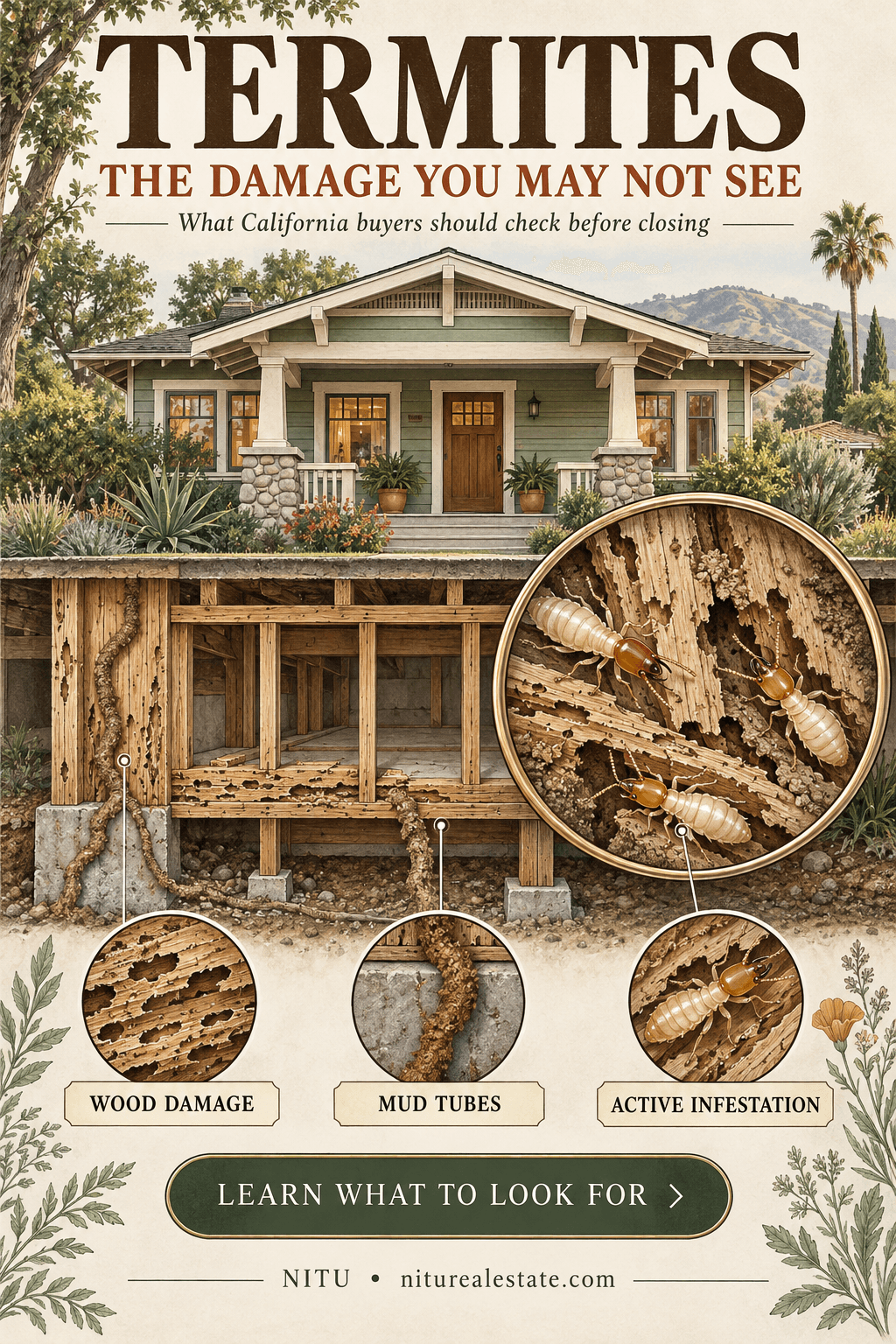
Here's the part that surprises a lot of first-time buyers: the general home inspector usually isn't the one checking for termites. Termite and wood-destroying pest inspections in California are done by a separate, state-licensed structural pest control company, regulated by the Structural Pest Control Board, and they produce their own report, not a section of the general inspection.
Southern California's climate makes this a real issue, not boilerplate. Drywood termites are California's second-most significant termite pest, and they're especially common along the Pacific coastal region, the Central Valley, and the deserts of Southern California, exactly where a lot of NITU Path readers are house hunting. Unlike subterranean termites, which need soil contact and travel through mud tubes, drywood termites live entirely inside the wood itself, in colonies usually under 1,000 individuals, which makes them slow to cause obvious damage and genuinely hard to spot. The clearest sign is small hexagonal fecal pellets near tiny exit holes, or discarded wings after a summer or fall swarm. Most buyers never see either one. That's what the licensed inspection is for.
The pest report splits findings into two sections, and the difference matters. Section 1 covers active problems: live termites, active dry rot, wood in direct contact with soil, damage that's already happening. Section 2 covers conditions that could lead to a problem later but haven't yet, things like excess moisture, debris in a crawlspace, or poor drainage near the foundation. Section 1 items are the ones that typically hold up a loan and get negotiated hardest. Section 2 items are usually just noted, and often left for the new owner to address on their own timeline.
What This Means for Your Loan and Your Escrow
FHA and VA loans specifically require a clear pest report. The inspector fills out a standardized form, the NPMA-33, documenting exactly what was found. Any Section 1 finding generally has to be treated and cleared, sometimes with a follow-up inspection to confirm it, before the loan can fund. Conventional loans vary more by lender, but a clean pest report is still standard practice in most California transactions.
Who pays for it has gotten more flexible, not less. VA loans used to restrict which party could pay pest inspection costs, but under VA Circular 26-22-11, veteran buyers can now pay for the inspection themselves or negotiate with the seller to cover it, whichever makes the offer work. In practice, Section 1 repairs are still commonly negotiated as a seller credit or a pre-close repair, simply because it's hard to get loan funding without them cleared. Section 2 items are where the real negotiating happens.
You have less time than it feels like. The standard California Residential Purchase Agreement gives buyers a default 17-day window for inspection, loan, and appraisal contingencies, all running at the same time, not stacked one after another. A general inspector can usually come out within a few days. A pest inspection needs to be scheduled separately, and if it turns up something in Section 1, the treatment and re-inspection can eat several more days on top of that. Ordering both inspections the same week you go into escrow, not the week the contingency is due, is what actually protects that window.
Budgeting for the Full Picture
A termite or pest inspection on its own runs $75 to $375. Add that to a general inspection on an average-sized home, and a realistic combined budget lands around $769 to $1,069 for the two together, before any specialty add-ons like a sewer scope ($200 to $300) or a standalone roof or foundation inspection if the general report flags a reason to dig deeper.
Whatever the two reports turn up, not everything needs to be fixed before you close. Some of it is urgent, and some of it can genuinely wait a year. We've laid out how to tell the difference, including the water heater strapping issue again, in the repair that can't wait vs. the ones that can.
Before You Sign Off
The inspection period isn't really about finding a perfect house. Almost nothing is perfect, especially anything built before the 1990s. It's about knowing exactly what you're buying, what's already broken, what's likely to break, and what's simply a California house doing what California houses do in earthquake country with a termite-friendly climate. A good pair of inspectors gives you that picture. What you do with it, walk away, negotiate a credit, or buy it as-is with eyes open, is the actual decision the inspection period is for.
Whatever you find, it's worth double-checking again at the very end. We wrote about what one buyer caught at her final walk-through, right before keys changed hands, in what a buyer found at the final walk-through.
Quick Check: Home Inspections and Termites in California
Q1. Who typically performs a termite or wood-destroying pest inspection in California?
(a) The buyer's real estate agent
(b) The same general home inspector who checks the roof and foundation
(c) A separate, state-licensed structural pest control company
C
Termite and wood-destroying pest inspections are done by a separate, state-licensed structural pest control company, not the general home inspector.
Q2. What does a Section 1 finding on a California pest report mean?
(a) An active infestation or existing damage happening right now
(b) A condition that might lead to a future problem, like poor drainage
(c) A cosmetic issue with no effect on the loan
A
Section 1 findings mean an active infestation or existing damage right now, as opposed to Section 2, which covers conditions that could lead to a problem later.
Q3. Which of the following is true about drywood termites in California?
(a) They only appear in homes built after 2000
(b) They live entirely inside the wood in small, slow-growing colonies
(c) They require direct soil contact to survive
B
Drywood termites live entirely inside wood, without soil contact, in colonies usually under 1,000 individuals, which is part of why they're slow to detect.
Q4. Why do Zinsco and Federal Pacific Electric panels get flagged during inspections?
(a) They're simply outdated in appearance
(b) They're no longer compatible with California's power grid
(c) Their breakers can fail to trip during an overload, creating a fire risk
C
Zinsco and Federal Pacific Electric panels are flagged because their breakers can fail to trip during an electrical overload, a genuine fire risk, not just a cosmetic or compatibility issue.
Q5. (T/F) California requires general home inspectors to hold a state-issued license, similar to how it licenses structural pest control companies.
F — California does not license general home inspectors. Structural pest control companies are separately licensed and regulated by the Structural Pest Control Board.
Q6. Under the standard California Residential Purchase Agreement, what is the default inspection contingency period?
(a) 17 days
(b) 7 days
(c) 30 days
A
The standard California Residential Purchase Agreement gives buyers a default 17-day window for inspection, loan, and appraisal contingencies.
About the author: I'm a licensed real estate agent practicing in California. This article is part of NITU Path, Chapter 4, a series written to walk buyers through their entire homeownership journey.
This article is for general informational and educational purposes only and is not legal, financial, or pest control advice. Inspection requirements, contingency timelines, and loan program rules change and can vary by lender, county, and contract terms. Confirm current requirements with your agent, lender, and a licensed inspector before making decisions in escrow.
Sources:
GC Termite Control — VA/FHA Certified WDO/Termite Inspection Requirements
BPFund — Buyers Can Pay for Termite Inspections on California VA Loans (VA Circular 26-22-11)
Houzeo — How Much Does a Home Inspection Cost in California?
G4 Electrical — Zinsco & Federal Pacific Electrical Panels: Fire Risks, Recalls & Replacement Costs
GoodLife Inspections — Are Home Inspectors Licensed in California?
Roman Doktorovich — Contingencies Explained: California Buyers
California Health and Safety Code, Article 8 — Water Heater Strapping and Installation
Back to Magazine