Home Owner
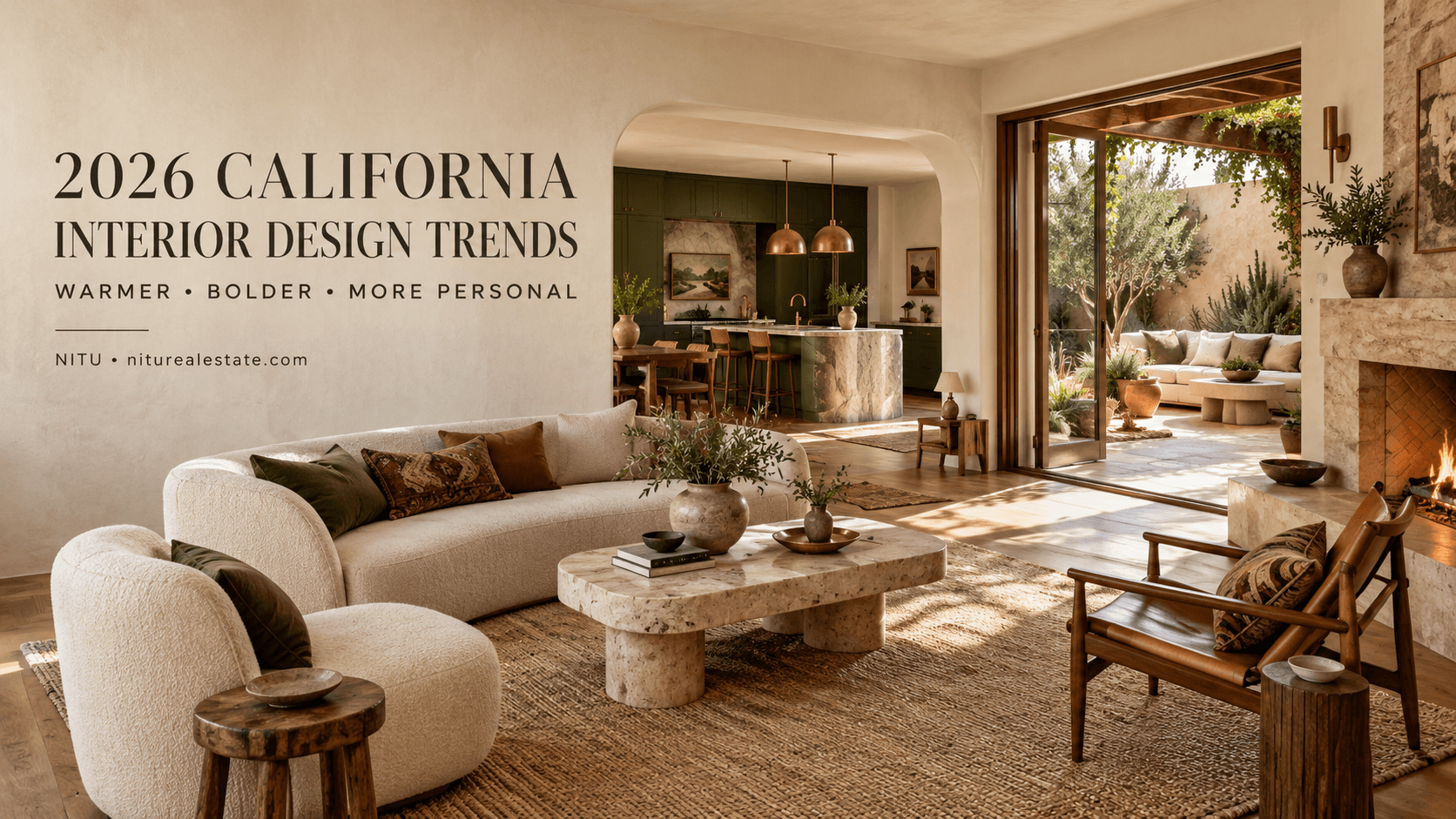
All-white minimalism is losing ground in 2026. Here are the five trends replacing it, warm wood, deep color, curves, vintage layering, and true indoor-outdoor rooms, and why California housing stock is already built for them.
NITU Path, Chapter 5: Settling In.
In short: In the most recent industry survey of professional designers, maximalism and eclecticism outranked minimalism as the leading style direction for the first time in years, and the all-white, cool-gray look that defined the last decade is losing ground fast. Five trends are driving that shift: warm wood and natural stone, deeper and richer color, curves in place of hard angles, vintage pieces layered into new builds, and outdoor space designed with the same intention as a living room. None of these are trends California homes have to force. A lot of the state's housing stock, Spanish Revival plaster and beam ceilings, mid-century post-and-beam, ranch homes built around a patio, was already halfway there.
Ask a group of professional designers which direction interiors are heading in 2026, and the honest answer isn't a single word like "minimalism" anymore. In the most recent industry-wide survey of design professionals, maximalism and eclecticism topped the list of leading style directions, each cited by well over a third of designers, ahead of the pared-back, all-white look that's dominated listing photos and renovation shows for the better part of a decade.
That shift shows up in specifics. Vintage and antique sourcing sat at its highest share of completed projects since 2021. Deep, saturated colors climbed at the expense of cool neutrals. And separately, outdoor living reports are describing yards designed with the same deliberateness as an interior room, not an afterthought behind the house.
Five trends sit at the center of that shift, and California housing stock lines up with them more naturally than most. Here's what each one actually looks like, and why it fits a California home in particular.
1. Warm Wood and Natural Stone, Replacing Cool and Synthetic
The material palette moved away from stark white and cool gray toward wood, stone, plaster, and clay tile. Warm metal finishes, bronze, soft brass, matte black, are replacing polished chrome on the hardware and fixtures that tie a kitchen or bathroom together. The throughline across all of it is texture and warmth over the flat, showroom-white look that dominated the last decade of renovations.
This is closer to a return than a new invention for a lot of California housing stock. Spanish Revival homes built in the 1920s and 30s were designed around plaster walls, clay roof tile, and exposed wood beams from the start. Mid-century post-and-beam homes, especially common across parts of Southern California, were built to showcase natural wood framing as a visible structural and design element, not something to cover up. A homeowner leaning into this trend in a home like either of those isn't fighting the architecture. They're working with what's already there.
2. Deep, Rich Color, In Place of the All-White Decade
Color is showing up with more confidence, and in more saturated tones. Chocolate brown nearly doubled as a top color choice among designers compared to a few years ago, and burgundy roughly tripled over the same stretch. One technique driving a lot of this is "color drenching," painting walls, trim, and ceiling in a single saturated hue instead of a wall-plus-white-trim combination, which reads as a deliberate, cohesive room rather than a leftover paint-chip decision.
A lighter, warmer counter-trend is rising alongside it, not instead of it. Soft, buttery yellows have also roughly doubled in use, functioning as a pastel middle ground between stark white and the deepest saturated tones. The common thread across both directions is the same: color with more warmth and more intention than a safe, resale-ready gray.
California's light is part of why this works especially well here. A deep, saturated wall color that might feel heavy in a room with limited daylight reads completely differently in a house that gets real sun for most of the year, which describes a large share of the state's housing stock. The color has room to feel rich rather than cave-like.
3. Curves and Organic Shapes, Softening the Hard Angles
Furniture and architecture are both moving away from strict rectangles and boxy minimalism. Rounded sofa arms, curved kitchen islands, arched doorways, and furniture silhouettes borrowed from rivers stones and rolling landscape lines are replacing the sharp-edged, right-angle look that defined the last decade. It's a practical shift as much as an aesthetic one. A curved piece softens a room that's otherwise dominated by straight architectural lines, a common condition in a lot of newer construction.
Outdoor space is following the same logic. A recent national outdoor living report specifically flagged curved pathways and organic garden geometry, more meandering movement instead of straight, formal lines, as one of the defining shifts in yard design this year, alongside a documented pullback from traditional lawn.
This isn't actually new to California design, it's a return to a look the state helped popularize decades ago. Curved architectural lines showed up throughout Art Deco and mid-century design, both of which have a real footprint in California's housing stock. A curved kitchen island in a 1960s ranch home isn't a trend import. It's closer to the house's own design language.
4. Vintage Pieces and Personal Layering, Over a Matched New Set
Vintage and antique sourcing reached its highest share of design projects since 2021, and the vast majority of designers surveyed used at least one vintage piece, spanning decades of design eras, somewhere in a recent project. The look driving this isn't a themed vintage room. It's a mixed one: a genuinely old piece next to something newly bought, next to something inherited, arranged like it was collected over years rather than ordered as a matched set in a single trip.
This is a meaningfully easier trend to pull off in an older home than in new construction. A lot of California's housing stock, Spanish Revival, Craftsman, older mid-century homes, already carries real architectural character: original tile work, built-in cabinetry, plaster details, wood floors with actual age to them. Layering vintage furniture into a home like that reinforces what's already original instead of competing with an all-new builder-grade interior trying to look intentionally mismatched.
5. Indoor-Outdoor Living, Designed Like an Actual Room
Outdoor space is being treated with the same intentionality as an interior room, not as leftover yard behind the house. Recent outdoor living data describes a rise in spaces built around how people actually use them day to day, a morning coffee spot, a reading corner, a flexible gathering area for entertaining, alongside a real pullback from traditional lawn in favor of planting that needs less water and less mowing.
California's climate has always supported this. The follow-through on styling it is what's catching up. A lot of the state's housing stock, especially ranch homes built around a central patio and mid-century homes with a strong indoor-outdoor sightline, was already designed to blur that line architecturally. What's changing in 2026 is that the outdoor half is finally getting furnished, lit, and planted with the same intention as the living room it opens onto, instead of getting a plastic table and calling it done.
Weighing It Honestly
None of these five trends require a full renovation to start applying, and none of them are really about chasing a look that'll feel dated in three years. They line up with materials, light, and architectural bones that a lot of California homes already have, which is a big part of why they're landing here more naturally than in a lot of other markets right now. If you're trying to sort which home issues are cosmetic versus which ones actually need attention before anything else, that's covered in the repair that can't wait vs. the ones that can, and if you haven't worked through the broader first-year rhythm of what a house needs and when, we built that out in the home maintenance calendar every first-time owner wishes they'd had sooner.
About the author: I'm a licensed real estate agent practicing in California. This article is part of NITU Path, Chapter 5, a series written to walk buyers through their entire homeownership journey.
This article is for general informational and educational purposes only and is not design, contracting, or financial advice. Trend data reflects industry surveys and reporting current as of 2026 and will shift over time. Confirm current material and labor costs with a licensed contractor before making renovation decisions.
Sources:
Back to Magazine