Home Owner
From rekeying the locks to your first earthquake kit, here's the practical shopping list nobody hands you at closing, organized so you buy the safety items first.
NITU Path, Chapter 5: Settling In.
In short: Nobody hands new homeowners a shopping list at closing, so most people figure it out the hard way, usually at 11pm when something breaks and there's no flashlight, no tool kit, and no idea where the water shuts off. This list is organized in the order it actually matters: safety and security first, tools you'll reach for in the first week second, everyday maintenance and the small setup items nobody warns you about last. Budget roughly $1,000 to $2,000 total, less if you're bringing items from a previous place, more if you're starting from a completely empty apartment.
Keys in hand, first night in the new house, and the kitchen drawer where the takeout menus used to live is completely empty. No flashlight. No idea where the water main is. No plunger, which is somehow always the one that gets discovered at the worst possible moment. This is roughly when it hits most first-time buyers that a house doesn't come with the things an apartment quietly had already, a maintenance line, a landlord's toolbox, someone else's smoke detector batteries.
Here's the list, organized so the parts that matter for actual safety come first, not buried on page two of a general "housewarming" list.
Safety and Security First
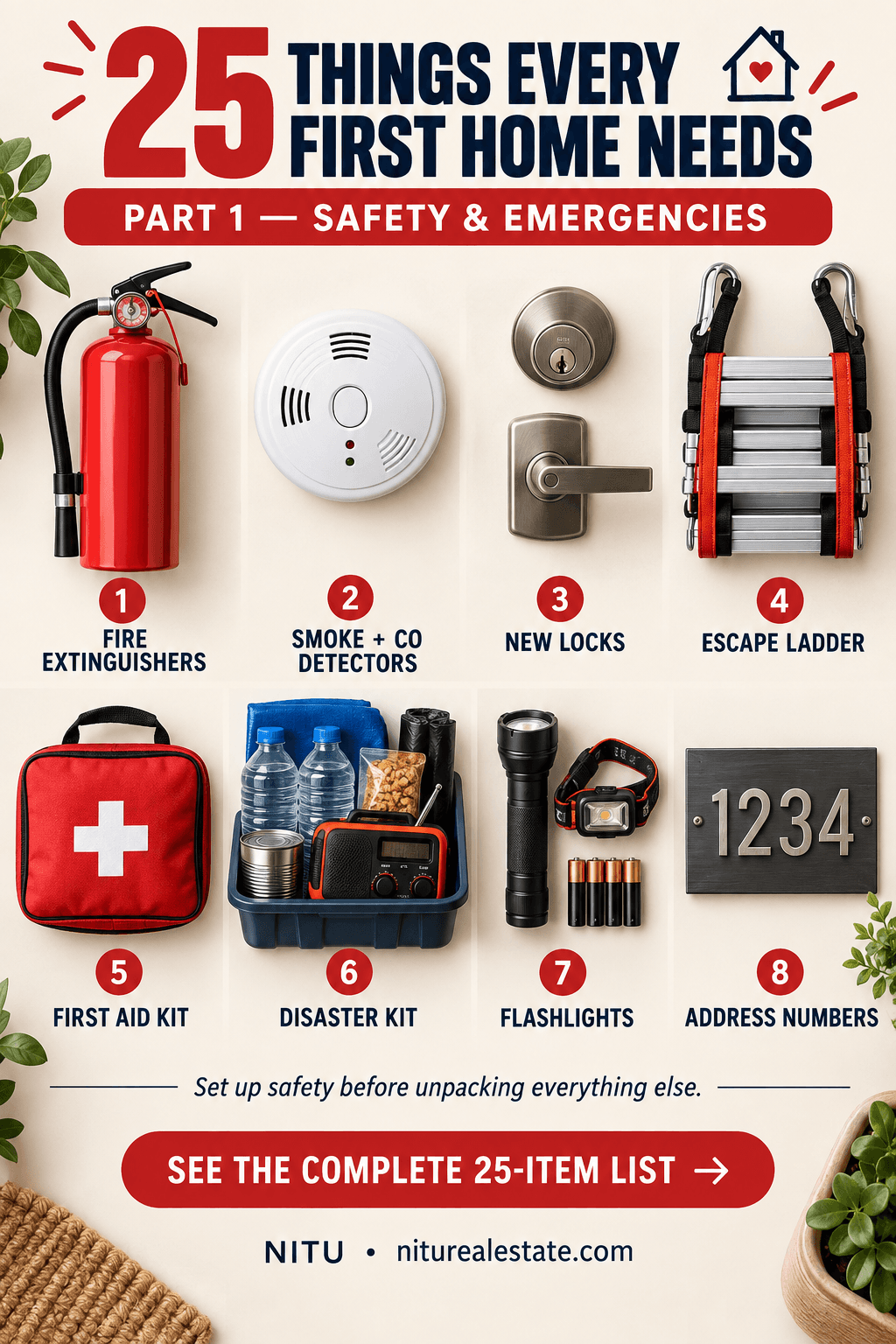
1. A fire extinguisher for the kitchen, and a second for the garage. An ABC-rated extinguisher covers ordinary combustibles, flammable liquids, and electrical fires, which covers most of what goes wrong in a house.
2. Fresh smoke and carbon monoxide detectors, and confirmation the existing ones actually work. California has required CO detectors in single-family homes since July 2011, specifically in homes with a fossil-fuel heater or appliance, a fireplace, or an attached garage, installed near the bedrooms. Test whatever's already mounted before assuming it works, and don't guess on the battery age.
3. A locksmith to rekey the exterior doors, or new deadbolts entirely. This is the one item on this list that isn't optional. You have no way of knowing how many keys exist for your new front door, the previous owner's, a contractor's, a house-sitter's, a real estate sign lockbox code. Rekeying an average house runs somewhere around $95 to $270 for a full set of locks, noticeably cheaper than replacing the hardware outright.
4. A fire escape ladder if any bedroom is on a second floor. Cheap, collapsible, and the kind of thing you buy once and hope to never use.
5. A first aid kit, stocked beyond the contents of a travel-size one from a drugstore.
6. An actual earthquake or disaster supply kit, not just good intentions. California's own guidance calls for at least one gallon of water per person per day, for a minimum of three days, on top of shelf-stable food, a battery or hand-crank radio, medications, and a manual can opener. This is a stay-in-place kit, meant to get a household through the days after a major quake when water and power are both out.
7. Flashlights or headlamps for every level of the house, with spare batteries. Not just one flashlight buried in a junk drawer somewhere.
8. Visible address numbers on the house itself, not just the curb. It sounds minor until a fire truck or ambulance is trying to find the right house on a dark street.
Tools You'll Reach for in the First Week
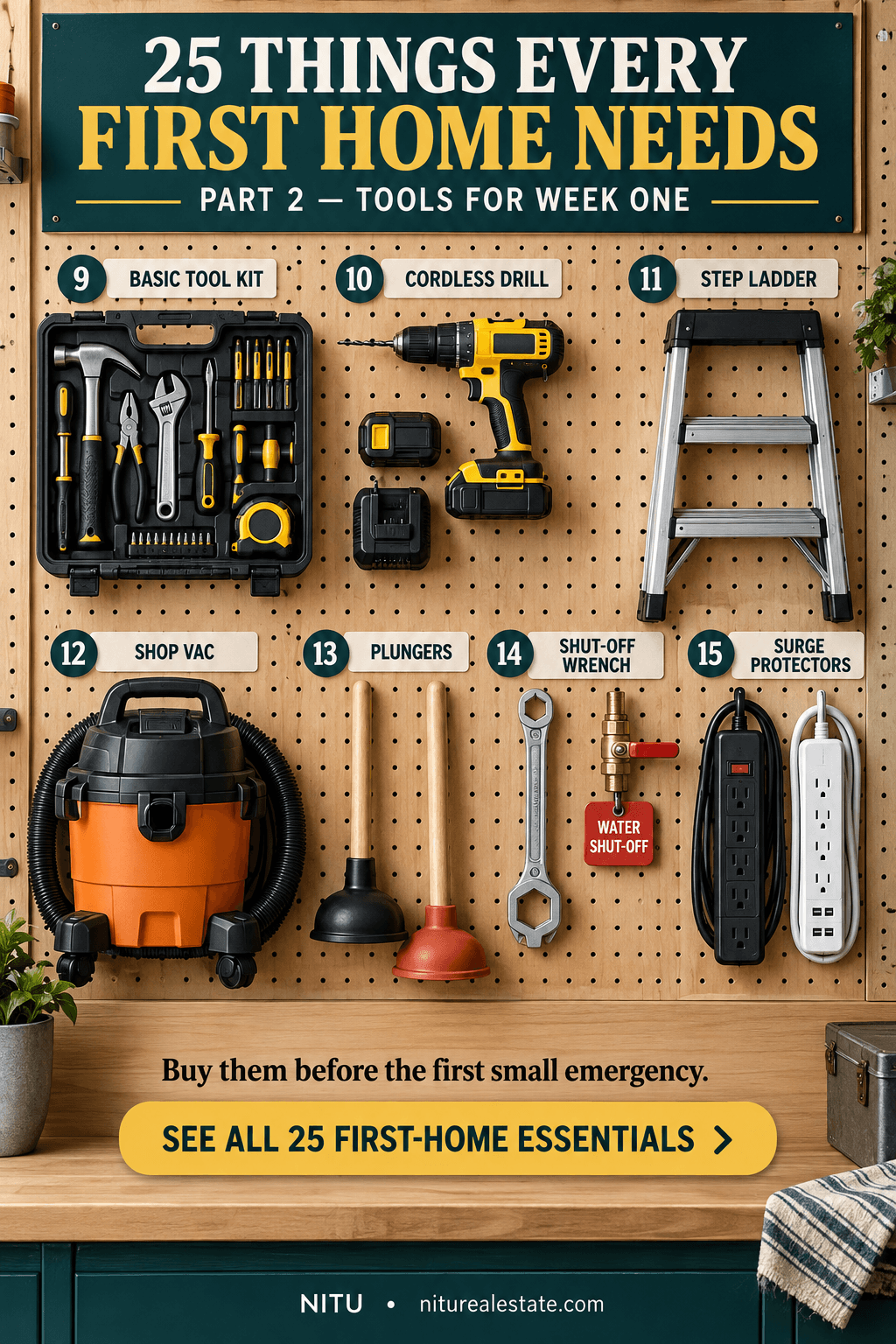
9. A basic tool kit, screwdrivers, a hammer, an adjustable wrench, a level. Nothing fancy, just enough to hang a mirror or tighten a loose hinge without a special trip to the hardware store.
10. A cordless drill. Mounting shelves, curtain rods, and babyproofing a house all go faster with one, and it pays for itself the first weekend.
11. A sturdy step ladder. Changing a lightbulb in a vaulted ceiling or cleaning a gutter both require one, and a kitchen chair is not a substitute.
12. A wet/dry shop vacuum. Useful for an overflowing toilet, a flooded garage after a storm, or a workshop full of sawdust, none of which a regular vacuum should ever touch.
13. A plunger for every bathroom, not one shared plunger for the whole house. Buy them now, not during the emergency.
14. A water shut-off wrench, and a tag marking exactly where the main shut-off valve is. Knowing this before a pipe bursts, not during one, is the entire point.
15. A few surge protectors or power strips. Older houses in particular tend to be short on outlets exactly where you need them.
Everyday Cleaning and Maintenance
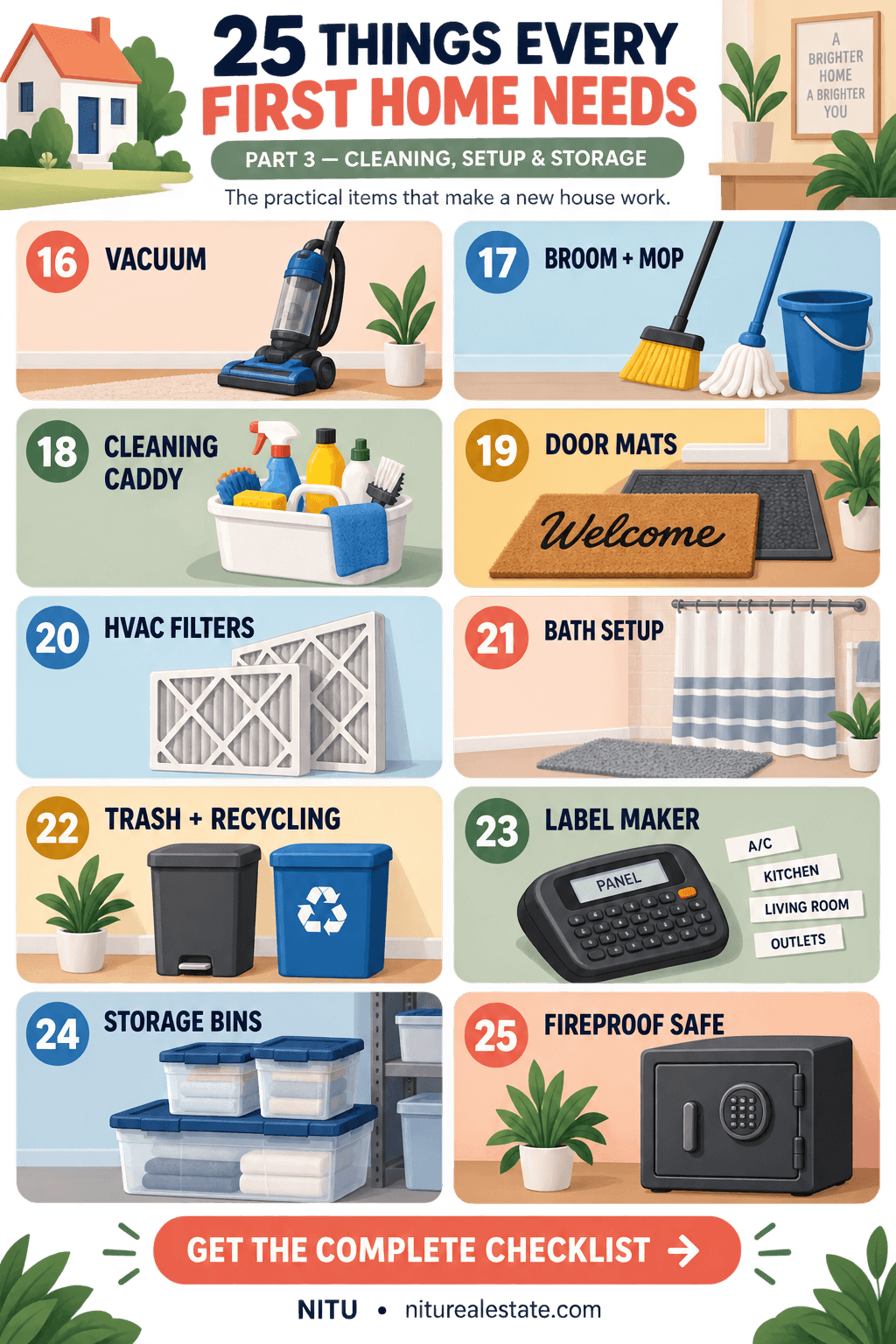
16. A vacuum suited to your actual flooring, carpet, hardwood, or a mix of both.
17. A broom, mop, and bucket. Unglamorous, and used constantly.
18. A basic cleaning supply caddy, so everything lives in one place instead of scattered across three cabinets.
19. Door mats for every entrance. A cheap, unglamorous way to keep a meaningful amount of dirt, pollen, and whatever's on the driveway from making it onto your floors.
20. A multi-pack of HVAC air filters sized to your specific unit. Check the size the day you move in, buy several at once, and set a recurring reminder. A clogged filter is one of the most common, and easiest to prevent, reasons an HVAC system works harder than it should.
The Small Setup Items Nobody Warns You About
21. A shower curtain, liner, and bath mat, if the bathroom doesn't already have them. An oddly common first-week gap.
22. Trash and recycling bins that actually match your city's collection system. Sizes and color-coding vary by municipality, so check before buying.
23. A label maker, or at minimum tape and a marker, for the electrical panel. Label every breaker while the house is calm and well-lit, not during an actual outage when you're standing in the dark trying to guess which switch controls what.
24. Storage bins for the garage or a shed. Garages fill up fast, and bins keep it from becoming an unusable dumping ground within the first six months.
25. A small fireproof safe or lockbox for the deed, insurance documents, passports, and anything else that would be genuinely painful to lose in a fire or flood.
What This Actually Costs
Pricing all twenty-five out, using mid-range, not premium, options, lands somewhere around $1,000 to $2,000 total. Where you land in that range depends heavily on what's already coming with you from a previous apartment or house. A vacuum and a tool kit you already own knock a real chunk off that number. Starting completely from zero pushes you toward the higher end. Either way, spreading these purchases across the first month, safety and security items in week one, everyday tools and cleaning items after, tends to feel a lot less overwhelming than trying to buy all twenty-five in a single weekend.
The Order Actually Matters
None of this needs to happen the day you get keys. What does need to happen early is the safety tier, rekeying the locks, confirming smoke and CO detectors work, knowing where the water shuts off. Everything else can wait a week or two without any real consequence. If you want the fuller picture of what has a real deadline attached versus what's simply good practice, we've laid that out in new homeowner checklist: what to do after closing.
Once the shopping list is handled, the next decision most new owners face is what to do about the things the inspection flagged but didn't require before closing. We've written a framework for sorting those into what actually can't wait versus what genuinely can, in the repair that can't wait vs. the ones that can. And once the first-week essentials are handled, it's worth looking further out. We built a full first-year maintenance calendar, the kind of thing that turns surprise expenses into budgeted ones, in the home maintenance calendar every first-time owner wishes they'd had sooner.
Quick Check: Buying After Closing
Q1. Which item on this list is described as genuinely non-optional
(a) A fireproof safe
(b) A label maker for the electrical panel
(c) Rekeying or replacing the exterior locks
C
Rekeying or replacing the exterior locks is the one item the article calls genuinely non-optional, since there's no way to know how many keys already exist for the doors.
Q2. According to California guidance, how much water should a home earthquake kit include per person, per day?
(a) One gallon
(b) A half gallon
(c) Two gallons
A
California's earthquake preparedness guidance calls for at least one gallon of water per person, per day, for a minimum of three days.
Q3. (T/F) California has required carbon monoxide detectors in single-family homes with a fossil-fuel appliance, fireplace, or attached garage since July 2011.
T — California has required CO detectors in single-family homes with a fossil-fuel appliance, fireplace, or attached garage since July 1, 2011.
Q4. Roughly what does it cost to rekey the locks on an average house?
(a) $800 to $1,200
(b) $95 to $270
(c) $10 to $25
B
Rekeying a full set of locks on an average house typically runs about $95 to $270, noticeably less than replacing the hardware outright.
Q5. Why does the article recommend labeling the electrical panel right after moving in?
(a) It's required by California law
(b) It increases the home's resale value
(c) It's much easier to do it calmly in advance than during an actual power outage
C
Labeling the panel is far easier to do calmly in advance than to figure out breaker by breaker during an actual outage.
Q6. What's the article's rough total budget estimate for all 25 items, using mid-range options?
(a) $200 to $400
(b) $1,000 to $2,000
(c) $3,000 to $5,000
B
The article estimates a rough total of $1,000 to $2,000 for all 25 items using mid-range, not premium, options.
About the author: I'm a licensed real estate agent practicing in California. This article is part of NITU Path, Chapter 5, a series written to walk buyers through their entire homeownership journey.
This article is for general informational and educational purposes only and is not financial, legal, or safety advice. Product needs vary by household, and pricing is a rough estimate based on typical mid-range options, not a quote. Confirm any safety-related requirements, including smoke and CO detector placement, with a licensed professional.
Sources:
Back to Magazine