Home Owner
A home warranty and a homeowners insurance policy sound like they overlap, and they almost never do. Here's exactly where one stops and the other starts, with a real burst-pipe example showing both at work.
In short: A home warranty and homeowners insurance solve two completely different problems, and the coverage almost never overlaps. A home warranty is a paid service contract that covers your major systems and appliances when they break down from ordinary wear and tear, things like an aging water heater or a dishwasher that finally gives out. Homeowners insurance covers sudden, named events, fire, theft, wind, a burst pipe's water damage, and liability if someone gets hurt on your property. Neither one covers everything, and in California specifically, standard homeowners insurance skips earthquake and flood damage entirely, which need their own separate coverage.
Two things go wrong in the same house, the same month. The water heater, nine years old, finally stops heating water. A week later, a storm knocks a tree branch through a side window. Both are real damage, both are expensive to fix, and only one of them gets paid for by homeowners insurance. The other one depends entirely on whether a home warranty was ever in place.
That split confuses a lot of new owners, and it's an easy mix-up to walk into. Here's where the line between the two actually falls.

The Core Difference: Wear and Tear vs. Named, Sudden Events
A home warranty covers breakdowns that happen from ordinary use over time. It's a paid annual service contract, not insurance, that covers specific major systems, HVAC, plumbing, electrical, and major appliances, when they fail because they've simply reached the end of their working life. An aging water heater finally rusting through is exactly the kind of thing it's built for.
Homeowners insurance covers sudden, named events, not slow decline. Fire, lightning, windstorm, theft, vandalism, and the sudden, accidental discharge of water from a burst pipe are examples of events a standard policy is written to cover. It also covers liability if someone's injured on your property, and in many cases, temporary housing if the home becomes unlivable after a covered loss.
The two were never designed to overlap, and in practice, they mostly don't. Owning both isn't redundant. It's closer to covering two different categories of risk that happen to live under the same roof.
What a Home Warranty Actually Covers, and Where It Stops
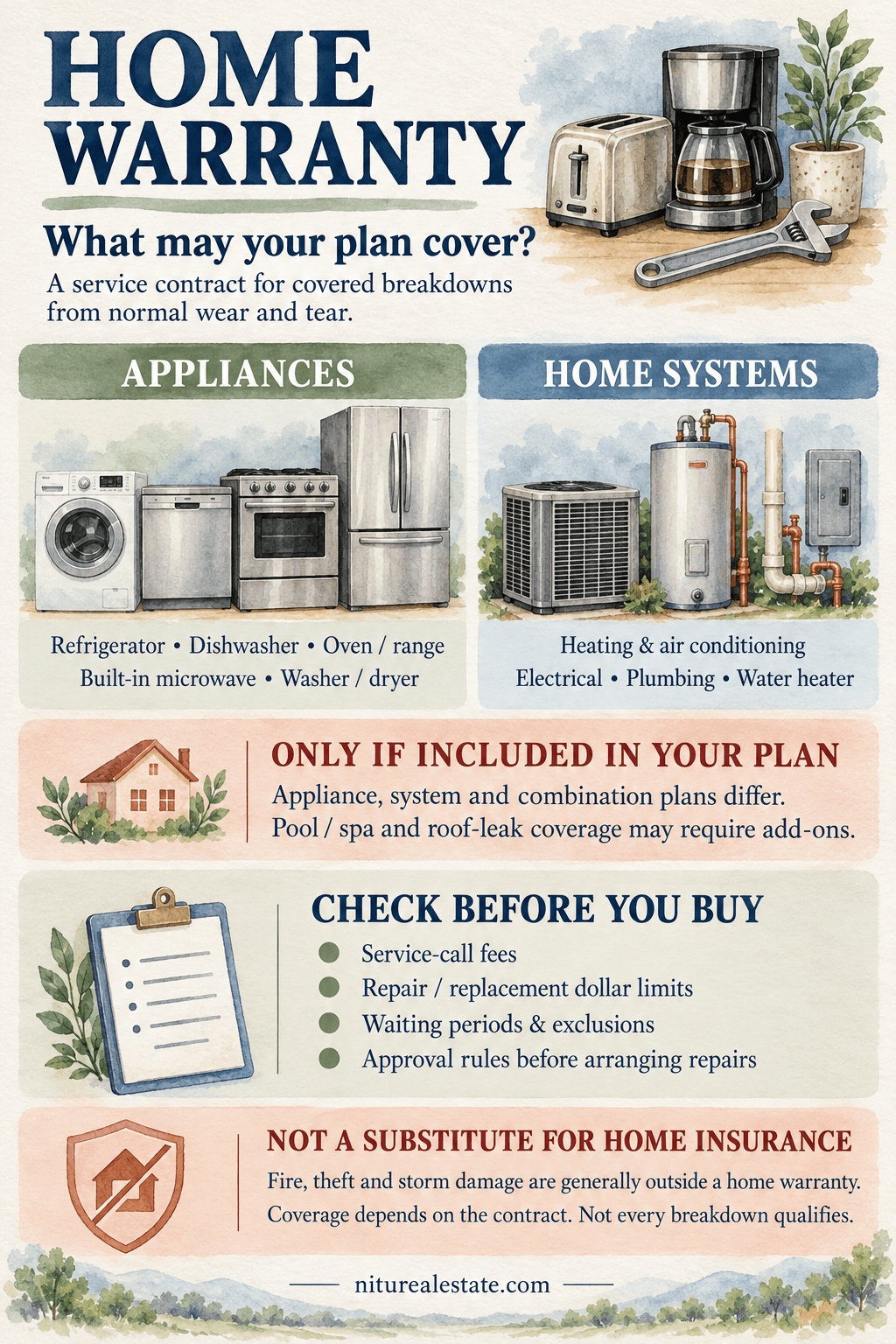
Coverage centers on major systems and appliances failing from normal wear. That typically means HVAC, plumbing, electrical systems, and appliances like the refrigerator, oven, dishwasher, washer, and dryer. Roof leaks, pools, septic systems, and hot tubs are usually separate add-ons rather than standard inclusions.
You'll pay a service fee every time you use it, and payouts are capped per item. Most contracts charge $75 to $125 each time a technician is dispatched, and coverage per item is capped, often somewhere between $300 and $3,000 depending on the plan and the item. If an actual repair or replacement costs more than the cap, the difference comes out of your pocket. A refrigerator that costs around $1,925 to replace against a $1,305 payout cap leaves roughly $620 you're covering yourself, which is a real gap worth knowing about before a claim, not during one.
What voids a claim matters as much as what's covered. A warranty generally won't pay out for a failure caused by improper installation, a modification someone made to the system, or a lack of basic maintenance, a neglected furnace filter, for instance, that eventually burns out the blower motor. Rust, corrosion, and sediment buildup are commonly excluded too, even on an otherwise covered item.
California requires specific disclosures from every company selling these. The state calls a home warranty a "home protection contract," and even though it isn't insurance, the California Department of Insurance licenses and regulates the companies that sell them. State law requires every contract to clearly spell out what's covered, every exclusion, the fees, and how fast the company has to respond, generally within 48 hours of a service request. You can check a company's license status directly through the Department of Insurance before signing anything.
What Homeowners Insurance Actually Covers, and Where It Stops

A standard policy covers the structure, your belongings, and your liability against specific named perils. Fire, lightning, windstorm, hail, theft, and vandalism are typical examples. It generally also covers additional living expenses if a covered event makes the home temporarily unlivable, and liability coverage if a guest is injured on the property.
It does not cover gradual deterioration, mechanical breakdown, or normal wear. An HVAC system that simply dies after fifteen years of service isn't a named peril, it's wear and tear, which is precisely the gap a home warranty is built to fill instead.
In California specifically, two of the biggest risks in the state aren't included at all. Standard homeowners insurance excludes both earthquake and flood damage entirely. Earthquake coverage has to be added separately, most commonly through a California Earthquake Authority policy offered through participating insurers, and it typically carries a higher deductible than the rest of your policy. Flood coverage runs through the National Flood Insurance Program, and a new flood policy typically has a 30-day waiting period before it actually takes effect, which makes it a bad idea to wait until a storm is already forecast to buy one. If you're still getting a handle on what's actually changed in California's insurance market and what coverage is realistically costing homeowners right now, we laid that out in home insurance in California: what changed, and what it actually costs now.
The Burst Pipe Example: Where the Line Actually Falls

A corroded pipe fitting finally gives out and sprays water across a bathroom floor for an hour before anyone notices.
The pipe or fixture itself is a home warranty matter, assuming plumbing is part of the plan. It failed from age and wear, which is exactly the category a warranty is meant to cover, generally up to a payout cap, often somewhere in the $500 to $5,000 range depending on the contract.
The water damage to the floor, the drywall, and anything it ruined on the way down is a homeowners insurance matter. Sudden, accidental water discharge like this is a commonly covered peril under a standard policy. The two claims run on separate tracks, filed with separate companies, covering two separate halves of the exact same incident.
One exception worth knowing: a frozen pipe that bursts from cold weather is treated as insurance's problem, not the warranty's. A home warranty covers wear and tear, not weather-driven failure, so freeze damage generally falls to your homeowners policy instead.
Weighing It Honestly
Neither of these is a complete safety net on its own, and buying one doesn't make the other optional. A home warranty is a modest, predictable annual cost, roughly $300 to $800 a year, against the much larger and far more unpredictable expense of a major system failing years before you expected it to. Homeowners insurance is the far bigger financial backstop, typically $1,000 to $4,000 a year with a real deductible attached, built for the events a warranty was never meant to touch. If you're trying to figure out which repairs genuinely can't wait versus which ones are safe to put off regardless of which coverage applies, we built that decision framework in the repair that can't wait vs. the ones that can.
About the author: I'm a licensed real estate agent practicing in California. This article is part of NITU Path, Chapter 5, a series written to walk buyers through their entire homeownership journey.
This article is for general informational and educational purposes only and is not insurance or legal advice. Coverage terms, exclusions, and pricing vary by company, policy, and contract, and change over time. Confirm current terms directly with your insurance carrier or home warranty provider before making decisions.
Sources:
Back to Magazine