Home Owner
What actually stops a break-in, what California law says about cameras and window bars, and the security checklist worth working through in your first month as an owner.
NITU Path, Chapter 5: Settling In.
In short: Most burglaries aren't a mystery. They come through the front door or a first-floor window, involve forced entry, and target homes that look like nobody's paying attention. A visible alarm sign alone changes a burglar's decision more often than people expect. Beyond the basics, rekeying and a real deadbolt, California adds a few wrinkles worth knowing: window security bars need a code-compliant quick-release, home security cameras have real limits on recording audio, and HOAs can restrict a video doorbell depending on exactly where it's mounted. None of it is complicated. Most of it just never gets explained in one place.
What actually stops a break-in, the yard sign, or what's behind it? The honest answer is a little of both. Visible security measures change a burglar's math before they ever touch a door, and the actual hardware behind that sign is what stops the attempt that isn't deterred by the sign alone. Here's what the numbers say actually matters, and the California-specific rules that shape how you're allowed to set it up.

Why This Deserves Its Own Checklist
Entry points aren't evenly distributed. Roughly 34 percent of burglars come through the front door, 23 percent through a window, and 81 percent of break-ins start on the first floor. Almost none of this involves anything dramatic. It's mostly a door that wasn't locked as well as the owner assumed, or a ground-floor window nobody thought to reinforce.
Force is normal, stealth is not. About 95 percent of burglaries involve some kind of forced entry, prying, kicking, breaking glass, rather than a burglar quietly picking a lock. That matters for where to spend money: a strong door frame and a real deadbolt do more than a fancy lock cylinder on a weak door.
Visible deterrents genuinely work. Around 83 percent of would-be burglars check for a visible alarm system before attempting a break-in, and homes without any security system are roughly three times more likely to be targeted. This is the part that makes a modest setup worth doing even on a tight budget. The yard sign and the sticker on the window are doing real work, not just decoration.
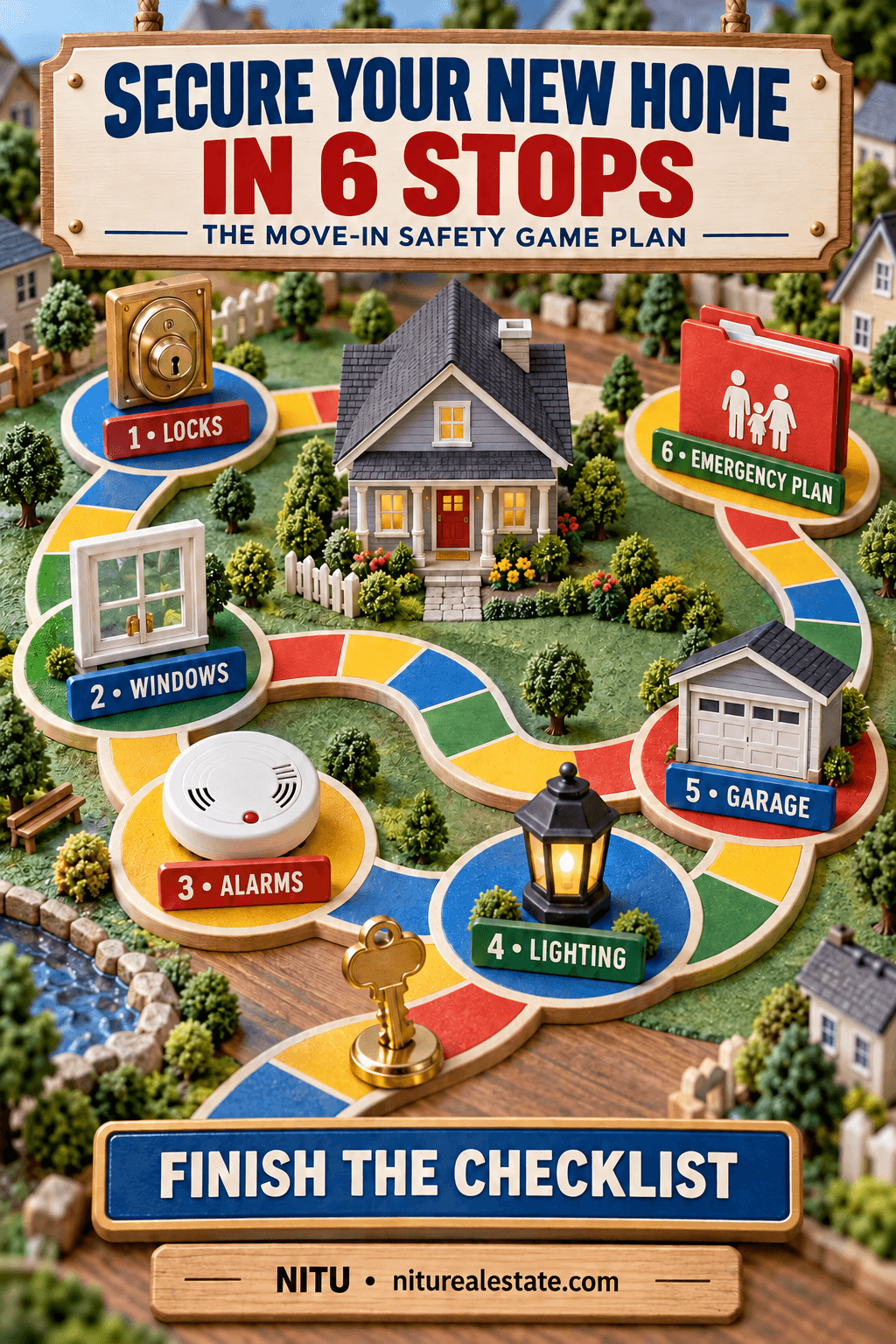
Start With the Locks and the Doors
Rekey or replace the exterior locks before anything else. If you haven't already, this is the single most important item on any new-homeowner security list, and we've covered the mechanics and cost of it in 25 things to buy after closing on your first home.
Check what's actually holding the door shut. A deadbolt with at least a one-inch throw, set into a strike plate anchored with 3-inch screws into the actual door frame stud, resists kicking far better than the short screws most builders use by default. This is a five-minute upgrade with a screwdriver, not a locksmith call.
Don't forget the sliding glass door. A charley bar or a simple dowel in the track stops a slider from being forced open, and it costs almost nothing.
Reset the garage door opener's code, and treat the garage like a front door. A garage that connects to the house is a full entry point, not a separate structure, and a lot of new owners never think to reset the remote codes or check whether the interior door between the garage and the house even has a working lock.
The Window Bars Trade-off Nobody Explains
Older homes across California, especially ones bought as fixer-uppers or in denser neighborhoods, sometimes still have decorative security bars on windows. If any of those windows serve as a bedroom's emergency escape opening, California code has a specific requirement: the bars need a release mechanism that opens immediately from inside, without a key, a tool, or any special knowledge, and it has to work under roughly 5 pounds of force by hand and in the dark. Bars installed before this became standard, or installed without it, turn a break-in deterrent into a fire escape hazard. If your new home has old-style security bars on any bedroom window, this is worth checking in your first month, not your first year.
What California Law Actually Allows With Cameras
Video-only recording of your own property is straightforward. California allows security cameras to record video in areas visible from the street or your own yard, as long as they're not aimed into a space where someone has a reasonable expectation of privacy, a neighbor's window or a fenced backyard that isn't yours.
Audio is where the law gets stricter. The moment a camera records sound, California's all-party consent law, Penal Code 632, applies. Recording a conversation without everyone's consent can carry fines up to $2,500 and up to a year in jail for a first offense. Most doorbell camera brands let you disable audio recording specifically for this reason, or you can post visible signage noting that audio and video are being recorded.
If you're in a condo or HOA, where the camera attaches matters. An HOA generally can't stop you from installing a doorbell camera or peephole camera built into your own unit's door, since that's your property, not the association's. It has much more authority to block one mounted on a shared hallway wall or door frame, since that's common area the HOA controls. Worth checking your specific CC&Rs before assuming either way.
Alarm Systems, Permits, and the Insurance Angle
Most California cities require a permit to operate a home alarm system. Los Angeles, for example, treats operating an alarm without one as a misdemeanor, with fines up to $1,000. Most alarm companies handle this as part of installation, but it's worth confirming rather than assuming.
A monitored system is worth more than the alarm itself once insurance gets involved. Basic, unmonitored alarms typically earn a small discount, in the 2 to 5 percent range. Professional monitoring alone tends to land between 5 and 15 percent, and monitoring paired with fire and CO detection can reach 10 to 20 percent off a homeowners policy. Self-monitoring through an app, without a monitoring center that actually dispatches emergency services, usually doesn't qualify for much of a discount at all. Given how much California premiums have moved recently, this is worth asking your insurer about directly. We covered what's actually driving those increases, and where the FAIR Plan fits in, in home insurance in California: what changed, and what it actually costs now.
The Exterior Matters More Than People Assume
Motion-activated lighting at every entry point is cheap and effective. It removes the cover of darkness exactly where a burglar needs it most, and it's one of the few upgrades that requires no permit, no monitoring fee, and almost no maintenance.
Overgrown landscaping near windows and doors works against you. Tall shrubs by a ground-floor window give a burglar cover to work unseen. Keeping sightlines open from the street to your entry points is a free security upgrade that just takes an afternoon with pruning shears.
Visible house numbers still matter here too, for the same reason they matter during an emergency call: officers responding to an alarm or a call need to find the right house fast, not guess between two look-alike numbers on a dark street.
Weighing It Honestly
None of this makes a home immune to a determined break-in. What it does is move your house out of the easiest category, the one with old hardware, no visible deterrent, and a side door nobody thought about. Most of what's on this list is inexpensive, doesn't require a permit beyond the alarm system itself, and can be handled over a single weekend. If you haven't worked through the broader first-month list yet, that's covered in new homeowner checklist: what to do after closing.
Quick Check: Home Security in California
Q1. According to the cited research, roughly what share of burglaries involve some form of forced entry rather than an unlocked door or window?
(a) About 50 percent
(b) About 95 percent
(c) About 20 percent
B
About 95 percent of burglaries involve some form of forced entry, which is why door and frame strength matters more than a fancy lock alone.
Q2. What does California code require for security bars on a bedroom window used as an emergency escape opening?
(a) A quick-release mechanism operable from inside without tools or keys
(b) A separate fire department key
(c) They're simply illegal in California
A
California code requires security bars on emergency escape windows to have a quick-release mechanism operable from inside, without tools, keys, or special knowledge.
Q3. (T/F) Recording audio on a home security camera in California requires consent from all parties being recorded, under Penal Code 632.
T — California's Penal Code 632 requires consent from all parties before recording a confidential conversation, which applies to a security camera's audio recording.
Q4. Under California condo and HOA rules, when can an HOA generally block a resident's video doorbell?
(a) Never, owners always have the right to install one
(b) Whenever the HOA simply prefers not to allow i
(c) When the device attaches to HOA-owned common area, like a shared hallway wall, rather than the unit's own door
C
An HOA has much stronger authority to block a device attached to common area, like a shared hallway wall, than one built into an owner's own unit door.
Q5. What discount range does the article cite for a monitored alarm system paired with fire and CO detection?
(a) 10 to 20 percent
(b) 50 to 60 percent
(c) Under 1 percent
A
Monitoring paired with fire and CO detection typically earns a 10 to 20 percent discount, well above a basic unmonitored alarm.
Q6. What percentage of would-be burglars check for a visible alarm system before attempting a break-in?
(a) About 10 percent
(b) About 83 percent
(c) About 33 percent
B
About 83 percent of would-be burglars check for a visible alarm system before attempting a break-in, which is why visible deterrents matter even on a modest budget.
About the author: I'm a licensed real estate agent practicing in California. This article is part of NITU Path, Chapter 5, a series written to walk buyers through their entire homeownership journey.
This article is for general informational and educational purposes only and is not legal, security, or insurance advice. Laws, city ordinances, and insurance discount programs change and vary by jurisdiction and insurer. Confirm current requirements with your city, your HOA, a licensed security professional, and your insurance carrier before making decisions.
Sources:
UpCodes — Releasing Systems for Security Bars in Dwellings, California Referenced Standards Code
RecordingLaw.com — California Security Camera and Surveillance Laws
MBK Chapman — Can a California Condo Owner Install a Video Doorbell Outside Their Unit?
Los Angeles Office of Finance — Alarm Permits and Alarm Ordinance FAQs
Back to Magazine