First Home Buyer
The median home in Orange County costs about $587,000 more than the median home in LA County right now. Before that number decides anything, here's what it actually means.
NITU Path, Chapter 4, a series written to walk buyers through their entire homeownership journey.
In short: As of July 2026, the median home in Orange County runs about $1,475,000, versus roughly $888,000 in Los Angeles County, a gap of nearly $587,000. That number is real, but it hides two things worth knowing before it decides where you house-hunt. First, "Los Angeles County" isn't one market. It's 88 cities stretched from the coast to the high desert, and the median blends neighborhoods that have almost nothing in common. Second, the property tax difference between the two counties isn't really about the county at all. It's about price, and the rate itself works almost the same way on both sides of the border.
Here's a question worth sitting with before you pick a county to search in: if property tax rates, freeways, and job markets all cross the Orange County and LA County line without changing much, why does one median home cost 66 percent more than the other?
The honest answer isn't "Orange County is simply better." It's that the two counties aren't really comparable as single units, and the number everyone quotes, one median price against another, flattens a lot of real differences that actually matter to a first-time buyer.
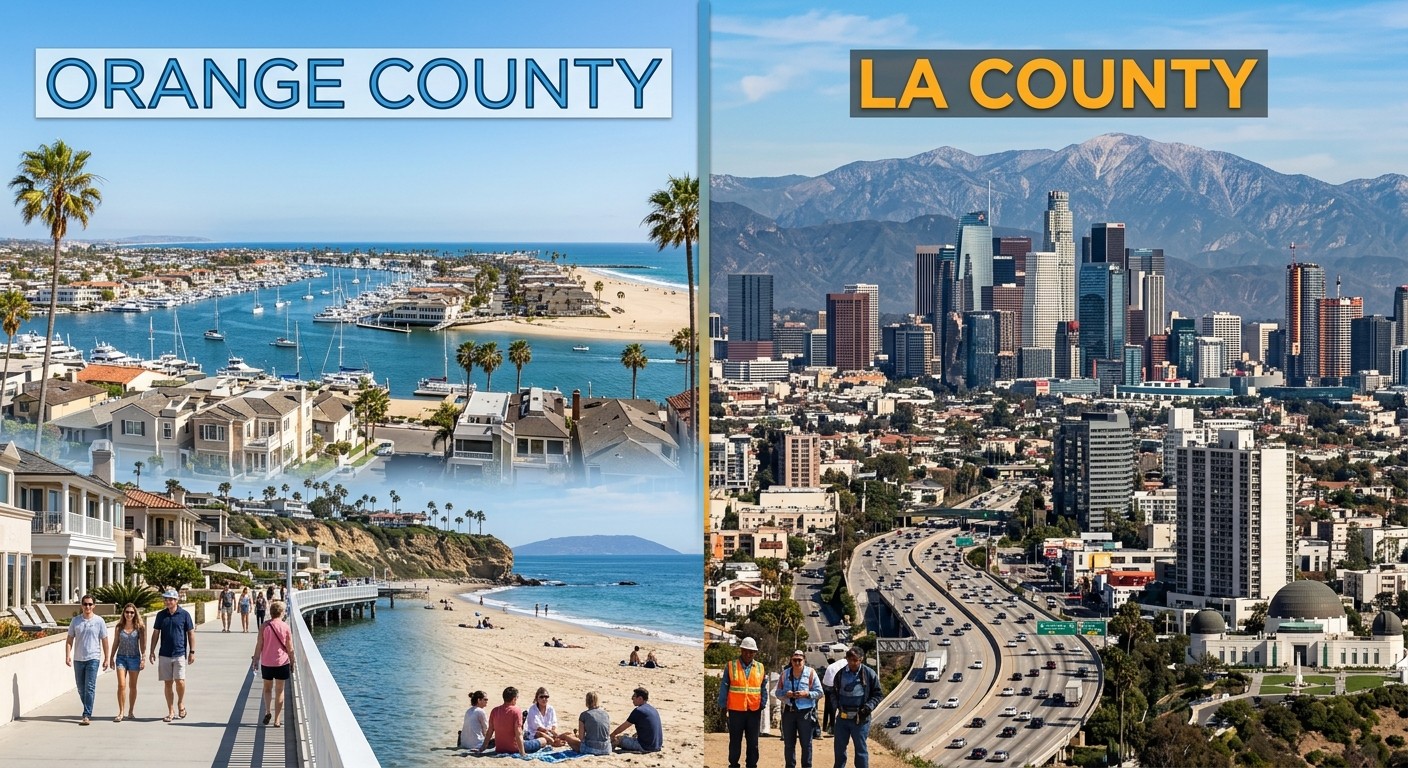
The Price Gap, With This Year's Numbers
According to the California Association of Realtors, the median home price in Orange County was $1,475,000 in July 2026, up 5.4 percent from a year earlier. Los Angeles County's median that same month was $888,120, down 2.6 percent year over year. The two counties moved in opposite directions this year, one climbing, one softening, which is its own signal about how differently these markets are actually behaving right now.
The gap between them comes to $586,880. Put another way, the typical Orange County home costs about 66 percent more than the typical LA County home. That's the number most people stop at. It shouldn't be.
Q1. What was Orange County's median home price in July 2026, according to the California Association of Realtors?
(a) $888,120
(b) $1,220,914
(c) $1,475,000
C
Orange County's median home price was $1,475,000 in July 2026, up 5.4 percent year over year.
Why "LA County" Isn't Really One Market
Los Angeles County has 88 incorporated cities. Orange County has 34. That difference in scale matters more than it sounds like it should, because LA County's median price is an average pulled across an enormous range: ultra-expensive coastal and hillside communities on one end, far more affordable cities in the Antelope Valley and parts of the San Fernando and San Gabriel Valleys on the other. A buyer targeting Pasadena is shopping a completely different market than a buyer targeting Palmdale, even though both purchases count toward the same countywide median. We've written about what one specific LA County market actually looks like in what is Pasadena, California like, and the pricing swings between neighborhoods just a few miles apart make the point well.
Orange County doesn't have this problem to nearly the same degree. Its 34 cities sit in a narrower band, mostly suburban, mostly built out, with fewer of the extreme highs and lows that stretch LA County's number in both directions. That makes Orange County's median a more reliable stand-in for what a typical purchase there actually costs. LA County's median is a starting point for research, not a number to budget around until you've picked a specific city or two.
The Property Tax Difference Isn't Really a County Difference
It's easy to assume Orange County's higher tax bills come from a higher tax rate. They don't, not in any meaningful way. Proposition 13 sets the same basic framework statewide: roughly 1 percent of purchase price at the time you buy, plus local voter-approved additions that typically push the real rate to somewhere around 1.1 to 1.3 percent almost everywhere in California, Orange and LA counties included. We've covered how that reassessment actually works, and the surprise bill that follows it, in your first property tax bill will surprise you.
What actually drives the tax bill gap between the two counties is the price gap itself. A 1.2 percent rate on a $1,475,000 home comes to about $1,475 a month. The same rate on an $888,120 home comes to about $888 a month. Same framework, same math, different price. The county line itself has almost nothing to do with it.
Q2. What mainly explains why Orange County's typical property tax bill is higher than Los Angeles County's?
(a) Orange County has a fundamentally different tax rate under state law
(b) Orange County homes carry a higher purchase price, and property tax is based on that price
(c) Los Angeles County exempts new buyers from reassessment
B
Property tax is calculated as a percentage of purchase price, so the higher tax bill reflects Orange County's higher prices, not a different rate.
What the Price Gap Is Actually Buying
Orange County's median premium reflects a few real, specific things: a shorter average commute to a dense coastal job base, a housing stock that leans newer and more uniformly suburban, and a large share of master-planned communities with amenities built in from day one. It also comes with more consistent HOA dues across a bigger share of its listings than LA County, where older, non-HOA neighborhoods are far more common outside the newest developments.
Los Angeles County's lower blended median buys access to a far larger and more varied job market, entertainment and media, healthcare and biotech anchored around several major hospital systems, logistics and trade tied to the ports, and a genuinely wider range of housing types, from dense urban condos to single-family homes with real yards, often at very different price points depending on exactly which of those 88 cities you're looking at.
Neither of those trade-offs is automatically the right one. They're just genuinely different, which is exactly why the countywide median price is a starting point for the search, not the deciding factor.
Q3. (T/F) In July 2026, Los Angeles County's and Orange County's median home prices moved in the same direction year over year.
F — The two counties moved in opposite directions: Orange County's median rose 5.4 percent year over year while Los Angeles County's fell 2.6 percent.
Running the Monthly Numbers
Here's what the price gap looks like as an actual monthly payment, using each county's July 2026 median price, a 10 percent down payment, and a 6.76 percent 30-year fixed rate.
LA County median ($888,120) | OC median ($1,475,000) | |
|---|---|---|
Down payment (10%) | $88,812 | $147,500 |
Loan amount | $799,308 | $1,327,500 |
Monthly principal & interest | $5,189.61 | $8,618.97 |
Monthly property tax (~1.2%) | $888.12 | $1,475.00 |
Combined monthly | $6,077.73 | $10,093.97 |
That's a difference of about $4,016 a month, or just over $48,000 a year, before homeowner's insurance or HOA dues even enter the picture. Insurance is worth flagging separately here rather than folding into one number, since both counties now carry meaningful wildfire-adjacent risk in specific neighborhoods, hillside and canyon areas in LA County, and the wildland-urban interface in parts of eastern Orange County alike, and premiums vary sharply by exact location rather than by county line.
Q4. Why can Los Angeles County's countywide median price be misleading to plan a purchase around?
(a) It blends extremely different submarkets, from the priciest coastal communities to far more affordable high-desert cities
(b) LA County has only one type of housing stock
(c) LA County doesn't track home sales data
A
Los Angeles County's 88 cities span an enormous price range, so its countywide median blends markets that have little in common with each other.
When Each County Actually Fits
Orange County tends to make sense when your job, or your household's main income, is genuinely based there, when you want a more predictable, suburban, HOA-managed environment, and when the higher monthly payment fits comfortably rather than stretching your other finances thin.
Los Angeles County tends to make sense when you're targeting one of its more affordable cities specifically, rather than shopping the county as a whole, when you value access to its much broader job market and housing variety, and when you're willing to do the extra homework of comparing very different submarkets against each other rather than relying on a single countywide number.
For buyers who find that neither county's price fits their budget, it's worth widening the search one county further east. We've run the full trade-off, savings on paper versus the real cost of a longer commute, in Orange County vs. Riverside County.
Q5. In the worked example (10% down, 6.76% rate), roughly how much higher was the combined monthly principal, interest, and property tax payment for the Orange County median home versus the LA County median home?
(a) About $400
(b) About $4,000
(c) About $40,000
B
About $4,016 a month higher, driven by both the larger loan amount and the larger property tax bill on the higher-priced home.
Weighing It Honestly
The $587,000 gap between these two counties is real money, and it deserves to be taken seriously. But a countywide median is a blunt tool for a decision this personal. The more useful question isn't "Orange County or LA County." It's which two or three specific cities, in either county, actually fit your job, your budget, and the kind of home you're looking for, then comparing those cities directly instead of the counties they happen to sit in.
About the author: I'm a licensed real estate agent practicing in California. This article is part of NITU Path, Chapter 4, a series written to walk buyers through their entire homeownership journey.
This article is for general informational and educational purposes only and is not financial, legal, or tax advice. Home prices, tax rates, and market conditions vary by specific city and change over time. Consult a local real estate agent for current conditions in your target area.
Sources:
Back to Magazine